
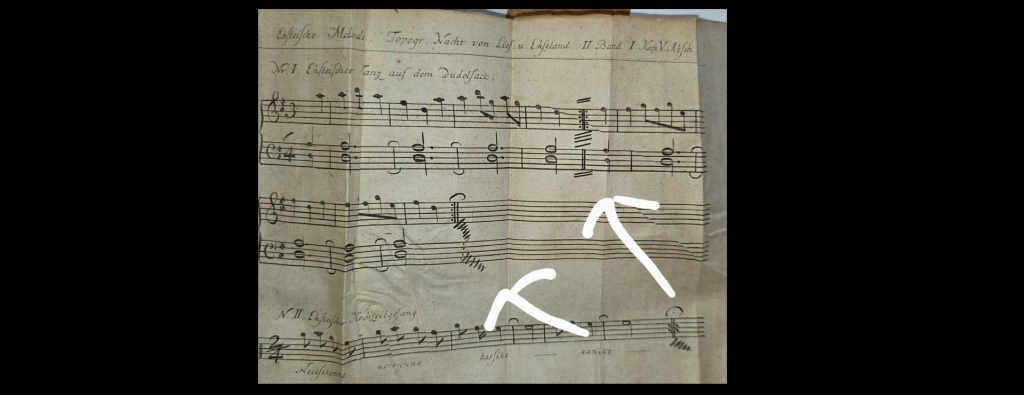
August Wilhelm Hupel's 1777 "Topographische Nachrichten Von Lief – Und Ehstland" is a foundational work on the history of Estonia. Amongst its multiple foldouts is this sheet of traditional Estonian folk music. Let's explore how Gemini 3 Pro can help us understand this page. Here we ask it to explain several 18th-century notations, transcribe and translate the lyrics and even attempt to play the music (through unfortunately Gemini returned wildly different results each time it was run so it appears that music transcription is still beyond it). Incredibly, when attempting to compare the lyrics of the wedding song with a different song in the book, the combination of Google Lens and Gemini were able to transcribe and translate into English a page of mixed German/Estonian text from 250 years ago in Fraktur gothic typeface!
Here is the full foldout:
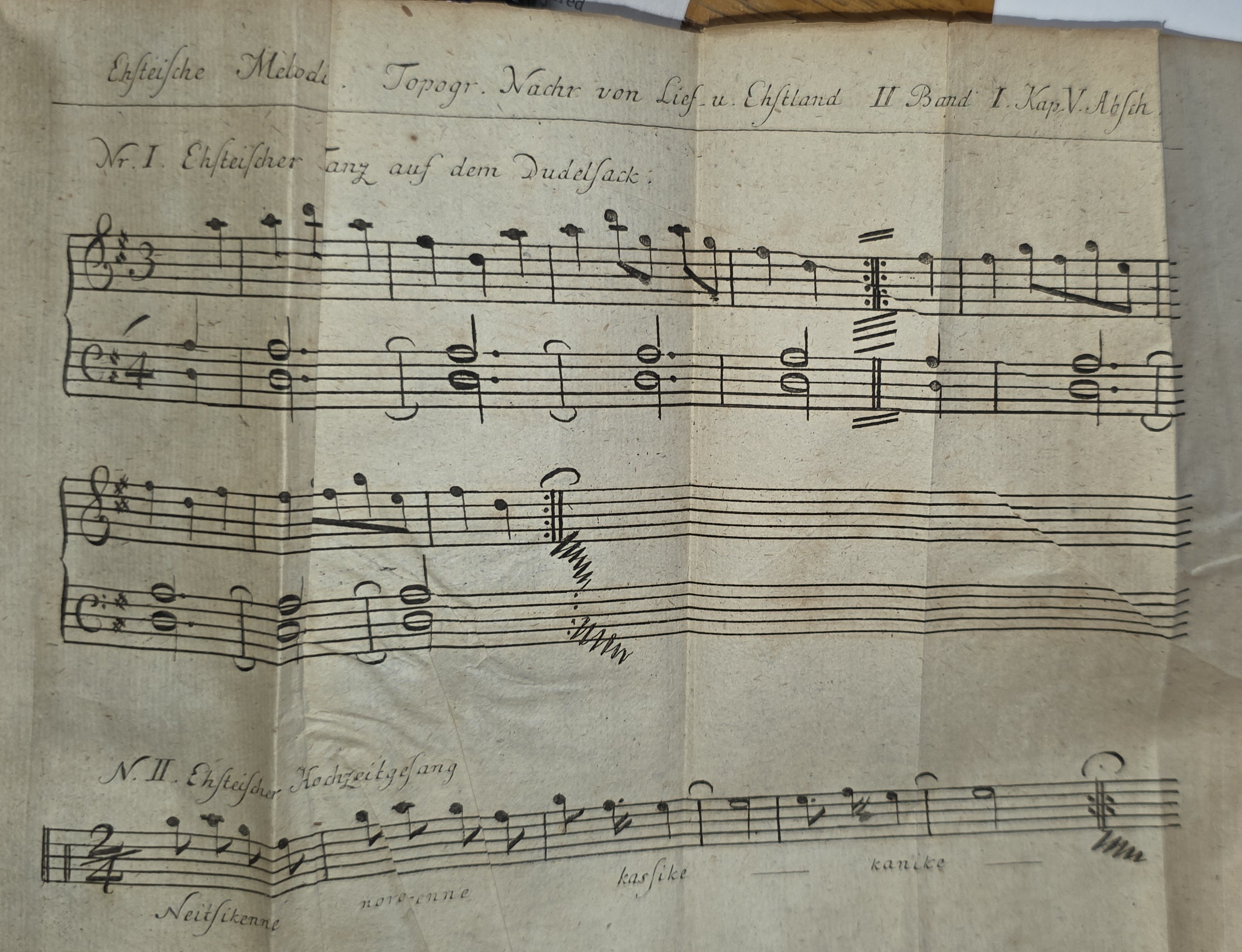
First off, let's ask Gemini to explain the diagonal and squiggly lines that appear under and above the staff:
This is music from 1777.
What do the diagonal lines mean under and above the staff where the top arrow is pointing?
What do the squiggly diagonal lines under the staff mean where the bottom arrow is pointing?
Be concise and explain in a sentence or two why they appear here.
We drew arrows to point them out for Gemini:
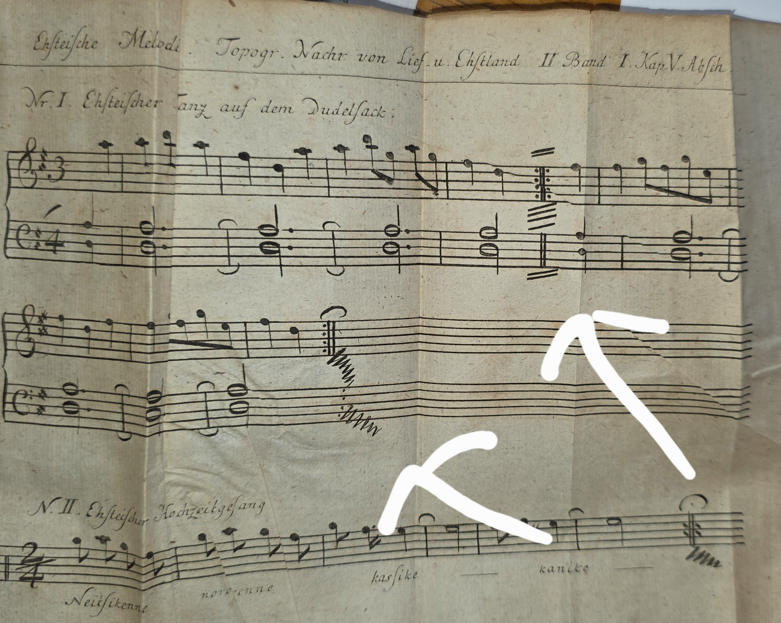
Amazingly, Gemini follows our arrows and responds with:
- Top Arrow: These are calligraphic highlights intended to emphasize the repeat sign (the double bar line with dots). They serve as a visual aid to ensure the musician notices the end of the section and the instruction to repeat, but they are not played. In modern music, a repeat sign is simply a double bar with two dots. In 18th-century manuscripts, scribes often added thick, cross-hatched, or horizontal lines between the staves at these points. This was done to make the structure visually obvious to the musician, ensuring they didn't miss the fact that they needed to go back and repeat the section.
- Bottom Arrow: This is a terminal flourish (or line filler). It signifies the end of the piece ("Nr. I") and fills the remaining empty space on the staff to clearly separate it from the next musical selection below. You will notice the same symbol appears at the very bottom right of the page (under the "Hochzeitsgesang" or Wedding Song), marking the absolute end of the piece.
Let's see what the lyrics say:
transcribe and translate the text into english. be concise.
Yielding:
Header
Transcription: Ehstnische Melod. Topogr. Nachr von Lief u. Ehstland II Band I. Kap V. Absch
Translation: Estonian Melodies. Topographical Accounts of Livonia and Estonia, Volume 2, Chapter 1, Section 5.
Piece No. I
Transcription: Nr. I. Ehstnischer Tanz auf dem Dudelsack.
Translation: No. I. Estonian Dance on the Bagpipe.
Piece No. II
Transcription: N. II. Ehstnischer Hochzeitgesang
Translation: No. II. Estonian Wedding Song.
Lyrics (Bottom)
Transcription: Neitsikenne noro-enne kassike kanike
Translation: (Estonian folk lyrics) "Little maiden, young one, kitten, chick."
Since this was only a sample page and lacks the rest of the lyrics, let's ask Gemini to try and find them for us:
find me the full lyrics of the wedding song. give me a link to it online
While Gemini fails to find a digitized or transcribed copy online (it consistently hallucinates links to unrelated digitized books), it does provide us what it claims are the lyrics. It correctly transcribes the Estonian, but even after attempting to modernize to modern Estonian, we have been unable to locate the original song in any of the digitized archives we searched. While the opening phrase "Neitsikene noorukene" is a common phrase, we cannot find the phrase "Neitsikene noorukene Kassike". Thus, we cannot attest to whether the expanded lyrics below are accurate or whether they are merely a hallucination from whole cloth.
The Lyrics (from Hupel, p. 127)

Original Estonian (1777 spelling):
Neitsikenne, noro-enne!
Kassike!
Kanike!
Kui sinna sad mehhele;
Siis sinna sad seale;
Suggulsele soale.

English Translation:
Little maiden, young one!
Kitten!
Little hen (chick)!
When you get a husband,
Then you get a pig (swine);
[You get] a relative to a pig.

(Note: The lyrics are a warning to the bride that marriage is difficult and her husband may behave like a beast/pig. Hupel translates the last two words as "Dem Verwandten zum Schwein" - "A relative to the pig.")
Where did Gemini get the rest of the lyrics then, if we can't find them ourselves? Unfortunately, the complete lyrics do not appear in the book, so we cannot vet Gemini's work. However, a different wedding song appears on page 159 with full lyrics as an example of the kinds of lyrics of the era. Note that this is in German in Fraktur typeface, but Google Lens is able to transcribe and then Gemini translate. This is itself nothing short of extraordinary that with a few mouse clicks we can now instantly translate into English a page of mixed German/Estonian text from 250 years ago in Fraktur gothic typeface!
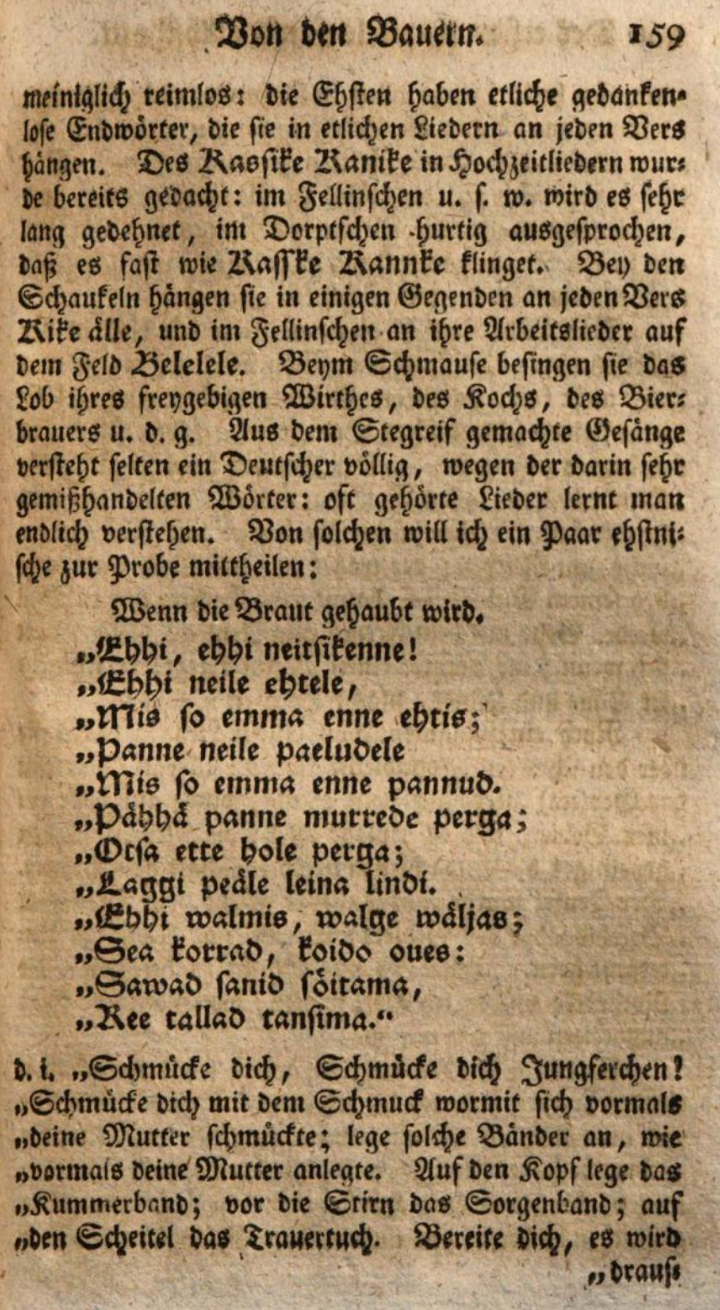
Of Rassike Rannike in wedding songs mention has already been made: in the Fellin dialect, etc., it is drawn out very long; in the Dorpat dialect it is pronounced briskly, so that it almost sounds like Rasske Rannke. On the swings, in some regions, they append Rike ålle to every verse, and in the Fellin dialect to their work songs in the field they add Belelele.

At feasts they sing the praises of their generous host, of the cook, of the beer brewer, and the like. Songs made extemporaneously are rarely fully understood by a German, because of the very badly mangled words used in them; songs that are often heard one eventually learns to understand. Of such songs I will communicate a couple of Estonian ones as a sample:

When the bride is veiled.

bbi, ehbi neitsikenne!
Ehhi neile ehtele,
„Mis so emma enne ehtis;
„Panne neile paeludele
„Mis so emma enne pannud.
„Pabha panne mutrede perga;
„Orsa ette bole perga;
„Laggi pedle leina lindi.
„Ebhi walmis, walge wåljas;
„Sea korrad, koido oues:
„Sawad sanid sõitama,
„Ree tallad tansima."

That is:

“Adorn yourself, adorn yourself, little maiden!
Adorn yourself with the ornaments with which your mother once adorned herself;
put on the ribbons that your mother once put on.
Place on your head the band of sorrow;
before your forehead the band of care;
upon the crown the cloth of mourning.
Prepare yourself, it will be bright outside;
set things in order, dawn is in the yard:
the words will begin to ride,
the sled-runners to dance.”
Can we actually hear this music? Let's have it transcribed:
Convert this sheet music into ABC notation
Unfortunately, each time we asked Gemini to transcribe the music it gave us wildly different results that sounded absolutely nothing like each other across runs. Thus, we provide the output below merely as an example of the workflow.
- Nr. I (Bagpipe Dance): The melody is in D Major. The original manuscript writes the first note of the measure as a half note (white head with stem) in 3/4 time. To ensure the music plays back correctly with 3 beats per measure, I have transcribed these as dotted half notes (d3, F3, etc.), which was a common shorthand in older notation. The bottom staff is a drone accompaniment; I have transcribed this as a continuous open fifth (D and A), which is standard for bagpipe music of this era.
- N. II (Wedding Song): This is a 2/4 tune. There is a fast instrumental run in the middle (sixteenth notes) bridging the two verses of text. The text "Neitsikenne noro-enne…" is included as lyrics.
For those who want to listen to the first song, here is an instrumental (non-bagpipe) audio of it. And here is the instrumental of the second song.
X:1
T:Nr. I. Ehsteischer Tanz auf dem Dudelsack
T:Estonian Dance on the Bagpipe
S:Topogr. Nachr von Lief- u. Ehstland II Band I. Kap V. Absch
M:3/4
L:1/4
K:D
% Melody Voice
V:1 clef=treble
|: d3 | c B A | G F E | D2 d | c B A | G F E | D3 :|
|: F3 | E F G | F G A | G A B | A3 :|
E F G | F G A | TA3 | D3 |]
% Drone Voice (Approximated based on Bagpipe tuning D/A)
V:2 clef=bass
|: [D,3A,3] | [D,3A,3] | [D,3A,3] | [D,3A,3] | [D,3A,3] | [D,3A,3] | [D,3A,3] :|
|: [D,3A,3] | [D,3A,3] | [D,3A,3] | [D,3A,3] | [D,3A,3] :|
[D,3A,3] | [D,3A,3] | [D,3A,3] | [D,3A,3] |]

X:2
T:N. II. Ehsteischer Hochzeitgesang
T:Estonian Wedding Song
S:Topogr. Nachr von Lief- u. Ehstland
M:2/4
L:1/4
K:D
% Melody
d d | c B | A G | F E |
w: Neit-si-ken-ne no-ro-en-ne
L:1/16
(D E F G A B c d) |
L:1/4
d d | c B | A G | F E | !roll![D2A,2] |]
w: kas si-ke ka-ni-ke