
The Internet Archive's Television News Archive spans nearly 6 million hours of global television news from 75 countries over the past quarter-century. We've ASR'd and OCR'd this massive archive to make both its spoken and onscreen textual transcripts keyword searchable, but the concept of search still implies that a journalist or scholar knows what they are looking for and is using search to identify relevant clips. But what about the opposite? How can researchers find the things they didn't even know they were looking for? We've begun exploring the potential of advanced visual, research and contextual reasoning models to understand the concept of "contextualized importance": stories that hold particular significance and importance to their given society, whether or not that significance might be readily apparent to an unfamiliar observer. Take three small peaceful gatherings of anti-war protesters: one in Washington DC today, one in Moscow today and one in Moscow a decade ago. A small peaceful protest in DC or the Moscow of the mid-2010s is interesting, but far less significant than one held in Moscow today under its current conditions. Even if the Moscow protest today received little attention or media coverage due to government restrictions, its very existence holds considerable meaning. Historically social scientists used crowd size or volume or caliber of media coverage to gauge importance, but modern AI models are increasingly capable of deeply reasoning and contextualizing the specific sociocultural context of an event.
What might it look like to ask Gemini to watch a Taliban broadcast from Afghanistan from earlier today, breaking it into 1 minute clips and asking it to evaluate each for its significance to and meaning within Afghan society and the evolution of the Taliban. The results below suggest tremendous potential for this approach to fully autonomous identification of "significant" events and narratives at global scale. In fact, this is actually how we first identified the fascinating clip we discussed earlier today discussing the Taliban's view of the pen versus the rifle. No data was used to train or tune any model.
Here is the prompt we used and the clip it discusses:
Watch this clip from RTA very carefully.
Consider both the imagery and transcript.
Using your deep knowledge of Afghanistan, the Taliban and Afghan society, contextualize this clip for me. Be detailed and justify your answers.
Would you flag this clip as being of particular interesting/importance to a scholar studying the evolution of Afghanistan since the Taliban takeover?
If so, explain why and justify your answer.
And Gemini's results for this clip:
This video from RTA (Radio Television Afghanistan), the official state broadcaster under the Taliban's Ministry of Information and Culture, provides an articulate look into the Taliban's ongoing ideological self-reckoning.
Titled in the video's title card as «مسؤولیتهای اهل قلم و صاحبان تفنگ» (Responsibilities of the People of the Pen and Owners of the Gun), the segment tackles the philosophical and practical dialectic between the pen (qalam / knowledge / ideology / bureaucracy) and the gun (tufang / military force / jihad).
Clip Contextualization: Transcript and Imagery
-
The Core Thesis: The narrator argues that secular societies artificially separate—or even pit against each other—the "pen" and the "gun," weakening both. Under an "Islamic perspective," the video claims, the two must exist in strict equilibrium: knowledge without power becomes impotent, while power without knowledge/awareness descends into tyranny (zulm).
-
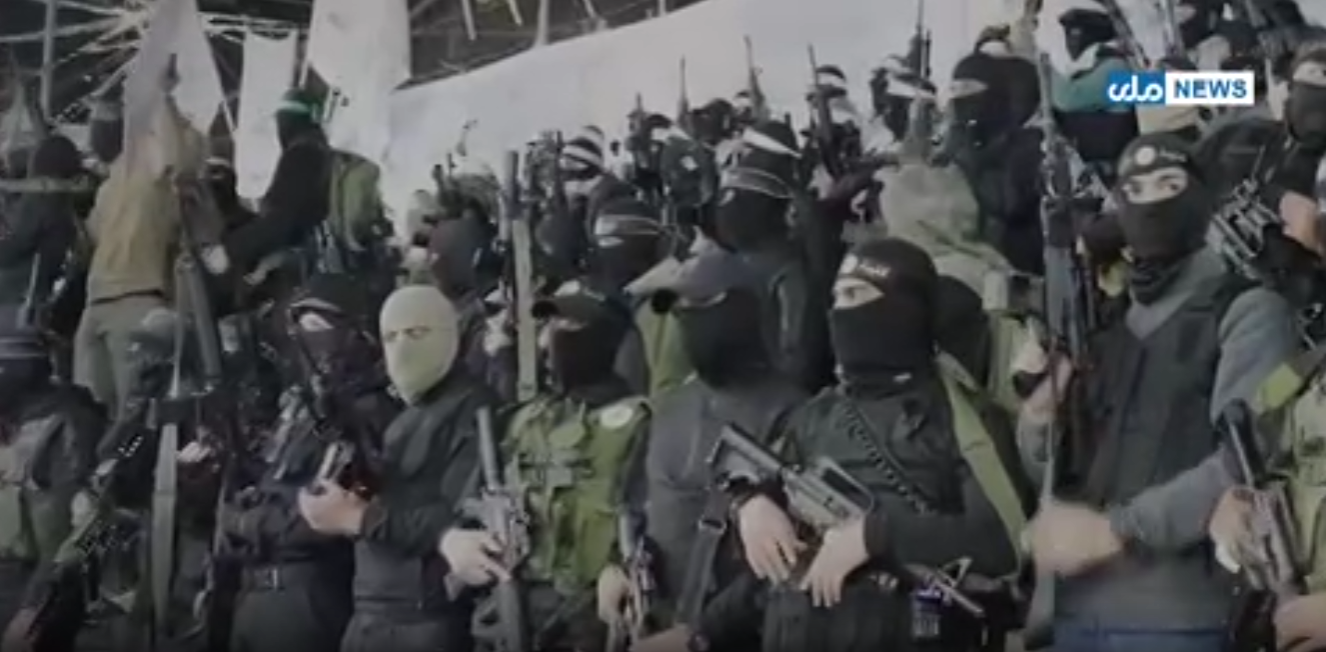
Framing Resistance & Transnational Ties: The report opens with footage of armed Palestinian fighters in balaclavas and green headbands, holding rifles alongside pens, claiming that Palestinian resistance fighters defended their Islamic identity by unifying the pen and the rifle.
-
Shift to Afghanistan’s Internal Reality: The imagery transitions from 3D models and artistic sketches of pens merged with assault rifles to actual scenes inside post-2021 Afghanistan: young men in traditional clothes and turbans sitting in madrasa/university classrooms writing with ballpoint pens, followed by large assemblies of religious and military figures, and fighters riding into the dust.
Importance to Scholars of Post-2021 Afghanistan
Yes, this clip is of primary importance to any scholar tracking the institutional evolution and ideological statecraft of the Islamic Emirate.
Specifically, it illustrates three fundamental structural dilemmas confronting the Taliban:
1. The Transition from Insurgency to Governance (Talib vs. Fighter)
For twenty years, the Taliban was an asymmetric fighting force whose primary currency was armed militancy (tufang). Since taking Kabul in August 2021, the movement has faced the immense challenge of converting rural guerilla fighters into civil servants, tax collectors, diplomats, and municipal bureaucrats.
- Many rank-and-file fighters experienced demoralization, boredom, and cultural alienation after being assigned desk jobs in Kabul.
-
This clip is part of an official internal messaging campaign to dignify desk and administrative work (ahl-e qalam) as equal in virtue to frontline combat (sahiban-e tufang), reassuring veterans that administrative and intellectual production are legitimate forms of Islamic state-building.
2. Reconciling Religious Legitimacy with Technocratic Survival
A central fault line inside the Taliban administration lies between hardline clerics (predominantly centered in Kandahar under Supreme Leader Hibatullah Akhundzada) and pragmatists/ministers in Kabul who recognize that Afghanistan cannot avoid state collapse without technocrats, modern education, and administrative know-how.
-
By emphasizing that "power without awareness leads to oppression" and "knowledge without power is powerless," state media is attempting to construct an Islamic justification for administrative competence without ceding ideological ground to secular or Western governance models.
3. Framing Armed Bureaucracy as Universal Islamic Solidarity
The juxtaposition of Palestinian militants with Afghan madrasa students is a deliberate narrative technique. The Taliban frequently invokes Palestine to:
-
Bolster its pan-Islamic anti-imperialist bona fides to domestic and regional Muslim audiences.
-
Demonstrate that armed jihad and ideological education are complementary throughout the Muslim world, thereby vindicating their own military takeover and continued authoritarian monopoly on force.
Analytical Assessment
For researchers studying totalitarian media, civil-military integration in non-state actors transitioning to states, and the sociology of the Taliban, this broadcast serves as evidence of the Islamic Emirate's attempt to synthesize clerical-administrative orthodoxy with its militant origins.