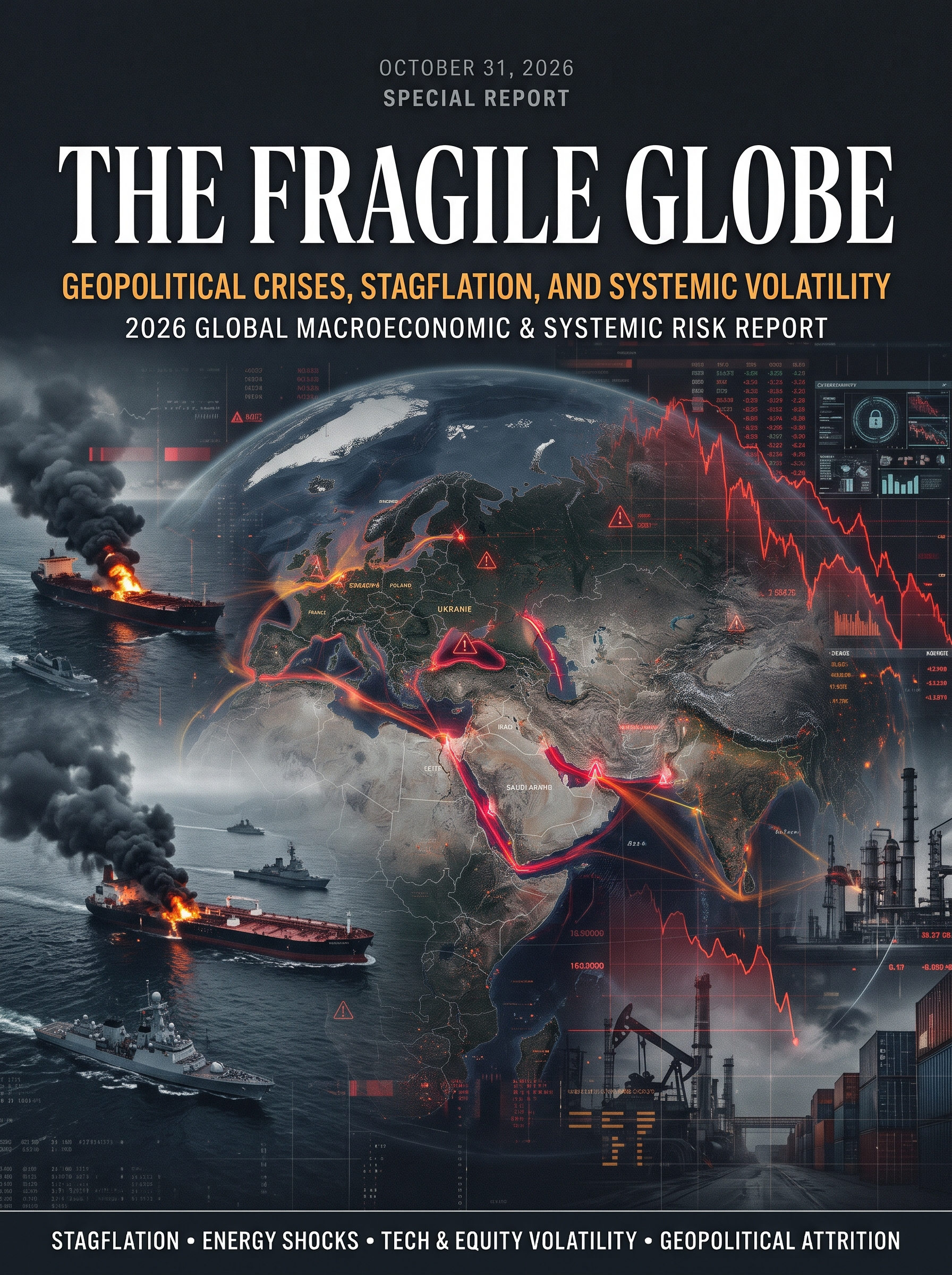
What would it look like to feed all of our daily Media Trends deep analytic reports from yesterday into Gemini 4 Argon and ask it to produce a global macroeconomic landscape report based solely on global television news reporting? No data was used to train or tune any model and we used only our own Media Trends PDF reports, not the actual broadcasts themselves.
I'm a central bank economist.
Attached is a compilation of deep trend analysis reports of a day of selected television news channels around the world.
Read through all of these reports and prepare me a custom report that outlines the state of the global economy and
individual national and bloc economies around the world yesterday through the eyes of these reports and using
ONLY the data from these reports.
The global macroeconomic landscape on October 31, 2026, is defined by acute stagflationary pressures, energy supply shocks, and severe digital and equity market volatility, driven by an eight-month war between the United States, Israel, and Iran alongside the fifth year of attrition in the Russia-Ukraine conflict.
Global Macroeconomic & Systemic Vectors
-
Energy & Maritime Chokepoints: The global economy is straining under a "triple choke point" crisis across the Strait of Hormuz, the Red Sea (Bab al-Mandab), and the Black Sea. In the Strait of Hormuz, four to six oil tankers (including supertankers carrying 2 million barrels each) struck naval mines or caught fire within a 24-hour window. Consequently, Brent crude surged to intraday highs of $118–$119 per barrel (settling between $107.64 and $117.64 across global exchanges), while WTI crude reached $102.95–$104.12. Analysts warn a total blockade could push crude past $133 to $200 per barrel. To mitigate winter price surges, EU member states are releasing 42.6 million barrels from strategic reserves. Simultaneously, port strikes across 100–113 ports in 22 countries protesting arms shipments disrupted 40% of Mediterranean shipping, causing over $1 billion in trade delays.
-
Global Equity & Tech Sell-Off: Global equity markets suffered a $1.7 trillion single-day sell-off as investor skepticism mounted over the return on investment for massive Artificial Intelligence (AI) capital expenditures. The US Nasdaq dropped 2.8% to 2.86% on the day (down 7.8% for October). Intel plunged 28%–29%, Alphabet suffered a $500 billion market cap haircut, Microsoft fell 6%, Meta dropped 4% (receiving an S&P credit outlook downgrade to negative), and Ford missed earnings expectations. Conversely, AI firm Anthropic filed for a record IPO seeking a $1 trillion to $2 trillion valuation after reporting H1 2026 revenue of $16.3 billion (up from $41 million two years prior), alongside plans for $800 billion in infrastructure spending over seven years.
-
Digital Assets & Cyber Contagion: The world's largest cryptocurrency exchange, Binance, suffered a historic $6.3 billion to $6.6 billion cyber heist executed in 20 minutes via a compromised engineer's laptop, attributed to North Korea's state-sponsored "Trader Traitor" (Lazarus/Office 121) group. While stablecoin issuers Circle and Tether froze $2.5 billion to $3 billion in illicit funds and Binance pledged to cover 80%–90% of user losses from cold-wallet reserves, withdrawal freezes triggered a 4.5% drop in Bitcoin (falling below $70,000) and a 15% drop in BNB. North Korea now accounts for 89% of global crypto thefts in 2026.
-
Precious Metals, Industrial Commodities & Sovereign Debt: Gold fell 3.5%–3.63% to $2,388–$3,884 per ounce globally due to interest rate hike expectations and liquidity shifts. Global copper prices are up 40% year-on-year, driven by electric grid and AI data center demand, though a global shortage of high-voltage power transformers (where China holds 60% of production capacity) has stretched delivery lead times to 3–5 years. Meanwhile, developing nations face a $1.4 trillion sovereign debt crisis, with 3.4 billion people living in countries where debt interest payments exceed health and education spending, exacerbated by a 40% drop in global humanitarian funding and record declines in Official Development Assistance (ODA).
North America
United States
-
Fiscal & Monetary Position: The US economy recorded 3.4% GDP growth and 88 stock market record highs, alongside $22.2 trillion in two-year reshoring investment commitments. However, the federal national debt has surpassed $40 trillion (a 30% increase during the current term). Net interest payments have exceeded $1 trillion annually (14% of the federal budget), surpassing defense spending as the third-largest budget item. The flagship "One Big Beautiful Bill" (OB3)—which eliminated taxes on tips, overtime, and Social Security while cutting Medicaid by $1 trillion—added $4 trillion to the national debt, pushing bond yields above 5%. Meanwhile, the eight-month Iran war has cost $47.1 billion (a 25% overrun), with the Pentagon requesting an additional $70 billion emergency appropriation and a $1.5 trillion overall military budget.
-
Inflation, Labor & Consumer Strain: Headline CPI stands at 3.7% and the PCE price index is at 3.6%, costing the average American family an extra $3,000 annually ($200/month from war-driven fuel spikes). Gasoline averages $4.18–$4.50 per gallon (up 20.4%–40% from under $3 in February), and diesel has surged 70%–78% to $6.00–$6.89 per gallon, driving producer prices up 6%. Real wages adjusted for inflation fell at an annual rate of 0.6% in Q3, the steepest drop in four years. Furthermore, 40% of Americans are cutting food or healthcare spending, only 39% of adults dine out weekly (down from 53% in 2019), and Obamacare benchmark premiums are set to rise 13% on average (doubling or tripling to $865/month in some regions following the cancellation of 760,000 plans).
-
Sectoral Shocks & Trade: Aggressive immigration enforcement ("ICE raids" totaling 980,000 detentions since January 2025) has imposed an "ICE Tax" on local economies: every arrest surge depresses local employment by 0.43% and has triggered acute agricultural labor shortages in Arizona and California, where farmers also face a 33% spike in fertilizer costs and $1,000 combine parts. Conversely, ExxonMobil and Chevron reported surging quarterly profits of $14.5B–$15.4B and $9.9B–$12.1B, respectively. In trade policy, the administration imposed 50% tariffs on Canadian goods (including dairy and steel) under Section 338 of the Tariff Act; overall tariffs generate over $100 billion annually for the Treasury while costing US families $2,800 per year. Local moratoriums on AI data centers are spreading across Ohio, South Carolina, Pennsylvania, and Iowa due to rural water depletion and utility rate spikes.
Canada
-
Monetary Policy & Trade Pivot: The Bank of Canada hiked its policy interest rate by 25 basis points to 2.5% to combat energy-driven inflation from the Iran war, with economists projecting up to three additional hikes through 2027. Facing 50% US tariffs that cost individual exporters up to $40 million annually, Prime Minister Mark Carney is pivoting Canada toward Associate Membership in the European Union ("Alliance for the Future"), set to finalize in June 2027 to integrate resource funding, critical minerals, AI supercomputers, and satellite networks.
-
Domestic Measures & Infrastructure: To bypass US land bottlenecks, Ottawa designated the Roberts Bank Terminal 2 expansion at the Port of Vancouver a project of national interest to support $100 billion in annual trade by 2035. Alberta froze education property tax rates for three years to save homeowners $100 million, Parks Canada laid off 500 workers nationwide, and the big four banks (RBC, TD, BMO, CIBC) blocked third-party AI agents from accessing online bank accounts. In Nova Scotia, a proposed AI data center campus threatens to consume all excess provincial grid capacity.
Europe & Post-Soviet Eurasia
European Union & Eurozone Bloc
-
Stagnation & "China Shock 2.0": Eurozone GDP growth has slowed to 0.4% amid an average inflation rate of 3.8%, while the Iran war has cost the European economy over €100 billion in eight months. The European Central Bank faces leadership uncertainty following President Christine Lagarde's announcement of an early resignation in February. Europe's trade deficit with China has reached an "unsustainable" €1 billion per day as Chinese high-tech EVs, batteries, and humanoids dominate the market—prompting France and Germany to propose a "Structural Rebalancing Instrument" ("kill switch") to block market-distorting imports. Chinese FDI in Europe hit a seven-year high of €16.8 billion (concentrated in Hungarian and German auto/battery sectors). Additionally, a new €4 EU customs fee on small non-EU e-commerce parcels (targeting Temu and Shein) takes effect November 1, alongside a 2027 Digital Product Passport mandate for textiles. The 12-month Euribor closed October at 3.24%, adding €100/month to average household mortgages, and European civil aviation projects losing 11,000 flights in 2026 due to Middle East conflicts.
Western & Southern Europe
-
France: GDP contracted by 0.1% in Q3 2026, placing France on the brink of recession. Fitch downgraded France's credit outlook to negative (maintaining an A+ rating, while Moody's holds at AA) as the government attempts to cut the budget deficit to 5% in 2027 via public service cuts. Youth unemployment has reached 21%, and three consecutive weekends of mass cost-of-living protests have caused €1.2 billion in looting and property damage.
-
Germany: Facing €100 billion in excess energy costs, Germany is shedding 10,000 manufacturing jobs per month. Volkswagen announced 100,000 job cuts by 2030 and BMW cut 8,000 domestic roles due to high energy costs and Chinese EV competition. To modernize, Berlin signed €16 billion in AI and data infrastructure deals with Amazon and Nvidia.
-
United Kingdom: Annual inflation rose to 3.5%. With 6 million Britons in food-insecure households, government advisories to stockpile 72 hours of emergency supplies triggered a 40% surge in canned food sales and a 284% spike in flashlight sales. To bolster domestic heating supplies, the UK approved the North Sea Jackdaw gas field.
-
Italy: Public debt is projected to hit 138.5% of GDP in 2026, with the European Commission forecasting meager 0.5% GDP growth as inflation reaches 4.2%. Over 1.5 million workers struck across 50–60 cities, blocking ports and motorways over diesel prices and defense spending.
-
Spain: Interannual CPI held at 4.9% in October as household electricity bills rose 7.2% to nearly €100/month. Following a fatal high-speed train crash in Toledo, the Transport Ministry is considering a 12-to-24-month total shutdown of the Madrid–Barcelona high-speed rail corridor (which serves 14 million passengers annually and is state rail operator ADIF's only profitable line) for deep maintenance.
-
Portugal: Q3 GDP growth stalled at 0.2% (2.4% YoY) while headline inflation accelerated to 3.8% (driven by a 17% fuel spike and 4% food inflation). Median house prices surged 18.4% in Q2, triggering mass "Acampada" tent protests in Lisbon and Porto. Real household savings fell 1% (to a 12% savings rate), two million families are heavily indebted, the National Health Service (SNS) deficit is projected to double to €2.67 billion, and the retirement age will rise to nearly 67 in 2027.
-
Greece: With natural gas prices exceeding €100/MWh, Athens extended fuel subsidies for 15 days and raised winter heating allowances by 30% for one million beneficiaries. Construction costs have reached €2,500/sqm (with prime Athens new builds at €4,500/sqm), while the collapse of restaurant chain Pizza Fan left 2,000 workers unpaid and the "Choriatiko" bakery tax-fraud ring cost the state €50 million across 340 shell companies. Mandatory salary disclosure in job ads and an expanded Digital Work Card (covering 2.5 million workers) take effect November 1.
-
Switzerland: Upgraded its Free Trade Agreement with China, eliminating tariffs on 99%–99.8% of traded goods, particularly watches, machinery, and medical devices.
Nordic & Baltic States
-
Finland: The Ministry of Finance unveiled an €8 billion fiscal consolidation menu ("buffet") featuring 400 proposed cuts, including reductions to child benefits, pensions, student aid, and shrinking Parliament from 200 to 150 MPs. Healthcare brain drain to Norway persists, machinery firm Raute announced 40 layoffs, and a human trafficking probe hit a Chinese-subcontracted battery plant in Kotka, though domestic pet food production doubled and forest land prices peaked at €6,800/hectare. Onkalo, the world's first permanent nuclear waste repository, is entering operation alongside the €11 billion Olkiluoto 3 reactor.
-
Norway: Despite sovereign profitability, the 2027 state budget cuts rural grocery subsidies (Merkurprogrammet) by 40 million NOK (40%) and cancels northern police helicopter bases. Wealthy business owners are relocating to rural Bø as "tax refugees" to escape wealth taxes, while a massive police raid on organized fishery crime in Myre disrupted the seafood export sector.
-
Denmark & Greenland: Seasonal solar deficits created a 1.50 DKK/kWh price spread between daytime and nighttime electricity. In South Greenland, a municipal alcohol prohibition halved crime rates but slashed local taxi and hospitality revenues by 50%. Danish tax authorities also traced 150 million DKK in Arizona real estate linked to the Sanjay Shah dividend tax fraud.
-
Estonia: Driven by Generative AI replacement of junior coding, UI/UX, and customer service roles, tech and finance firms—including Pipedrive (cutting up to 70% of local staff), Telia, and Swedbank—initiated major layoffs, keeping sector headcount flat even as revenues grow. Meanwhile, national land valuations surged 33% since 2022 to €44 billion (57% concentrated in Harju County), establishing a higher baseline for 2028 property taxes.
-
Lithuania: Heavy defense spending is crowding out public sectors, with cultural workers facing a 3.5% purchasing power drop next year and a projected 14% real value decline by 2029, while universal military conscription was delayed to 2032 due to infrastructure constraints.
Central Europe & The Balkans
-
Poland: A physical standoff at the Constitutional Tribunal between PM Donald Tusk's government and President Karol Nawrocki has paralyzed the judiciary, leaving over 1,000 constitutional and tax cases pending. The Ministry of Finance zeroed out the Tribunal's 2027 budget (0 PLN). Despite regulatory risk, Poland inaugurated Terminal T5 in Gdańsk to support 107 offshore wind turbines.
-
Hungary: Under Prime Minister Péter Magyar's Tisza administration, Q3 GDP growth stagnated at 0.1% (1.5% YoY), investment volumes fell 30%–40%, and diesel prices rose from 615 HUF to 721 HUF/liter since April. The newly submitted 2027 budget aims to cut the deficit from 7.5% to 4.9% of GDP via 26 tax hikes (including a 422 billion HUF business tax increase) and a 1 million HUF income cap on mothers' tax exemptions, while doubling family allowances, cutting municipal solidarity taxes by 62 billion HUF, and replacing the expiring 3% "Otthonstart" mortgage subsidy with the 5% "Vekerle Plus" scheme. Decaying water infrastructure is leaking up to 50% of treated water, costing 17 billion HUF annually, and Russian gas transit contracts through Ukraine expire in January 2027.
-
Romania: Eurostat data showed Romanian household energy prices surged 50% in H1 2026 against a 2% EU-wide decline, while winter gas storage sits at 88% (down from 98% last year). The government enacted a 10 billion RON budget rectification for health and pensions. While the Galați steel plant struggles with raw material shortages, Romania has integrated 26,000 Sri Lankan workers to offset domestic labor shortages.
-
Serbia: Following the electoral defeat of Aleksandar Vučić's SNS party by the "Student List," the National Bank of Serbia revoked the license of politically linked Alta Bank (Altabanka) at 3:30 AM due to critical liquidity deterioration, deploying armed police to secure assets, freezing deposits above the €50,000 insured limit, and forcing state utility EPS to switch payment accounts. Meanwhile, US OFAC extended the license for Croatia's JANAF to pump oil to Serbia's NIS until December 11.
-
Croatia & Bosnia-Herzegovina: Croatia passed a 2026 budget rebalance raising revenues to €36.6 billion and expenditures to €40.6 billion, and set the 2027 gross minimum wage at €1,130, though food inflation continues to erode real purchasing power. Bosnia and Herzegovina ranks 146th globally in trade deficit, lacks a state property law to unlock foreign investment, and put the bankrupt Koksara Lukavac industrial plant up for auction at 171 million KM after 800 job losses.
Russia, Ukraine, Belarus & Central Asia
-
Russian Federation: Russia has transitioned into a "necronomy" and wartime fiscal cannibalization. The 2027 federal budget increases defense spending by 25% to 17.15 trillion rubles (over 21 trillion rubles including security, exceeding 50% of total spending), while debt servicing reaches 5.2 trillion rubles (9% of the budget, eclipsing health and education combined). With real consumer inflation at 15%–20%, the central bank key rate and 10-year OFZ bond yields have reached 16.5% (with retail banks VTB and Sber offering up to 35% first-month deposit rates), leaving 830,000 apartments unsold and driving 3.5 trillion rubles into cash circulation to evade a new 15%–22% aggregated income tax and a 22% import e-commerce VAT. To curb domestic fuel inflation, Moscow extended its diesel export ban through January (though a 4,000-ton diesel tanker departed for New York under US sanctions relief, and Dutch LNG purchases exceeded 1 million tons). Domestically, Russia is leveraging the "silver economy" (hiring workers 50+) and Ozon gig workers (earning up to 17,000 rubles/day) to offset demographic shortages, investing 570 billion rubles in Technopolis Moscow (growing Moscow industrial output by 7.6%), and pushing a commodity-backed (tin/titanium) BRICS digital clearing system alongside $27 billion in African trade and a 25% trade surge with Thailand.
-
Ukraine: Facing stagflation with GDP contracting by 0.4% and inflation revised upward to 12.5% due to Russian strikes on thermal power plants (TETs-6), bridges, and rail depots, the National Bank of Ukraine hiked its discount rate to 16.5%. The Hryvnia hit record lows of 45.52 UAH/USD and 50.67 UAH/EUR, while diesel prices reached 110 UAH/liter. Ukraine's 2027 budget requires €70 billion in external financing, raising Fitch default warnings, though Canada and the EU finalized a €45 billion loan package backed by frozen Russian assets. Despite a $2.1 billion US Patriot missile sale funded by allies, Ukraine produces 60% of its own defense needs (400+ defense-tech firms) and continues drone strikes that cut Russian refinery output in Omsk by 45%.
-
Belarus: The 2027 budget proposes a 10% hike in public sector base pay and pensions despite a planned deficit, funded by a new three-tier income tax (up to 30% on incomes over 600,000 rubles), a luxury vehicle/property wealth tax, and 700 tax audits recovering 136 million rubles from "envelope salary" schemes. Following mediation in the Oleshky humanitarian corridor, the US Commerce and Treasury Departments lifted sanctions on Belaruskali's head and granted Boeing a license to supply parts and software to state airline Belavia. Minsk also signed 2027–2029 industrial roadmaps with Vietnam and Mongolia (aiming to triple Mongolian trade via BelAZ LNG mining trucks and MTZ tractors) and is planning a third nuclear reactor block alongside 4,400 km of grid upgrades.
-
Kazakhstan: President Tokayev announced a $16.5 billion nuclear power plant partnership with Russia's Rosatom (85% financed by Russian export credits) alongside a 100-year uranium reserve strategy, and a $10 billion deal with Nvidia (100,000 GPUs, including GB300s) to build a "Valley of Data Centers" in Ekibastuz.
Middle East & North Africa (MENA)
-
Iran: Operating on a war footing during the "Third Imposed War," Iran tightened capital controls (banning passengers from exporting over €5,000 or 150 grams of gold) and provides electronic rationing coupons ("Caliper") to 40–71 million citizens. Tehran demands the lifting of US naval blockades, oil sanctions relief, and the release of frozen assets via Qatari/Pakistani mediation in Doha before reopening the Strait of Hormuz under a joint Iran-Oman corridor scheme, while threatening to sever Gulf undersea data cables and strike regional AI data centers.
-
Israel: Following a deadlocked Knesset election and a 900% spike in acute civilian stress, Israel's economy faces a "defense paradox": record high-tech, AI, and missile defense exports alongside a profitable gas sector (e.g., Delek), contrasted with UK trade bans on West Bank settlement goods and European pension divestment risks over financing E1 zone settlement construction.
-
Palestinian Territories: A ten-day IDF siege of Hebron—which accounts for 40% of the Palestinian economy—is costing 12 million shekels daily in lost trade. Across the West Bank, settler attacks and military exclusion zones have cut the olive oil harvest by 50% (to 11,000 tons, a $157 million cumulative loss since 2023) and destroyed 3,000 dunams of Jordan Valley banana crops. Furthermore, frozen tax revenues (Maqasa) and Israeli banks' refusal to accept surplus Shekel deposits have created a severe liquidity trap, while Gaza remains restricted to 30% of its territory without cooking gas.
-
Syria: While the UN reports 90% of post-Assad Syria lives in poverty, the transitional government faces a $1 billion H1 2026 budget deficit alongside catastrophic floods across 10 provinces that collapsed the Al-Ghadir bridge and cut water to 70% of Raqqa. To attract capital, Damascus returned to FATF meetings in Paris to exit the "Grey List," joined the Global Institute of Internal Auditors, secured German easing on dual-use reconstruction goods, signed US/Qatari gas exploration deals, aims to boost Rumeilan oil output to 250,000 bpd, and is pursuing the $15 billion Kirkuk–Baniyas oil pipeline with Iraq.
-
Saudi Arabia: Positioned as an oasis of stability ahead of Expo 2030 (projected to generate $400 billion in returns), the Kingdom enacted a revised Commercial Transactions Law lowering the legal age for entrepreneurship to 15, arrested over 13,000 undocumented workers in a week, and grew its domestic film sector by 9% to 120 million SAR. However, Houthi drone and missile strikes targeted Riyadh, Medina, Mecca, and Aramco refineries, prompting a non-emergency US embassy departure order and UK fighter jet deployments.
-
Qatar, Oman, Kuwait & Bahrain:
-
Qatar: The 4th Real Estate Forum recorded 1 billion QAR in sales (up 100% YoY), the Qatar Stock Exchange surged 6% in a week to 9,151 points (adding 29.6 billion QAR in market cap), and Qatar Energy held November fuel prices steady (Diesel at 2.05 QAR/L, Super Gasoline at 2.10 QAR/L).
-
Oman: The Muscat Stock Exchange recorded its best performance since April with over 1.29 billion OMR in October trading volume (closing at 7,346 points), as Sultan Haitham embarked on a historic state visit to China and Brunei to sign over 30 agreements in renewable energy, AI, and BRI port logistics.
-
Kuwait: Investing 4 billion KD in the Shagaya project (4,500 MW) to reach 15% renewable energy by 2030 and save 12 million barrels of oil annually, while establishing specialized Economic Courts and navigating compressed banking net interest margins.
-
Bahrain: Preparing for the Gateway Gulf 2026 investment forum and supporting SMEs via the "Biban" venture platform, while buffering citizens from inflation via the retroactive "Fixed Bill" utility stabilization policy.
-
-
Jordan & Yemen: Jordan maintained domestic subsidies on diesel (900 fils) and kerosene (550 fils) despite $117 oil, backed by a 35% revenue jump at the National Petroleum Company, 9 billion JOD in industrial exports, a burgeoning domestic drone defense industry (SOFEX 2026), and a 120 million JOD Baptism Site tourism plan. Conversely, Yemen remains bifurcated between Houthi maritime disruption and the PLC's "Operation Fajr al-Yemen," with the state wholly reliant on $29 billion in cumulative Saudi aid.
-
Egypt, Morocco & Algeria: Egypt's Suez Canal transit volumes and revenues have plunged 50% due to Red Sea militarization. Morocco launched operations at the 54 billion dirham Nador West Med port complex (targeting 3.5 million containers and 5 billion cubic meters of LNG, creating 34,000 direct/indirect jobs via MSC and CMA CGM concessions) alongside a 4 billion dirham wind-powered desalination plant in Dakhla. Algeria allocated 133,000 housing units under the AADL3 construction stimulus program and launched state-backed "Open Innovation" startup challenges for banking and medical AI.
Asia-Pacific
East Asia
-
China: While October Manufacturing PMI dipped into contraction at 49.7% post-holiday, China attracted 6,300 new foreign-funded enterprises in the first three quarters, with high-tech FDI surging 33.8% (accounting for 41.6% of total FDI) and digital economy FDI jumping 70%. Phase 3 of the 140th Canton Fair showcased 1.2 million enterprises integrating AI across manufacturing ("New Quality Productive Forces"). Chinese automotive exports surged 65% YoY to 8.2 million vehicles in the first nine months. Beijing also brought the world's largest 60MW/600MWh liquid air energy storage facility online in Qinghai, opened the Peru Chancay Belt and Road port, and enforced new national standards for medical escort services and e-bike 3C certifications alongside anti-corruption purges in the PLA and energy giant Sinopec.
-
Hong Kong: Recorded 5.1% H1 GDP growth and maintained a full-year forecast of 3.5%–4.5% backed by 6,817 billion HKD in fiscal reserves. However, the US FCC moved to revoke operating licenses for Hong Kong Telecom (PCCW) subsidiaries over China Unicom links.
-
Taiwan: Anchored by its "Silicon Shield," TSMC reported record Q3 revenue of 763 billion TWD and Macronix surpassed 10 billion TWD in quarterly profit. However, the New Taiwan Dollar faces downward pressure, bus operators canceled 65 northern routes due to driver shortages, a data breach at 91App exposed 479,825 retail consumers across 1,329 brands, and state utility Taipower faces a 120 billion TWD deficit—fueling KMT opposition demands to restart nuclear power to sustain AI data center expansion.
-
South Korea: Experiencing a starkly bifurcated economy: Samsung and SK Hynix reported record semiconductor earnings and unveiled 210 trillion won in shareholder returns (forging an HBM alliance with OpenAI), whereas Hyundai Motor's Q3 revenue fell 3.4% (its first drop in six years) amid an 11.3% global sales decline against Chinese EVs. Domestically, household debt breached 2,000 trillion won (plus 38 trillion won in "Bit-tu" margin stock debt), credit loan delinquency rose to 0.91%, youth and senior (60+) defaults doubled, and 2,500 high-end restaurants closed as consumers pivot to ultra-low-cost retail (Daiso). In Seoul, monthly rent (Wolse) transactions hit 51%, surpassing the traditional lump-sum Jeonse system for the first time, while Kyobo Life acquired SBI Savings Bank to stabilize real estate project finance bad loans. President Lee Jae-myung is proposing a record 821 trillion won budget centered on Rural Basic Income.
-
Japan: Implemented a new tourist tax-free system on November 1 requiring upfront tax payment and airport customs verification to stop illicit resale, while tightening rare earth export security strategies and testing autonomous vehicles via Toyota-Waymo partnerships.
South & Southeast Asia
-
India: A World Bank report highlighted that India's extreme poverty rate fell from 27.1% (2011–12) to 2.0%–2.6% (lifting 496 million people out of poverty), alongside 134 million jobs created over six years via Direct Benefit Transfers. India approved the Northern Bullet Train high-speed rail corridor and launched the indigenous NVS-03 navigation satellite. However, sugarcane farmers in Karnataka are blocking roads for higher Minimum Support Prices (MSP), and Delhi traders warn opposition rallies could cause 10,000–12,000 crore INR in Diwali retail losses.
-
Pakistan: In stark contrast, the World Bank reported Pakistan's poverty rate surged to 23%–29% (72.6 million people below the poverty line, with 57.6 million living on under $3/day). Diesel hit 402.96 PKR/liter, market LPG reached 700 PKR/kg after Iran cut gas supplies, wheat trades at 5,500–6,000 PKR/maund (with Punjab meeting only 1.8 lakh of its 25 lakh ton procurement target), and the federal government imposed emergency Governor's Rule in Khyber Pakhtunkhwa amid disputes over 800 billion PKR in security funds and a reported $500 million US rare earth minerals deal.
-
Afghanistan: The Islamic Emirate reported a stable currency (64.94 AFN/USD), a 13% rise in wheat production to 5.15 million metric tons, the inauguration of a $150 million cement plant in Kandahar (1,500 tons/day), 2.873 billion AFN in grid expansions, and 14.8 million AFN from Panjshir emerald auctions. While Japan praised poppy reductions since 2022, Pakistani reports allege a 330%–400% surge in Afghan poppy cultivation to 1,500 tons amid 40% poverty.
-
Malaysia: Recorded 5.4% GDP growth in Q1 2026 (beating 4%–5% forecasts), 2.9% unemployment, and a record 426.7 billion ringgit in FDI centered on AI data centers and semiconductors. The government launched the National Defense Industry Policy (mandating 30% local content and domestic MRO) and rolled out e-invoicing to formalize the shadow economy (40% of GDP), though SMEs face rising operating costs and an aging demographic time bomb projected for 2036.
-
Thailand: Nine-month exports surged to 9.76 trillion THB (+24% in September, led by AI servers and electronics), pushing 2026 GDP forecasts above 2.1%, though a 37.8% import jump created a 300 billion THB trade deficit and rice exports are projected to fall 15% due to Cambodian competition. The state launched the "Ari-polis" robotics hub, subsidized household solar ("Solar for People"), negotiated 6-month GP fee cuts with TikTok Shop, Shopee, and Lazada, and shortened SME credit terms to 45 days (injecting 25 billion THB), while grappling with heavy metal industrial flood contamination in central agricultural zones and a domestic gold slump to 62,000 THB.
-
Vietnam: Slashed the Special Consumption Tax on gasoline to 0% through March 2027 and cut average electricity prices by 2% to keep nine-month CPI at 4.52%. Public investment disbursement hit 75% as Hanoi targets 10% GDP growth in 2027, while rice export prices reached a two-year high despite a 62% drop in lychee exports to China.
-
Indonesia: Q2 non-oil manufacturing grew 5.32% (outpacing 5.29% GDP growth) with a 4.5-million-ton rice reserve, and the Prabowo administration is reviving the "Danantara" sovereign wealth fund to centralize BUMN profits. However, severe peatland fires in South Papua and Sumatra disrupted aviation and carbon credit buffer pools, prompting moves to revoke 22 foreign corporate permits (from Singapore, Malaysia, and the UK). Meanwhile, the KPK raided customs offices in a PT Djarum tobacco excise probe and uncovered 17.7 trillion IDR in illegal mining losses.
-
Singapore: Bank shares (DBS, OCBC, UOB) corrected by up to 10% in October on margin pressures and valuation downgrades, while 17 consecutive days of transboundary Indonesian haze prompted the NEA to serve legal notices to ten Indonesian firms.
Latin America & The Caribbean
-
Brazil: Following President Lula's re-election (51.77%), unemployment hit a historic Q3 low of 5.2% (103.6 million employed, though 37% remain informal, with average income at 3,790 BRL), and Petrobras announced a third oil discovery in the Foz do Amazonas. However, post-election uncertainty triggered a 10%–12% drop in the Brazilian Real against the dollar and a 15% stock market dip. Additionally, El Niño rains cut São Paulo wine output by 40%, the Central Bank hit its VASP crypto-regulation deadline, a unified VAT tax reform enters testing January 1, and the "Abundance Token" was launched to monetize forest restoration amid 1.1 million daily tree losses.
-
Argentina: Capitalizing on the Mercosur–EU agreement, Argentina captured 60% of the bloc's export capacity ($2.8 billion from Jan–Sept, including 21.3% of global peanut exports and rising beef exports) alongside a 1.7% November public transport fare hike. Domestically, retirees face severe purchasing power erosion as November pensions were adjusted by only 1.7% against >2% monthly inflation, 20,000 disability pensions were suspended, citizens are pawning heirloom gold to survive, and predatory Colombian-style "Gota a Gota" informal loan sharking (charging 50% daily penalties) is proliferating.
-
Chile: Suffering a "perfect storm" of 9.8% unemployment (over 1 million jobless; youth unemployment at 24.4%) and fuel inflation (gasoline +25%, diesel +60% YoY), which has slowed real retail growth to 4.2% and forced half of households to slash supermarket budgets. Pension Multi-fund E lost 10.39% in real terms from Jan–Sept. Copper extraction fell 2.6%–12%, compounded by a scandal at state giant Codelco where eight executives were fired for "double counting" 27,000 tons of copper to unlock bonuses, alongside record El Niño spring rains and mudslides.
-
Mexico: Focused on sovereign state-led infrastructure, operating 19 trains on the México–Toluca "El Insurgente" interurban rail line and probing a 2.4 billion peso procurement oligopoly at the National Electoral Institute (INE), while agricultural flower producers face stagnant farmgate prices despite rising water and land costs.
-
Venezuela: Recovering from the June 24 doublet earthquake with Chinese material aid, the Bolivar trades at 889.57 BCV/USD while the Caracas Stock Index fell 3.38%. Driven by inflation hedging, Venezuelans conducted $31.9 billion in crypto transactions over the past year, prompting the National Assembly to draft an Organic Law of Digital Economy. In energy, Chevron targets 300,000 bpd by year-end (though GE Bernova grid repairs remain stalled awaiting a state down payment), and Caracas is pivoting to export its massive gas reserves to Colombia and the Caribbean.
-
Colombia, Peru & Aruba: Colombia's Espriella administration proposed an "Economic Rescue Law" featuring a 19% VAT on essential foods (coffee, chocolate) and a 31% corporate tax rate (while cutting taxes for banks) to avert bankruptcy, threatening 360,000 jobs ahead of a "Super Niño" drought. Peru is leveraging the Chinese-built Chancay port to cut Asian export transit times. Aruba resisted raising its 2,070-florin minimum wage to the 2,670-florin subsistence level, enacted 10,000–25,000 florin fines for employing undocumented workers, mandated online vacation rental registration, and faces a vehicle inspection backlog through April 2027.
Sub-Saharan Africa
-
Continental & Bloc Initiatives: Abuja formally established the Africa Energy Bank with a $5 billion capital base to finance regional oil and gas projects. Meanwhile, the conclusion of the 3rd Russia-Africa Summit saw 48 African states sign 150 agreements (2027–2029 Action Plan) focused on civil nuclear power, mining, infrastructure, and grain supply chains to bypass Western sanctions and USD infrastructure.
-
Nigeria: President Tinubu requested National Assembly approval for a supplementary external borrowing plan of $20.52 billion and €1.045 billion to fund infrastructure and agriculture. Concurrently, the Debt Management Office (DMO) cut 364-day treasury bill stop rates to 15.80%, rejecting 1.84 trillion naira in investor bids. In H1 2026, export earnings rose 23.7% to $35.64 billion, the tax-to-GDP ratio reached 13% (with FIRS deploying AI to target 40 trillion naira in non-oil revenue while raising the corporate tax exemption threshold from 25 million to 100 million naira), Seplat Energy reported $260 million in adjusted EBITDA, and a $100 million Southeast gas pipeline deal was signed. However, 72% of Nigerians pay out-of-pocket for healthcare, bandits killed 80 civilians in Taraba State, suspected Ebola cases emerged in the Northeast, and labor unions (NLC and TUC) split over the government's 50,000 naira household cash relief and 70,000 naira transport allowance palliatives.
-
Republic of the Congo & CEMAC: The $1.4 billion Luyan Mines Congo (LMC) potash project and mineral port (5–10 million tonnes/year capacity) in Luango reached 80% installation completion ahead of a March 2027 production start, complemented by a planned 500km Russian petroleum pipeline. State oil company SNPC assumed management of the 40,000-hectare "Ecozamba" afforestation carbon-credit project. On October 31, Congo enforced mandatory Certified Electronic Invoices (FSEC) for medium and large firms and demonetized pre-1985 CEMAC coins at midnight.
-
Tanzania: Formally inaugurated 37 ministry buildings at the 700 billion TZS Mtumba Government City in Dodoma, domestically designed and funded. In agriculture, Mtwara cashew auctions opened strongly via the TMX digital system at 3,430 TZS/kg (37 billion TZS paid to farmers), whereas Katavi tobacco prices plunged 24.4% to $1.30–$1.95/kg amid high fertilizer costs.
-
Sudan: Amid civil war and RSF drone strikes on the Markhiyat power station, Khartoum requires $400 million to restore basic capital services (with only $15 million allocated), suffers severe fuel, bread, and livestock fodder shortages, and is phasing out old 500-pound banknotes by December 11 to force digital banking adoption while offering Russia gold and copper concessions in exchange for wheat and fuel.
-
Namibia & DRC: Namibia visited Moscow to advance civil nuclear cooperation and its National Development Plan targeting 57% processed mineral exports and 60% domestic ownership by 2030. In the DRC, a fast-moving Bundibugyo Ebola outbreak has surpassed 5,000 deaths across eight provinces (10,200 confirmed cases continent-wide), severely disrupting regional economic stability and cross-border trade.
produce a title page graphic for this report