What would it look like to feed all of our daily Media Trends deep analytic reports from yesterday into Gemini 4 Argon and ask it to produce a report on press freedom developments from around the world based solely on global television news reporting? No data was used to train or tune any model and we used only our own Media Trends PDF reports, not the actual broadcasts themselves.
I'm an NGO researcher focusing on press freedom around the world.
Attached is a compilation of deep trend analysis reports of a day of selected television news channels around the world.
Read through all of these reports and prepare me a custom report that outlines press freedom around the world yesterday
through the eyes of these reports and using ONLY the data from these reports.
Global press freedom on October 31, 2026, was defined by the permanent erasure of independent media in authoritarian states, the lethal targeting of conflict reporters, and the rapid rollout of digital censorship frameworks disguised as public safety measures. Across the analyzed television broadcasts, states increasingly treated the information ecosystem as a frontline theater of kinetic and cognitive warfare.
1. Direct State Suppression, Shutdowns, and Arrests
Russia: The Final Erasure of Independent Media and "Hostage Diplomacy"
-
Liquidation of Novaya Gazeta: After 30 years of operation, Russia’s last prominent independent newspaper was declared a "foreign agent," liquidated, and forced to pack up its offices. Following FSB pressure and police raids on its editors, Editor-in-Chief Sergij Sokolov was forced into professional exile, and the publication announced it will permanently shut down its servers on November 9.
-
Journalists as an "Exchange Fund": Russian security services are systematically detaining foreign citizens and journalists on fabricated espionage charges to serve as leverage in a "hostage diplomacy" pipeline, trading them for Russian intelligence operatives, assassins, and cyber-criminals held in the West.
-
Telegram Crackdown: Russian authorities arrested high-profile administrators and "pseudo-journalists" running Telegram channels (such as Nisizygory and Adskiye Babki, alongside lawyer Dmitry Gorin), accusing them of operating multi-million-ruble "block on negative" extortion schemes. Reports note the state is using these arrests to frame Telegram as a hub for terrorism and extortion to prepare the public for a transition to a "sovereign internet".
Iran: Total Digital Isolation and Hardline Broadcast Control
-
Internet Blackouts: The Iranian government has blocked internet access to impose "digital isolation" on the public and control the narrative surrounding military losses. Furthermore, the revocation of US communication technology waivers has deepened the digital isolation of Iranian citizens.
-
Censorship and Crackdowns: The Tehran Prosecutor announced intensified crackdowns on social media content under the guise of "promoting hijab," while hardline factions (the Paydari Front) consolidated total control over state broadcasting (IRIB) to enforce a unified pro-war, anti-negotiation narrative.
Moldova / Transnistria: Journalist Blockades
-
Press Ban: Moldovan authorities formally protested the ongoing blockade and ban prohibiting journalists from entering the separatist Transnistria region.
2. Physical Threats, Lethal Violence, and Intimidation
Gaza and the West Bank: Lethal Conflict and Settler Attacks
-
Mass Casualties Among Journalists: The Committee to Protect Journalists (CPJ) reported at the UN that over 200 journalists have been killed in Gaza alone, prompting calls for a standing, independent international force to investigate crimes against journalists and protect the "information lifeline". Meanwhile, autonomous AI drones are increasingly being perfected to target journalists and civilians with surgical precision.
-
Targeting by Settlers: Video evidence broadcast by Palestinian media documented direct settler attacks targeting a journalist in the West Bank, countering official Israeli denials.
United States: Executive Friction, Rhetorical Attacks, and Scene Exclusions
-
White House Expulsions and Rhetorical Hostility: Three news outlets were kicked out of the White House. On the campaign trail, President Donald Trump launched rhetorical attacks against Reuters journalists and displayed heightened hostility toward the press. Additionally, Trump publicly supported Elon Musk potentially taking control over CNN.
-
Scene Exclusions and First Amendment Clashes: Following a mass shooting at a Spirit Halloween store in Fairfield, California, private property rights were invoked to remove the press from the scene, limiting real-time media scrutiny. Concurrently, following incidents where ICE agents pointed a handgun at a bystander and ran over a worker, the ACLU intervened to remind the public that the U.S. Constitution protects the right of citizens to film and observe federal agents.
3. Legal Warfare, Regulatory Control, and Surveillance
Turkey: Ending Digital Anonymity
-
Mandatory e-Government Verification: Effective November 1, Turkey is implementing a sweeping social media law that bans access for children under 15, restricts features (such as live streaming and infinite scroll) for ages 15–18, and mandates that all users authenticate their identities via the state e-Government (e-Devlet) portal. Framed as child protection, the measure eliminates online anonymity and expands state digital surveillance.
India: Data Privacy Laws and "Brain Naxal" Framing
-
Suppression of Investigative Journalism: Commentators on Pakistani broadcasts alleged that new Indian data privacy laws are being weaponized as a "legal war" to stifle investigative journalism critical of the Modi administration, while Norwegian coverage highlighted Prime Minister Modi's increasing use of Instagram and Facebook blocks against student groups.
-
Ideological Policing: Domestically, Prime Minister Modi warned of "Brain Naxals" and "Urban Naxals" operating through social media and intellectual circles to destabilize India, signaling a shift in domestic surveillance and policing toward digital spaces, political commentators, and academic dissent.
Malaysia, Pakistan, and Australia: State Disinfection and Broadcast Oversight
-
Malaysia: During the Melaka State Election, the Malaysian Communications and Multimedia Commission (MCMC) and police actively monitored social media to "disinfect" the information space of "3R" (Race, Religion, Royalty) provocations.
-
Pakistan: The Federal Ministry of Information proposed a centralized National Cyber Security and Social Media Awareness Council to regulate social media, mandate AI content labeling, and embed state narratives into school curricula and micro-influencer networks under the guise of combating "misinformation".
-
Australia: Following an anti-Semitism report, political calls emerged for stricter regulation of the public broadcasters ABC and SBS.
Spain, Portugal, and Hungary: Protest Restrictions and Surveillance
-
Spain: Following a high-speed train crash in Toledo that killed at least 69 people, a judicial order prohibited the recording or dissemination of images from the crash site—ostensibly to protect victims' dignity, but effectively limiting visual evidence of state infrastructure failure. Simultaneously, Spanish police shut down four Telegram and TikTok channels accused of coordinating the youth "Blocus" protest movement.
-
Portugal: During "Acampada" housing protests in Lisbon, the Public Security Police (PSP) initially requested a drone and flight interdiction (no-fly zone) over protest zones before partially walking it back to allow media access. Notably, protesters also briefly voted to block media access to their popular assembly before overturning the ban.
-
Hungary: Thirty-two prominent jurists issued a declaration condemning "police state" tactics under the Tisza administration, including allegations that defense attorneys for political opposition figures are being subjected to state surveillance.
4. Political Transitions, State Media Purges, and Self-Censorship
Serbia: Post-Election Media Upheaval
-
State Broadcaster Purges and Pivots: Following the defeat of Aleksandar Vučić’s SNS party by the "Students' List," mass resignations hit state broadcasters Radio Television of Vojvodina (RTV)—including General Director Goran Karadžić—and Radio Television of Serbia (RTS), as staff and unions demanded an end to state propaganda.
-
Opportunistic Editorial Shifts: Pro-government outlets previously controlled or financed by Telekom Srbija (whose director, Vladimir Lučić, faces intense pressure to resign) rapidly pivoted their editorial lines to survive the regime change; the tabloid Kurir, for instance, abruptly stopped calling protesters "blockaders" and began referring to them as "students who won".
Poland: Constitutional Crisis and State Media Framing
-
Hacking and Partisan Broadcasts: Amidst a physical confrontation at the Constitutional Tribunal between President Karol Nawrocki and Prime Minister Donald Tusk’s police forces, the Tribunal's website was hacked to announce unauthorized leadership changes. Meanwhile, state broadcaster TVP Info maintained an aggressively pro-Tusk editorial posture, omitting legal scholars who supported the President's constitutional interpretation.
Denmark, Colombia, and Greece: Ethics, Art, and Cultural Censorship
-
Denmark: Network TV2 was forced to withdraw its series Alle elsker Rasmus and issue a formal apology following massive public and industry backlash over the psychological exploitation and four-month deception of comedian Rasmus Wallbridge, sparking a national debate on media ethics vs. social media outrage.
-
Colombia: A court overturned an attempt by the right-wing administration of President Abelardo de la Espriella to censor and remove 63 pieces of left-wing-associated artwork from the National Museum.
-
Greece: In domestic broadcasts covering the massive "Choriatiko" bakery bribery scandal, media outlets conspicuously kept the identities and specific departments of bribed police, tax, and labor officials vague due to legal sensitivities or institutional protection.
5. Algorithmic Manipulation, AI Threats, and Platform Censorship
-
AI Dataset Poisoning and Deepfakes: The Russian "Doppelganger" network has pivoted from simple bot farms to "AI Optimization"—intentionally flooding the web with fake data to poison Large Language Models (LLMs) so that AI search queries on Crimea or political dissidents yield pro-Kremlin results. Simultaneously, high-fidelity deepfakes were deployed to target Taipei mayoral candidate Shen Boyang with fabricated drug-use videos, smear a Syrian child ambassador, and flood the US midterms ($185M+ spent on AI ads) and the French protests (via Russia's "Storm 15-16" and "Matryoshka" bot networks). Google also recalled AI tools for Google Earth after they were used to generate realistic, fake disaster imagery.
-
Algorithmic Shadow-Banning and Decentralization: Protesters in France accused mainstream media and Western tech platforms of shadow-banning demonstrations and manipulating algorithms to hide the scale of civil unrest. In response to French government threats to suspend social networks, citizens mass-downloaded Bitchat, a Bluetooth mesh-network app designed to bypass internet shutdowns and state censorship. Similarly, in Brazil, the São Paulo Labor Court ordered Meta to remove posts inciting electoral harassment, while left-wing critics accused Meta of algorithmically sabotaging Lula's campaign.
-
Big Tech and the Erosion of Local Journalism: In Norway, media organizations challenged Meta over its refusal to compensate news outlets for using journalistic content to train AI models, warning that Big Tech’s ad-revenue monopoly and "closed box" algorithms are threatening the financial survival of investigative journalism. Concurrently, global reports highlighted the "dead internet theory"—noting that 60% of web traffic is now bot-generated, threatening original reporting—while 77% of US voters now receive news via content creators rather than traditional journalists.
-
State Media Proliferation: To bypass Western media filters and actively shape regional narratives, Algeria’s Ministry of Communication officially launched the AL-24 News International television channel, while Saudi Arabia's Manga Productions announced a 30-year strategy to place Saudi media in the global top 20 to counter "suspicious" foreign platforms and generative AI.
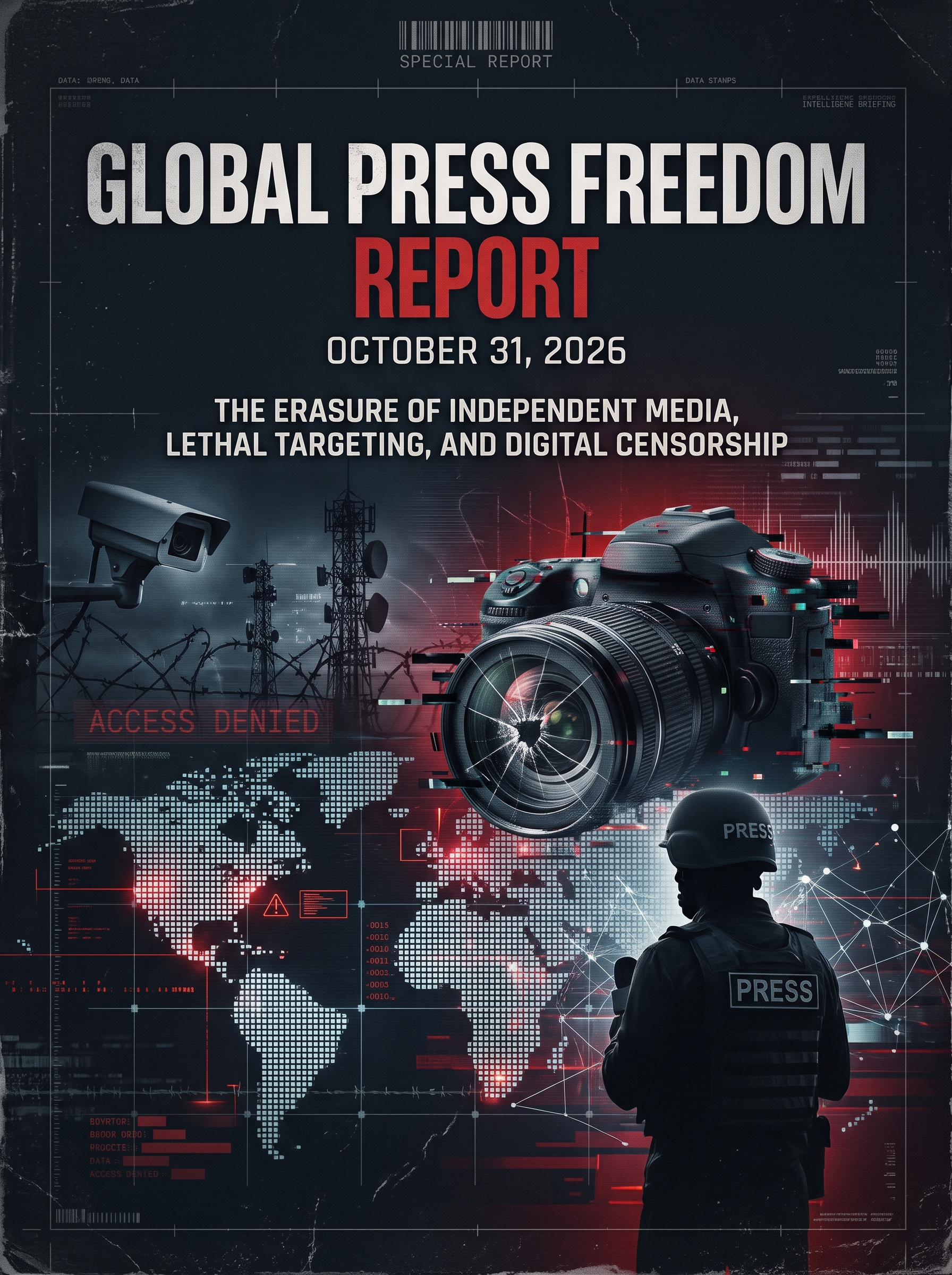
produce a title page graphic for this report