
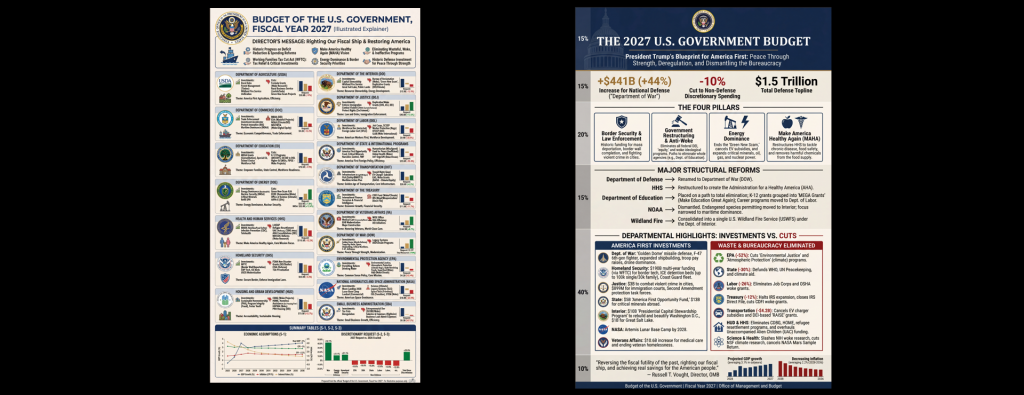
What does it look like to use Gemini Deep Research to compare the 2026 and 2027 White House budget proposals, leveraging its advanced reasoning and web search capabilities?
Create a large illustrated explainer poster designed to be printed on a large-format poster printer and hung up on the wall that narrates comparison below as a single large poster that can be printed and hung on a wall that outlines all of the core details. It should cover all of its key details and be in portrait orientation. The infographic should compare the similarities and differences in the White House 2026 and 2027 Budget requests. Find the official requests and compare and contrast them in the infographic.
You can see the text of the final report below. See the online interactive version for all of the inline citations and additional visuals.
Strategic Comparative Analysis of the Fiscal Year 2026 and 2027 Presidential Budget Requests: Macroeconomic Foundations, Defense Surges, and Domestic Realignments
1. Executive Summary and Fiscal Paradigm Shift
The presidential budget requests for Fiscal Year (FY) 2026 and Fiscal Year (FY) 2027 represent one of the most profound proposed realignments of federal fiscal priorities in modern American history. Formulated in a period of intense ideological polarization and macroeconomic transition, these budget blueprints systematically dismantle the post-Cold War consensus surrounding the balance of defense and non-defense discretionary spending. The overarching strategy across both fiscal years reveals a deliberate, two-pronged fiscal architecture: an unprecedented, historic surge in military and border security funding, coupled with severe, structural retrenchment of the domestic administrative state, environmental initiatives, and progressive social programs. This comprehensive analysis has been developed to provide the structural backbone for a large-format illustrative explainer poster, directly comparing and contrasting the strategic similarities and stark numerical differences between the two fiscal requests.
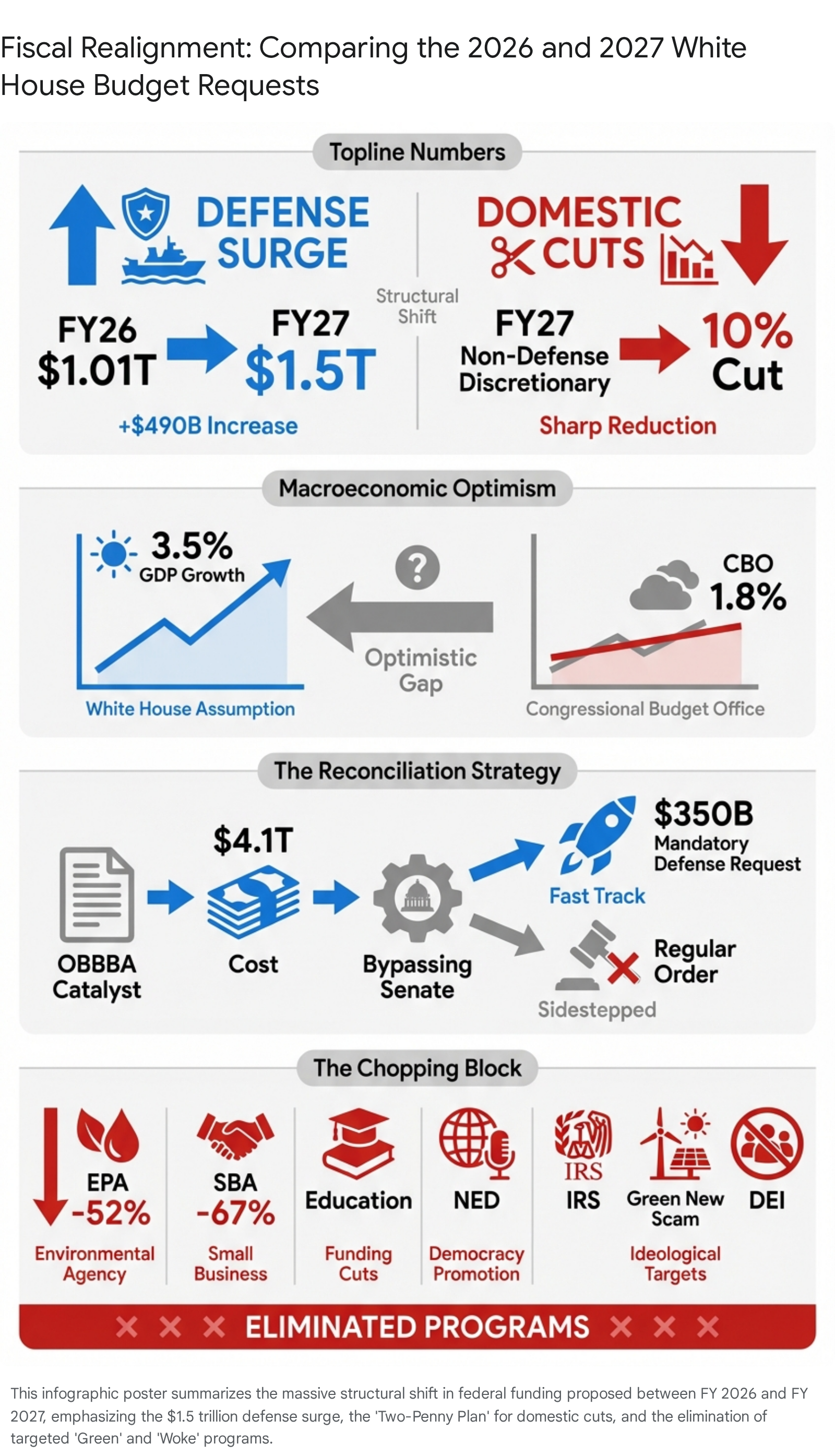
The FY 2026 budget request established the ideological and numerical foundation for this agenda, introducing steep cuts to independent agencies, proposing the consolidation of federal education and housing programs, and establishing a baseline for a new "America First" funding matrix. It initiated the rhetorical framing of targeting "woke" programs and eliminating the "Green New Scam," concepts that would become the central organizing principles of the subsequent year's fiscal document. The FY 2027 budget request, released on April 3, 2026, accelerates this trajectory drastically. Rather than merely continuing the FY 2026 baseline, the FY 2027 proposal proposes a record $1.5 trillion in total defense resources while demanding an immediate 10 percent reduction across all non-defense discretionary spending. This massive domestic cut is designed to be followed by a perpetual "Two-Penny Plan," an automatic reduction mechanism intended to continuously shrink the domestic footprint of the federal government throughout the remainder of the decade.
The similarities between the two budgets are evident in their shared ideological targets: both systematically seek to eliminate federal workforce diversity initiatives, dismantle environmental regulations, and aggressively scale back the Department of Education and the Environmental Protection Agency. However, the critical differences lie in the sheer scale, macroeconomic assumptions, and tactical legislative execution of the FY 2027 request. While the FY 2026 budget relied heavily on standard discretionary requests and early attempts at agency reform, the FY 2027 framework explicitly bifurcates its strategy. By moving massive amounts of targeted defense spending—such as the $17.5 billion "Golden Dome" missile defense system and advanced naval shipbuilding programs—into mandatory spending vehicles, the administration seeks to bypass the traditional Senate filibuster via the budget reconciliation process.
Citations:
- https://www.whitehouse.gov/wp-content/uploads/2025/05/Fiscal-Year-2026-Discretionary-Budget-Request.pdf
- https://www.whitehouse.gov/wp-content/uploads/2026/04/ending-weaponization-of-the-federal-government-fact-sheet.pdf
- https://iq.govwin.com/neo/marketAnalysis/view/FY-2027-Presidents-Budget-Request–GovWin-FMAs-First-Take/8921?researchTypeId=1&researchMarket=
- https://www.whitehouse.gov/wp-content/uploads/2026/04/rebuilding-our-military-fact-sheet.pdf
Strategic Comparative Analysis of the Fiscal Year 2026 and 2027 Presidential Budget Requests: Macroeconomic Foundations, Defense Surges, and Domestic Realignments
1. Executive Summary and Fiscal Paradigm Shift
The presidential budget requests for Fiscal Year (FY) 2026 and Fiscal Year (FY) 2027 represent one of the most profound proposed realignments of federal fiscal priorities in modern American history. Formulated in a period of intense ideological polarization and macroeconomic transition, these budget blueprints systematically dismantle the post-Cold War consensus surrounding the balance of defense and non-defense discretionary spending. The overarching strategy across both fiscal years reveals a deliberate, two-pronged fiscal architecture: an unprecedented, historic surge in military and border security funding, coupled with severe, structural retrenchment of the domestic administrative state, environmental initiatives, and progressive social programs. This comprehensive analysis has been developed to provide the structural backbone for a large-format illustrative explainer poster, directly comparing and contrasting the strategic similarities and stark numerical differences between the two fiscal requests.
The FY 2026 budget request established the ideological and numerical foundation for this agenda, introducing steep cuts to independent agencies, proposing the consolidation of federal education and housing programs, and establishing a baseline for a new "America First" funding matrix. 1 It initiated the rhetorical framing of targeting "woke" programs and eliminating the "Green New Scam," concepts that would become the central organizing principles of the subsequent year's fiscal document. 2 The FY 2027 budget request, released on April 3, 2026, accelerates this trajectory drastically. 3 Rather than merely continuing the FY 2026 baseline, the FY 2027 proposal proposes a record $1.5 trillion in total defense resources while demanding an immediate 10 percent reduction across all non-defense discretionary spending. 4 This massive domestic cut is designed to be followed by a perpetual "Two-Penny Plan," an automatic reduction mechanism intended to continuously shrink the domestic footprint of the federal government throughout the remainder of the decade. 5
The similarities between the two budgets are evident in their shared ideological targets: both systematically seek to eliminate federal workforce diversity initiatives, dismantle environmental regulations, and aggressively scale back the Department of Education and the Environmental Protection Agency. However, the critical differences lie in the sheer scale, macroeconomic assumptions, and tactical legislative execution of the FY 2027 request. While the FY 2026 budget relied heavily on standard discretionary requests and early attempts at agency reform, the FY 2027 framework explicitly bifurcates its strategy. By moving massive amounts of targeted defense spending—such as the $17.5 billion "Golden Dome" missile defense system and advanced naval shipbuilding programs—into mandatory spending vehicles, the administration seeks to bypass the traditional Senate filibuster via the budget reconciliation process.
2. Macroeconomic Assumptions and the Fiscal Baseline Divergence
To accurately assess the feasibility, trajectory, and long-term consequences of any presidential budget, an observer must first examine the foundational macroeconomic assumptions upon which its revenue, deficit, and debt projections are constructed. Historically, the Office of Management and Budget (OMB) and the Congressional Budget Office (CBO) maintain slightly divergent economic forecasts, often reflecting the inherent optimism of a sitting administration. However, the FY 2026 and FY 2027 budget requests reveal a massive, almost unprecedented gulf between the White House's economic modeling and the consensus of mainstream economists, the nonpartisan CBO, and the Federal Reserve.
2.1 The Rosy Scenario: GDP, Inflation, and Interest Rates
There are essentially two mechanisms by which a presidential administration can present a budget that appears fiscally responsible while simultaneously proposing vast increases in defense spending and massive, permanent tax cuts. The administration can enact brutal, systemic policy changes to mandatory spending programs—a route this administration has explicitly avoided regarding Social Security and Medicare outlays —or they can alter their baseline mathematical assumptions regarding how the broader economy will behave over the standard ten-year budget window. The FY 2026 and FY 2027 budgets rely overwhelmingly on the latter strategy, presenting what economic analysts frequently term a "rosy scenario".
The administration projects that real Gross Domestic Product (GDP) will jump to a highly robust 3.5 percent over the four quarters of 2026, before hovering just above 3.0 percent for several years and settling slightly below that level in the long term. The administration argues that this robust and thriving economy is a direct result of their pro-growth tax policies and aggressive deregulation. This forecast stands in stark, immediate contrast to the CBO’s projection, which models a brief, stimulus-driven bump to 2.2 percent in 2026 before settling into a significantly lower long-term average growth rate of just 1.8 percent per year. Similarly, the Federal Reserve projects a long-run growth estimate of only 2.0 percent, aligning closely with the CBO rather than the White House.
This divergence of more than a full percentage point in sustained annual GDP growth has massive, compounding effects on the budget's underlying mathematics over a decade. Faster presumed economic growth automatically translates into higher projected individual and corporate tax revenues, while simultaneously yielding lower projected outlays for social safety-net programs like unemployment insurance, Medicaid, and nutritional assistance. Consequently, by assuming the economy grows significantly faster than external analysts expect, the administration artificially shrinks the projected deficit, making the overall budget appear mathematically sound.
Furthermore, the administration's budget assumes the labor market will remain unnaturally tight without triggering subsequent inflationary spirals. The OMB projects the unemployment rate will drift down to a historically low 3.7 percent and remain persistently at that level indefinitely. Simultaneously, the administration projects that inflation, as measured by the GDP price index, will fall from 2.8 percent in calendar year 2025 to 2.7 percent in 2026, eventually moderating exactly at the Federal Reserve's target rate of 2.0 percent. Perhaps most optimistically, given the massive issuance of new federal debt, the White House expects the yield on the 10-year Treasury note to drop nearly a full percentage point, falling from 4.3 percent in 2025 to 3.4 percent by 2029. In direct contradiction, the CBO anticipates 10-year Treasury yields will grow to 4.4 percent by 2031 and beyond, driven upward by the very deficits the administration claims to be reducing.
2.2 Deficit Trajectories and Mathematical Disconnects
By relying entirely on these highly optimistic macroeconomic assumptions—higher sustained growth, persistently low unemployment, perfectly stable inflation, and plummeting sovereign borrowing costs—the FY 2027 budget paints a deceptively manageable fiscal picture. The White House proudly claims that its policy framework will result in $19.54 trillion in cumulative deficits from FY 2026 through 2036. The administration boasts that this figure is $6.7 trillion lower than the CBO's February 2026 baseline projection of $26.26 trillion in cumulative deficits over the same decade.
However, rigorous forensic analysis by organizations like the Committee for a Responsible Federal Budget (CRFB) reveals the structural illusion within these claims. Of the purported $6.7 trillion in deficit reduction championed by the administration, a staggering $6.295 trillion is entirely attributable to "baseline and economic differences"—meaning the savings stem strictly from the White House's optimistic economic modeling and aggressive revenue assumptions, rather than from actual enacted policy savings. When economic modeling discrepancies are removed, only roughly $435 billion represents net actual policy savings over the decade.
If the CBO's more standard, cautious macroeconomic assumptions are applied to the President's actual legislative proposals, the fiscal outlook darkens considerably. The CBO projects that, under realistic conditions, deficits will reach $1.9 trillion in 2026 alone, with the debt held by the public reaching 101 percent of GDP. The true cost of the administration's fiscal path becomes apparent in the explosive growth of debt-servicing costs. Nominal interest costs on the national debt are projected to more than double over the next decade, surging from $970 billion in 2025 to a crippling $2.1 trillion by 2036. As a share of the total American economy, these interest costs will rise from a record 3.2 percent of GDP in 2025 to an unprecedented 4.6 percent of GDP by 2036. In short, the viability of the FY 2026 and FY 2027 budgets is mathematically dependent on a "Goldilocks" economic scenario that external forecasters and nonpartisan budget monitors deem highly improbable, masking a trajectory of rapidly accelerating national debt.
3. The Legislative Catalyst: The "One Big Beautiful Bill Act" (OBBBA) of 2025
To fully comprehend the massive jump in baseline funding requirements, deficit projections, and strategic aggression between the FY 2026 request (issued in the early months of 2025) and the FY 2027 request (issued in April 2026), an analyst must look outside the strict confines of the budget documents themselves. One must analyze the defining legislative event of the intervening period: the passage of the "One Big Beautiful Bill Act" (OBBBA), officially styled as the Working Families Tax Cut Act, signed into law on July 4, 2025.
Passed unilaterally via the budget reconciliation process to systematically bypass the 60-vote Senate filibuster threshold, the OBBBA fundamentally rewrote the federal fiscal and regulatory landscape. It serves as the bridge between the aspirations of the FY 2026 budget and the hard realities of the FY 2027 budget. The legislation permanently extended the temporary individual income and estate tax provisions originally enacted in the 2017 Tax Cuts and Jobs Act (TCJA), cementing lower marginal rates and doubled standard deductions into permanent law.
Furthermore, the OBBBA introduced highly targeted, populist tax deductions designed to appeal to working-class demographics, specifically eliminating federal income taxes on tip income (providing a deduction of up to $25,000 per taxpayer) and overtime pay (up to $12,500 per taxpayer). To limit the cost, these deductions featured strict phaseouts for individuals with a Modified Adjusted Gross Income (MAGI) over $150,000, or $300,000 for married couples filing jointly. The law also increased the Child Tax Credit from $2,000 to $2,200 for qualified taxpayers and established federally funded "Trump Accounts," which mandate the federal government to make a one-time $1,000 contribution for each eligible American child beginning July 4, 2026, alongside authorizing significant tax-advantaged employer contributions.
On the corporate side, the OBBBA was equally transformative. It enacted large business tax cuts, most notably restoring 100 percent bonus depreciation, which provides permanent full expensing for many forms of business investment. It restored the expensing of specific research and development (R&D) costs, moved business interest deductions back to the more favorable EBITDA standard, provided 100 percent temporary expensing for certain manufacturing structures, and increased Section 179 limits. Conversely, the Act accelerated the expiration of vital clean energy incentives, stipulating that the New Clean Vehicle Credit (30D), Used Clean Vehicle Credit (25E), and Qualified Commercial Clean Vehicle Credit (45W) would not be allowed for any vehicle acquired after September 30, 2025.
3.1 The Severe Fiscal Cost and Macroeconomic Drag of OBBBA
While the administration consistently touted the OBBBA as a massive economic stimulus that would unleash unprecedented American economic dominance—claiming in its Mid-Session Review that the legislation would eventually cut deficits in half over a decade —independent analysis of its impact on the federal deficit has been dire. The legislation is entirely deficit-financed. According to the CBO, the OBBBA will increase federal borrowing by $4.1 trillion through 2034 on a conventional scoring basis, making it the most costly reconciliation act in recent American history.
| OBBBA Budgetary Impact (2025-2034) | Billions of USD |
| Total Deficit Increase |
$4,100 |
| Gross Tax Cuts & Spending Increases |
$5,900 |
| Offsets (Spending Reductions) |
-$2,500 |
| — Cuts to Medicaid & Other Health |
-$819 |
| — Cuts to Education/Food Security |
-$1,375 |
| Net Interest Cost on New Debt |
+$700 |
The Tax Policy Center and the Yale Budget Lab estimate that the sheer volume of borrowing required by the OBBBA will push the national debt to 126 percent of GDP by 2034, significantly higher than the CBO's pre-enactment baseline projection of 117 percent. In the long term, by 2054, the law is projected to raise the debt-to-GDP ratio by 28 to 45 percentage points, potentially pushing total debt-to-GDP to an astronomical, crisis-level 194 percent if temporary provisions are made permanent.
The Yale Budget Lab explicitly notes the catastrophic macroeconomic feedback loop created by this legislation. While the OBBBA provides a short-term boost to GDP growth averaging 0.2 percentage points per year from 2025 to 2027 through higher after-tax income, the massive increase in deficit-financed debt will eventually crowd out private investment and relentlessly drive up interest rates. By 2054, the 10-year Treasury yield is projected to be 1.4 percentage points higher than it would have been otherwise, resulting in a long-term economic drag where total US GDP is more than 3 percent smaller than it would have been had the bill never passed.
3.2 OBBBA's Distortion of the Defense and Border Baseline
Crucially, the OBBBA was not solely a tax reform bill; it also included massive, unprecedented mandatory spending authorizations that deeply distorted the comparative analysis between the FY 2026 and FY 2027 budgets. The legislation appropriated $151.5 billion in immediate, defense-related mandatory funding. It also included over $190 billion in multiyear mandatory funding for the Department of Homeland Security (DHS).
By securing these massive defense and security funds via a hyper-partisan reconciliation vehicle in July 2025, the administration effectively, and artificially, elevated the baseline for the FY 2027 budget. When the White House boasts in its FY 2027 fact sheets of delivering a 42 percent increase in defense funding over FY 2026 levels, it relies heavily on the mathematical sleight-of-hand that the OBBBA already injected $155 billion into the defense baseline outside the standard congressional appropriations process. This structural maneuver fundamentally altered how federal budgets are negotiated, severing the traditional requirement to balance defense increases with domestic spending.
4. The Unprecedented Military and Homeland Security Buildup
The most striking defining feature of both the FY 2026 and FY 2027 budgets is the staggering redirection of national wealth toward the military and border security apparatus, executed at the direct expense of the domestic administrative state. The administration has explicitly stated its overarching strategic goal is to rebuild the military to "secure peace through strength," aggressively comparing its proposed military buildups favorably to those enacted by President Ronald Reagan during the height of the Cold War and by President Franklin D. Roosevelt in the massive industrial mobilization prior to World War II.
4.1 From FY 2026 to FY 2027: Scaling the Defense Topline
The FY 2026 discretionary budget request initiated this military surge, calling for $1.01 trillion in defense spending—which represented a substantial 13 percent increase over the FY 2025 enacted level. However, the FY 2027 budget request accelerates this trajectory aggressively, moving from steady expansion into historic, structural militarization. The administration is seeking a record-breaking $1.5 trillion in total budgetary resources for the Department of Defense (referred to interchangeably as the Department of War in certain highly technical budget appendices).
This $1.5 trillion request is a functionally historic sum. Even when adjusted for inflation, budget analysts note that this level of expenditure exceeds the peak of total U.S. defense spending during World War II, which crested at slightly less than $1.2 trillion in modern, inflation-adjusted dollars in 1945. However, the mechanical structure of this request is vital to understand. The administration is fully aware that it cannot secure $1.5 trillion in standard discretionary funding through a divided Congress. Recognizing the near-impossibility of passing such a massive, unbalanced increase through a Senate requiring 60 votes to break a filibuster, the White House has strategically bifurcated its defense request.
The FY 2027 budget requests $1.15 trillion in base discretionary budget authority. Simultaneously, it requests an additional $350 billion in mandatory resources, explicitly designating that these funds must be moved through a future, partisan budget reconciliation process. This mirrors the highly successful strategy executed with the OBBBA in 2025 and represents a permanent paradigm shift in how the Pentagon is funded—formally decoupling massive defense increases from the traditional bipartisan requirement to simultaneously increase non-defense domestic spending. Critics, however, label this level of spending a "Bloody New Deal," warning that this $1.5 trillion request, combined with an unbudgeted $200 billion supplemental package reportedly being sought to sustain military operations in Iran, will add an estimated $5.8 trillion to the national debt over the next decade.
4.2 The "Golden Dome," Naval Expansion, and Space Force
The specific programmatic allocations within this $1.5 trillion request reflect a hyper-focus on strategic competition, domestic missile defense, and naval superiority. A crown jewel of the administration’s defense architecture is the "Golden Dome" for America. Described initially in the FY 2026 budget merely as a down-payment on a next-generation missile defense shield designed to protect the U.S. from any adversary , the program receives a massive acceleration in the FY 2027 request. The FY 2027 budget allocates a staggering $17.5 billion to the Golden Dome system. However, in a display of legislative brinksmanship, $17.1 billion of this funding relies entirely on the successful passage of the $350 billion partisan reconciliation package, with only a relatively scant $400 million included in the base discretionary request. Ultimately, the Golden Dome system is expected to cost $175 billion and take three years to build.
Shipbuilding also sees a historic, industrial-scale surge. The Navy is requesting $65.8 billion for shipbuilding alone in FY 2027—with roughly $60.2 billion coming from the base budget and another $5.6 billion sourced from reconciliation funding. This funding supports a "whole of nation shipbuilding order of 41 ships," which includes the highly publicized "Trump-class battleship" and next-generation frigates. The administration claims this represents the largest demand signal to the maritime industrial base since the 1940s.
Aviation and space assets are similarly prioritized. The budget significantly ramps up procurement of the F-35 fighter jet, requesting 85 aircraft (32 via the base budget, 53 via reconciliation), nearly doubling the FY 2026 request of 47 aircraft. Space Force operations and maintenance funding bumps up to $9.3 billion in the baseline request, plus a small reconciliation addition of $414 million, representing a vast increase from the FY 2026 level of $5.7 billion. Furthermore, the budget calls for a direct increase in active-duty military personnel, expanding the force by roughly 20,984 troops to a total of 1,342,900, backed by a pay raise of 5 to 7 percent depending on rank.
4.3 Border Security and the Domestic Homeland Security Apparatus
Parallel to the global military buildup is a massive, highly militarized expansion of the domestic homeland security apparatus. The FY 2026 budget initiated this posture by committing $175 billion to the Department of Homeland Security explicitly for border security to "repel the invasion". Building on the massive multiyear mandatory funding secured through the OBBBA, the FY 2027 budget aggressively expands the footprint of Immigration and Customs Enforcement (ICE) and the broader deportation machinery.
The FY 2027 request explicitly maintains funding to support an unprecedented expansion of detention infrastructure. Utilizing the $75 billion provided by the Working Families Tax Cut Act (OBBBA), the administration aims to activate up to 100,000 single adult detention beds and up to 30,000 family unit beds. It also provides $15.4 billion for enhancements to ground and air transportation capabilities to maximize annual removals and authorizes a 67 percent increase in ICE staffing through 2029. Complementing this, the budget proposes $899 million for the Executive Office for Immigration Review (an increase of $99 million over FY 2026 enacted levels) specifically to expand courtroom space and expedite deportation hearings. Conversely, reflecting its "America First" ideology, the budget entirely eliminates the Refugee Resettlement Program, characterizing previous humanitarian expenditures as "cash handouts and free healthcare used to welcome millions of illegal immigrants" to the direct detriment of American citizens.
5. Non-Defense Discretionary Retrenchment: The Execution of the "Two-Penny Plan"
To partially offset the astronomical financial costs of the military buildup and the revenue losses from the OBBBA tax cuts, both the FY 2026 and FY 2027 budgets target Non-Defense Discretionary (NDD) spending with unprecedented severity. The administration's stated philosophical justification for these cuts is radical decentralization—shifting governmental services and responsibilities away from what it repeatedly terms a "bloated Washington, D.C. bureaucracy" back to state and local governments, under the premise that local authorities better respect community needs.
5.1 The Architecture of the Domestic Cuts
In the FY 2026 budget request, the administration signaled its intent by proposing to lower the NDD base to $163 billion (or 22.6 percent) below current-year spending levels. While congressional appropriators fiercely resisted the full scope of these draconian cuts in 2025, the administration has returned in FY 2027 with a highly systematized, automated framework for domestic retrenchment, resurrected from earlier fiscal proposals, known as the "Two-Penny Plan".
The FY 2027 budget demands an immediate, devastating 10 percent cut ($73 billion) to NDD base spending compared to FY 2026 enacted levels, dropping total base NDD to an artificially constrained $660 billion. Following this initial shock reduction, the Two-Penny Plan dictates that base NDD will be subjected to an automatic 2 percent annual reduction for the remainder of the decade. According to analysis by the Committee for a Responsible Federal Budget (CRFB), this compounding, structural starvation mechanism would result in $2.5 trillion of lower NDD budget authority over the decade compared to the CBO's baseline, fundamentally crippling the operational capacity of the domestic federal government.
5.2 Broad Departmental Reductions
The blunt force of the 10 percent top-line cut in FY 2027 translates into severe, targeted reductions across nearly all civilian Cabinet departments, leaving practically no sector of the domestic administrative state untouched.
| Cabinet Department | FY 2026 Enacted vs. FY 2027 Request | Primary Targets / Program Eliminations |
| Dept. of Defense (Base + Recon) |
+ 42.2% |
"Golden Dome," Naval Shipbuilding, F-35s |
| Small Business Administration |
– 67.0% |
Entrepreneurial Development, Salaries & Expenses |
| Environmental Protection Agency |
– 52.0% |
Clean/Drinking Water State Revolving Funds, Grants |
| Dept. of Labor |
– 35.0% |
Federal workforce training program restrictions |
| Dept. of State / USAID |
– 30.4% |
USAID placed on "path to elimination," Global health |
| Dept. of Agriculture |
– 19.0% |
Rural Business Service, Community Facility Earmarks |
| Dept. of HUD |
– 13.0% |
CDBG, HOME, Homeless Assistance Grants |
| Dept. of HHS |
– 12.5% |
LIHEAP, Community Services Block Grant |
| Dept. of Commerce |
– 12.2% |
Broad cuts, offset by $110M increase for Trade Enforcement |
| Dept. of Education |
– 2.9% |
TRIO, GEAR UP, FSEOG, MSI programs eliminated |
According to federal budget analyses, the Small Business Administration (SBA) is effectively gutted, facing a 67 percent decrease ($671 million) to nearly eliminate its entrepreneurial development programs entirely. The Department of Agriculture (USDA) faces a 19 percent cut ($4.9 billion), explicitly targeting rural business services, food safety inspections, and community facilities. The Department of Health and Human Services (HHS) faces a 12.5 percent reduction ($15.8 billion), achieved largely by eliminating the Low Income Home Energy Assistance Program (LIHEAP) and the Community Services Block Grant (CSBG). The Department of Housing and Urban Development (HUD) is slashed by 13 percent, largely through the proposed absolute elimination of the multi-billion dollar Community Development Block Grant (CDBG) and the HOME Investment Partnerships Program. Even the Department of Commerce faces a 12.2 percent overall reduction, though it notably receives highly targeted increases for trade enforcement at the International Trade Administration (ITA) to align with the administration's aggressive global tariff policies.
6. Departmental Deep Dives: The Deconstruction of the Administrative State
Beyond the aggregate numerical cuts and the macro-level Two-Penny Plan, the FY 2026 and FY 2027 budgets target specific policy infrastructures for complete, irrevocable elimination. The administration utilizes targeted, highly politicized "Fact Sheets" to ideologically brand its cuts, focusing intensely on environmental policy, public education, international relations, and what it views as domestic ideological overreach by progressive bureaucrats.
6.1 Education: Radical Consolidation and the "Path to Elimination"
The administration harbors a profound, explicitly stated hostility toward the federal oversight of public education. The FY 2027 budget documents explicitly state that the proposal places the Department of Education (ED)—which it claims "has failed the Nation's children, teachers, and families"—on a formal "path to elimination," arguing that educational authority must be fully and permanently returned to the states.
In the FY 2026 budget, the administration proposed the "K-12 Simplified Funding Program" (SFP), a blunt attempt to consolidate 18 distinct federal educational grants into a single formula block grant to severely reduce federal influence. Having failed to secure this consolidation in the previous Congress, the FY 2027 budget rebrands and expands the effort as the "Make Education Great Again" (MEGA) grant program. The MEGA initiative would consolidate 17 elementary and secondary grant programs—representing $6.5 billion in existing funding—into a single block, allowing states to spend the funds entirely at their own discretion without any federal prescription, oversight, or equity mandates. Furthermore, 12 other K-12 programs totaling $2.1 billion, including English Language Acquisition programs, are slated for outright elimination. Crucially, however, the budget does spare and marginally increase funding for Title I ($18.4 billion) and Special Education/IDEA ($16 billion), avoiding the political fallout of cutting the most universally utilized local school funds.
In higher education, however, the devastation of student access and equity programs is absolute. The FY 2027 budget proposes the complete elimination of the TRIO and GEAR UP programs ($1.6 billion combined), which assist disadvantaged, low-income, and first-generation students in preparing for and persisting in college. It also entirely eliminates the $910 million Federal Supplemental Educational Opportunity Grant (FSEOG) program and slashes Federal Work-Study (FWS) funding to a mere $123 million, explicitly shifting the wage burden for working students to private employers. Additionally, Minority-Serving Institution (MSI) programs face a devastating $354 million cut, and the Fund for the Improvement of Postsecondary Education (FIPSE) is cut by $136 million.
Paradoxically, amidst these structural eviscerations, the FY 2027 budget actually requests a $10.5 billion nominal increase for the Pell Grant program. However, higher education analysts note this is absolutely not an expansion of student benefits, but rather an emergency mathematical backfill intended solely to address a projected statutory funding shortfall to maintain the existing maximum award at $7,395 for the 2027–28 academic year. Finally, to further hollow out the structural capacity of the ED, the budget proposes transferring the entire Office of Career, Technical, and Adult Education to the Department of Labor, stripping the ED of $1.5 billion in operating budget.
6.2 The EPA, Energy Policy, and "Ending the Green New Scam"
The administration’s approach to environmental regulation, climate science, and renewable energy is entirely combative and uncompromising. A dedicated FY 2027 fact sheet titled "Ending the Green New Scam" outlines the systematic dismantling of the federal government's entire climate mitigation infrastructure.
The Environmental Protection Agency (EPA) faces arguably the most severe proportional cut of any major Cabinet-level agency, with its discretionary budget slashed by a staggering 52 percent (down $4.6 billion) to a baseline of just $4.2 billion. This catastrophic reduction is achieved by nearly eliminating State Revolving Funds (SRFs)—which municipalities rely upon heavily for clean drinking water and wastewater infrastructure upgrades—and heavily reducing categorical grants. The budget also explicitly eliminates the EPA's environmental justice programs, including the $600 million "Thriving Communities" grantmakers program, which the administration claims is an "anti-oil and gas crusade" driven by radical energy agendas. Furthermore, all federal research grants to NGOs focused on climate equity, environmental justice, or ESG metrics are terminated immediately, with the administration requesting $277 million to rigidly refocus the agency on its "core mission" of basic clean air and water compliance, stripping it of any climate-related regulatory authority.
At the Department of Energy (DOE) and the Department of Transportation (DOT), the FY 2027 budget seeks to aggressively claw back massive sums of money authorized by the bipartisan Infrastructure Investment and Jobs Act (IIJA). The budget formally cancels over $15 billion in IIJA funds at the DOE previously allocated for renewable energy deployment, carbon dioxide removal technologies, and EV battery manufacturing. It also cancels $4 billion at the DOT intended for the buildout of electric vehicle (EV) charging networks, categorizing these investments as "wasteful and ineffective" handouts.
Internal DOE structural reorganizations further reflect this massive pivot toward fossil fuels. The Energy Efficiency and Renewable Energy (EERE) program is effectively abolished. The Advanced Research Projects Agency-Energy (ARPA-E) sees its funding severely restricted; it is mandated to refocus strictly on technologies that produce "reliable, domestic power," expressly forbidding it from utilizing federal funds for research into EV advancement, battery storage, or electric air-travel. Conversely, the budget heavily elevates the Office of Critical Minerals and Energy Innovation (CMEI), providing it with $1.1 billion to prioritize fossil fuel extraction technologies and secure critical mineral supply chains. Similar ideological cuts hit the Department of the Interior, where $45 million in renewable energy funding is eliminated specifically to halt offshore wind energy projects, which the administration alleges harm military readiness and coastal communities.
6.3 State, USAID, and the Isolationist International Retreat
The administration’s "America First" foreign policy translates structurally into a massive withdrawal from international developmental aid and multilateral diplomatic institutions. The Department of State and International Programs faces a staggering 30.4 percent cut in budget authority. The FY 2026 budget initiated the long-term process of subordinating the U.S. Agency for International Development (USAID) to the political arm of the State Department; the FY 2027 budget escalates this, explicitly stating it will eliminate all programming for USAID as the administration works to "fully turn off the lights at the Agency".
Historic multilateral commitments are heavily targeted for defunding. The FY 2026 budget paused contributions to the World Health Organization (WHO) and implemented the restrictive "Mexico City Policy" globally to prevent taxpayer dollars from promoting abortions abroad. The FY 2027 budget cuts over $642 million from international financial institutions and multilateral development banks, including abruptly withdrawing $197 million from the African Development Fund (citing its involvement in "radical climate and gender initiatives") and stripping $150 million from the Global Environment Facility for funding recycling projects in China. Instead of traditional developmental aid, the administration proposes a highly transactional $2.9 billion "America First Opportunity Fund" intended solely for strategic, quid-pro-quo investments in vital allied partners like India and Jordan.
7. Ideological Flashpoints: Purging "Woke" Programs and "Weaponization"
Beyond the stark fiscal restructuring, the FY 2026 and FY 2027 budgets function as highly ideological documents, utilizing the leverage of federal funding as a primary weapon in ongoing cultural and political conflicts. In an unusual departure from traditional OMB formatting, the White House produced specific, politically charged fact sheets outlining its intent to purge the federal government of perceived left-wing bias, institutional diversity initiatives, and regulatory overreach.
7.1 "Ending Weaponization of the Federal Government"
The administration contends, as a core policy thesis, that the federal bureaucracy has been weaponized against conservative citizens, political figures, and businesses. A primary target of this retribution is the Internal Revenue Service (IRS). In FY 2026, the budget proposed cutting $2.488 billion from the IRS to end its alleged "weaponization" against small businesses. The FY 2027 budget accelerates this attack, explicitly aiming to reverse the hiring of 19,000 new IRS agents authorized under the previous administration, arguing they represent a force of targeted harassment. It also forcibly rescinds the controversial regulation requiring Americans to report Venmo and Cash App transactions over a low $600 threshold.
The Department of Justice (DOJ) faces a punitive $1.7 billion reduction in state and local grants, eliminating almost 30 grant programs entirely. Furthermore, the budget totally defunds the National Endowment for Democracy (NED), saving $315 million. The administration alleges the NED pushed domestic propaganda against right-leaning politicians (including President Trump), blacklisted conservative media outlets via the "Disinformation Index Foundation," and collaborated with Big Tech to censor American citizens during the 2020 election.
Domestic housing policy also faces strict ideological policing. The FY 2027 budget eliminates the Fair Housing Initiatives Program (FHIP), claiming it provides federal grants to "radical leftist organizations" to pursue "racial justice" litigation that harasses businesses without evidence of actual discrimination. In a further move against perceived cultural Marxism, HUD-wide English translation and interpretation services are also targeted for total elimination.
7.2 "Cuts to Woke Programs" and Diversity Eradication
The budget systematically hunts down and defunds any federal programs associated with Diversity, Equity, and Inclusion (DEI). The National Science Foundation (NSF) is a highly visible target in this culture war; the administration proposes a massive 57 percent cut to the NSF (slashing it from $8.8 billion to $3.9 billion), explicitly taking aim at what it terms "woke social, behavioral, and economic sciences". The budget mandates the complete elimination of all DEI-related programs across the NSF, NOAA, and other scientific agencies, terminating grants previously awarded for research into topics such as climate anxiety, Hispanic environmental justice, gender-responsive agriculture, and equity-focused community engagement.
Labor and workforce training programs are similarly sanitized of any equity-focused metrics. The administration proposes giving states total, unregulated flexibility to spend federal workforce dollars specifically to avoid funneling money to "progressive non-profits finding work for illegal immigrants or focusing on diversity, equity, and inclusion (DEI)". Instead of utilizing DEI frameworks, states will be mandated by federal directive to spend at least 10 percent of their workforce grants on traditional apprenticeship models. Federal civilian employees are also directly impacted by this fiscal austerity; the FY 2027 budget is silent on the issue of federal employee pay, effectively suggesting a devastating pay freeze for the civilian workforce in 2027, even as members of the military receive a 5 to 7 percent pay increase.
8. Conclusion: The Fiscal Feasibility and Strategic Outlook
The Presidential Budget Requests for FY 2026 and FY 2027 are best understood not as traditional governing documents aimed at achieving bipartisan consensus, but as radical, uncompromising blueprints for structurally reshaping the American state. By combining historic, deficit-financed tax cuts (via the OBBBA) with an unprecedented $1.5 trillion military and border security surge, the administration has deliberately locked the federal government into a structural deficit trajectory that simply cannot be mathematically resolved by its proposed domestic cuts alone.
The mechanism of the "Two-Penny Plan" and the blunt 10 percent reduction in non-defense discretionary spending—while catastrophic to the operational capacity of agencies like the EPA, the Department of Education, and USAID—represent a relatively small fraction of total federal outlays when compared to untouched mandatory entitlement programs and the exploding, multi-trillion dollar cost of interest on the national debt. To bridge this gaping mathematical reality, the White House relies entirely on highly optimistic, unorthodox macroeconomic assumptions regarding GDP growth and interest rates that mainstream economists, the Federal Reserve, and the CBO broadly and vehemently reject.
Furthermore, the strategic reliance on partisan budget reconciliation to fund core military expansion—specifically requesting $350 billion in mandatory defense spending to bypass the Senate filibuster—represents a severe degradation of standard congressional appropriations processes. While past appropriations cycles have demonstrated fierce bipartisan resistance to eliminating popular, localized programs like the CDBG, agricultural earmarks, or clean water funds , the administration's aggressive use of executive tools, ideologically weaponized fact sheets, and reconciliation vehicles ensures that the FY 2026 and FY 2027 budgets will define the parameters of bitter fiscal warfare in Washington for the foreseeable future. The ultimate legacy of these budgets, should even a fraction of their structural realignments be enacted by Congress, will be a dramatically expanded military-security apparatus superimposed over a hollowed-out, decentralized domestic state, all balanced precariously atop an escalating mountain of sovereign debt that threatens the long-term stability of the American economy.