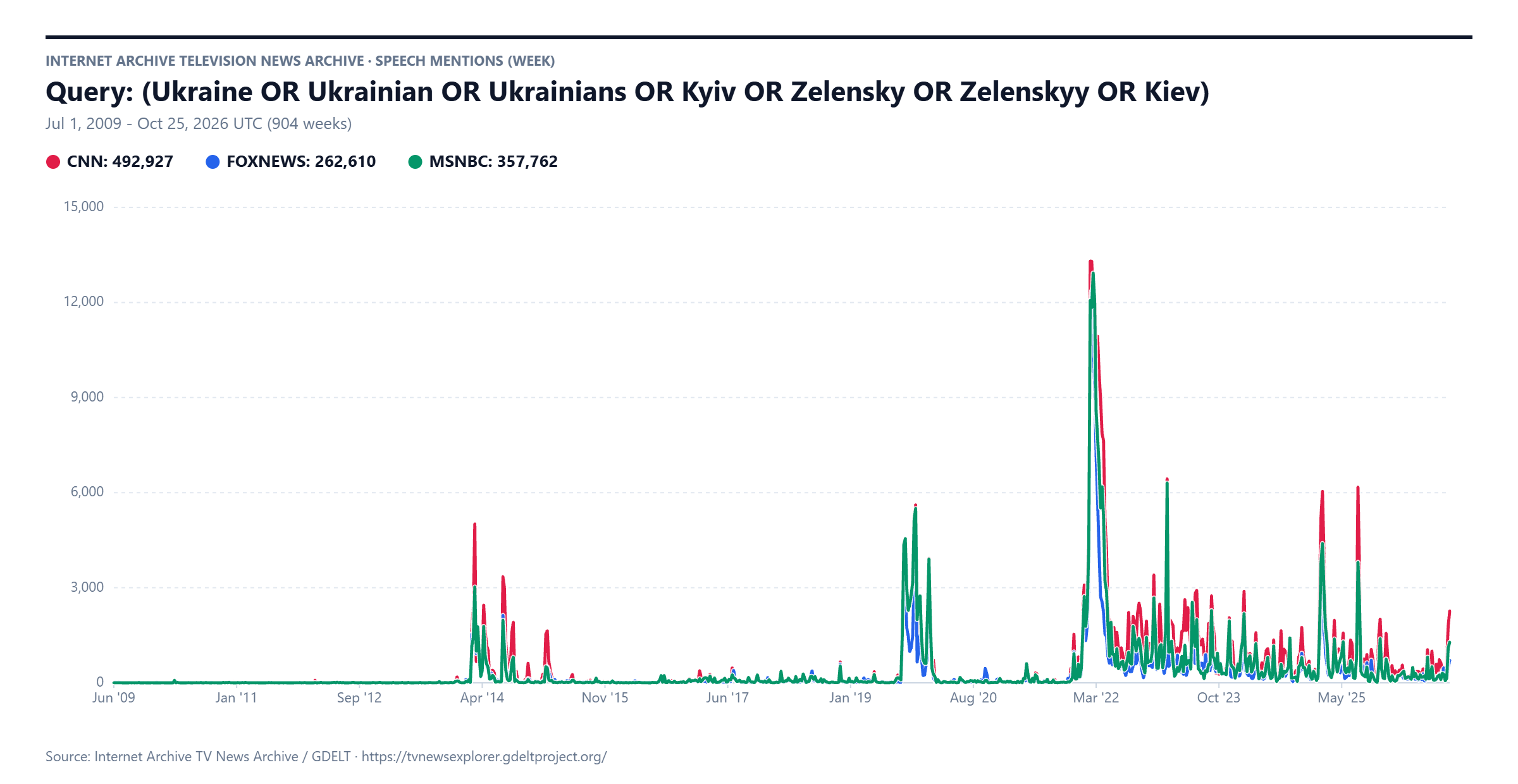
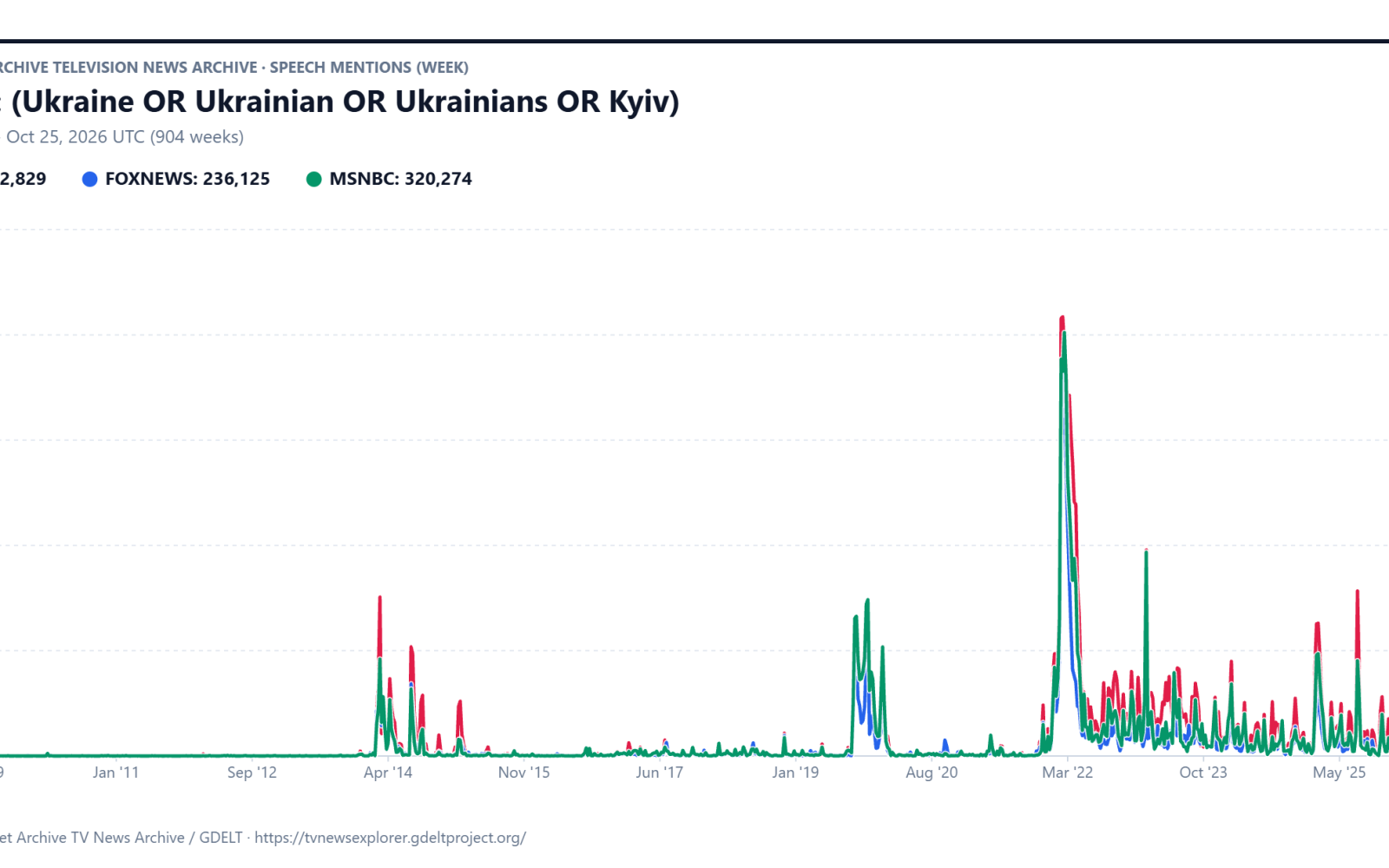
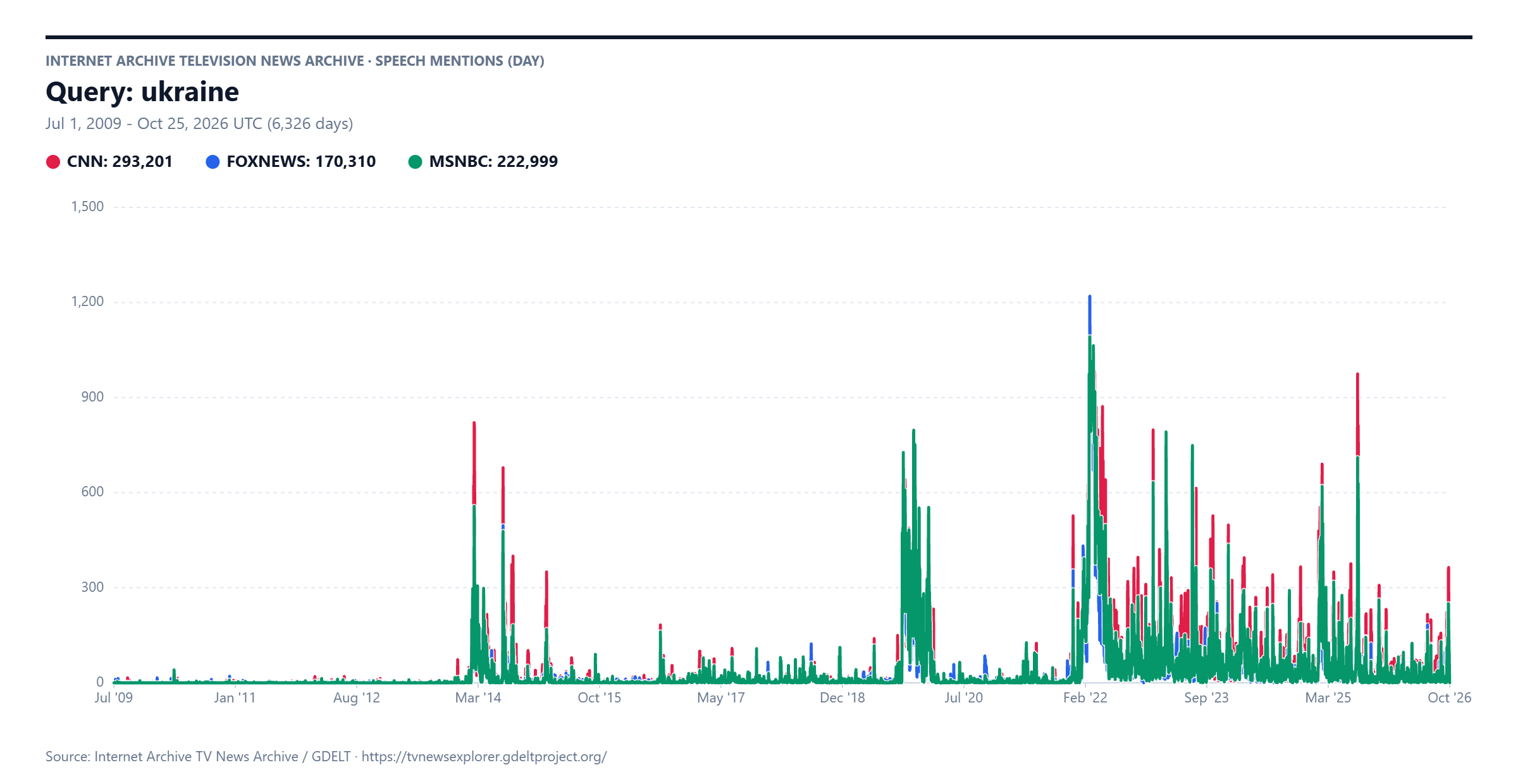
Let's say we want to search the TV News Explorer for coverage of Ukraine on American television news channels. A beginning user might just search for the literal keyword "Ukraine" and see that coverage has remained fairly steady since the initial burst of the invasion covereage, without realizing that discussion of Ukraine is likely to also mention "Ukrainian(s)", "Kyiv" and possibly even "Zelensky." Can Gemini help recommend keywords for a given search? Asking for a minimal set of keywords completely transforms our results, but with diminishing returns as we ask Gemini to continue to add keywords, suggesting tremendous potetnial for Gemini-based term autoexpansion.
Let's start with a simple search for the literal word "Ukraine":
 Now let's ask Gemini to expand our keyword list:
i want to keyword search television news for mentions of ukraine.
the search engine does not perform stemming.
give me the boolean OR statement to maximize my search results while minimizing false positives and keeping the total number of terms
minimal as possible. search has hard max of 50 characters.
Ukraine OR Ukrainian OR Ukrainians OR Kyiv
This string is 42 characters (including spaces) and captures virtually all television news transcripts or closed-caption mentions without triggering false positives.
-
-
Ukraine/Ukrainian/Ukrainians: Covers the country, adjective, and singular/plural demonyms needed when automatic stemming is disabled (most search tokenizers automatically split off possessives like'sat the punctuation mark). -
Kyiv: Captures segments and headlines that use the capital as a metonym for the Ukrainian government or military without explicitly stating the country's name, while using the remaining character budget efficiently. -
Why
Zelenskyis omitted: Television closed-captioning and news transcripts split his name across multiple transliterations (Zelensky,Zelenskyy,Zelenskiy), which would blow past the 50-character limit and rarely appear in a broadcast segment without at least one of the four core terms above.
-
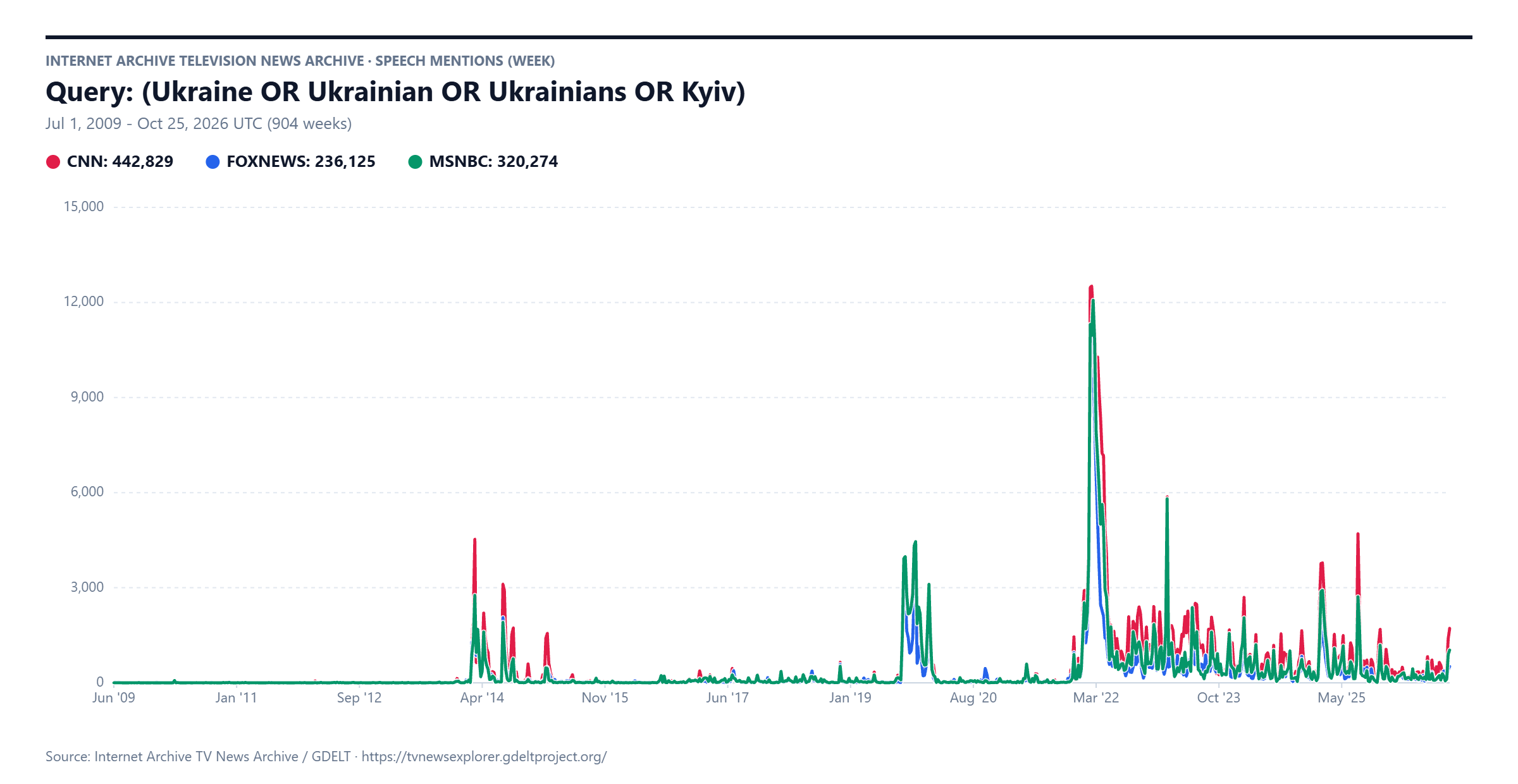
Now let's try this new search "(Ukraine OR Ukrainian OR Ukrainians OR Kyiv)". This time we get a trendline that is an accurate reflection of coverage:
What about mentions of President Zelensky? It is likely that most mentions of him will be in conjunction with the phrase "Ukrainian President Zelensky" and thus match our "Ukrainian" keyword above, but let's see – we'll repeat our Gemini query above, but this time let it go up to 75 characters for the query:
i want to keyword search television news for mentions of ukraine.
the search engine does not perform stemming.
give me the boolean OR statement to maximize my search results while minimizing false positives and keeping the total number of terms
minimal as possible. search has hard max of 75 characters.
Ukraine OR Ukrainian OR Ukrainians OR Kyiv OR Zelensky OR Zelenskyy OR Kiev
This string is exactly 75 characters (including spaces) and adds three high-value broadcast terms with zero false-positive risk:
-
-
Zelensky/Zelenskyy: Covers the two dominant spellings used across US/UK broadcast transcripts and closed-captioning systems (Zelenskyis standard for NYT, CNN, and BBC;Zelenskyyis the official AP, Reuters, and White House style). -
Kiev: Captures automated speech-to-text (ASR) closed captions and older lexicon dictionaries, which frequently still default to the legacy spelling when transcribing spoken audio of "Kyiv."
-
This time with "(Ukraine OR Ukrainian OR Ukrainians OR Kyiv OR Zelensky OR Zelenskyy OR Kiev)" we get a nearly identical result, other than the February and August 2025 peaks are higher, suggesting diminishing returns for adding additional keywords beyond Gemini's initial recommendations: