


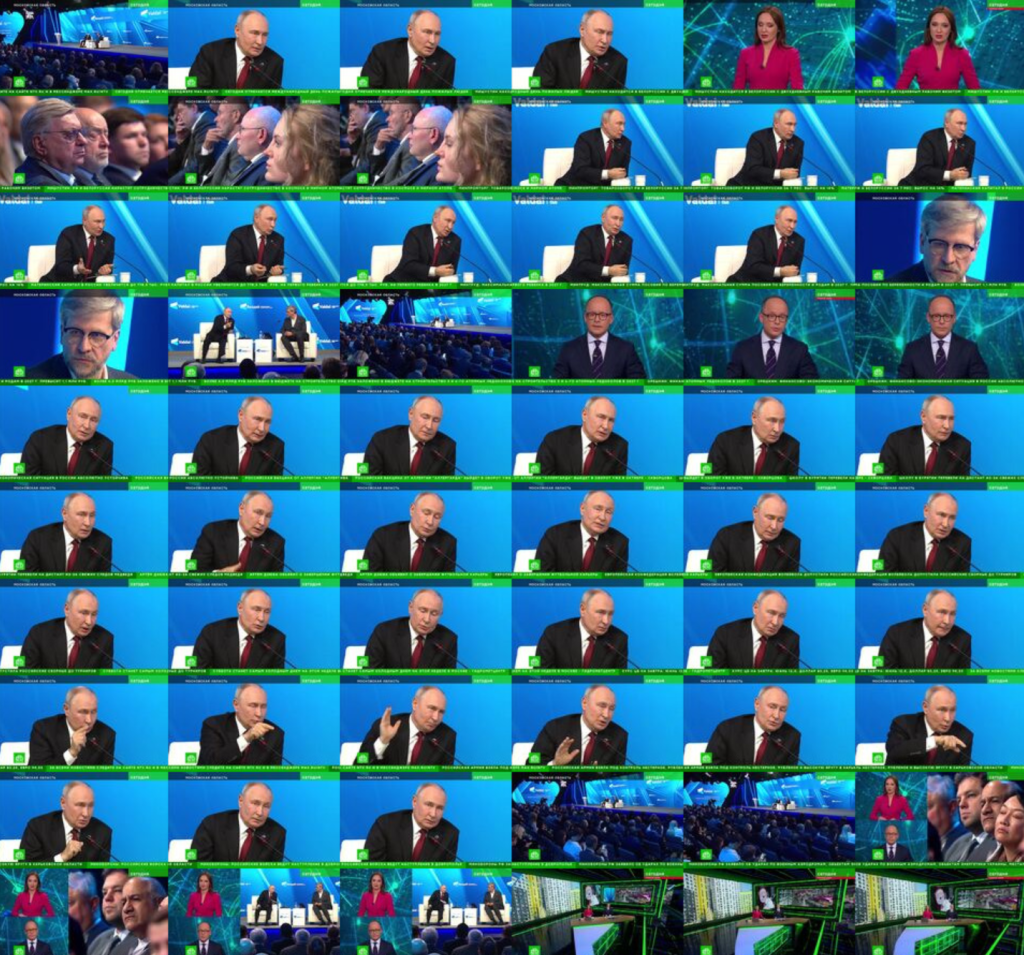
One of the most complex and important questions for journalists and scholars studying television news broadcasts lies in how they "frame" each story. A Ukrainian and Russian television channel might both cover the exact same story of a Russian attack on a power plant with the exact same details, but the way in which they frame it (a war crime against civilian infrastructure as a sign of Russian desperation on Ukrainian television / a legitimate strike on a military-adjacent target that is winning the war on Russian television) helps us understand their respective intents. Framing analysis is extremely complex, requiring deep cultural and contextual knowledge and historical baselines. To what degree could Gemini perform this kind of framing analysis for coverage of a world leader? What might it look like to ask Gemini to assess the framing and portrayal of Russian President Putin on Russian channel NTV in a broadcast from earlier this week by visually assessing a 1/4fps thumbnail montage and an ASR'd spoken-word transcript? The results here are quite fascinating. No data was used to train or tune any model.
For our analysis, we selected this broadcast from NTV from October 1st that opens with the last few minutes of an interview with Putin. We gave Gemini a 1/4 fps thumbnail montage of the broadcast and its Russian-language ASR'd transcript, along with this prompt:
How does this broadcast frame President Putin?
Look both at the thumbnail grid for the visual and the transcript for the spoken narrative and framing of Putin.
Explain in detail and explain your reasoning in detail.
Just from these two sources, Gemini does a quite decent job of not only correctly identifying the base framing of Putin, but adding substantial contextualization:
The NTV broadcast frames President Putin as a rational, supremely powerful, yet reluctant defender of the Russian state, utilizing both visual prominence and strategic narrative positioning.
-
-
Visual Authority and Centrality: In the provided visual grid, Putin dominates the opening frames of the broadcast. The thumbnails show him repeatedly featured in stable, centered medium shots and close-ups against a formal blue background, wearing standard professional attire. This extended visual focus establishes him immediately as the central, authoritative voice of the nation, projecting stability and control.
-
Unmatched Military Strength: The spoken narrative reinforces this visual dominance by highlighting Putin's command over unparalleled military assets. The broadcast explicitly relays his warning that "no one has such means of destruction as Russia has today," framing his leadership as possessing an ultimate "competitive advantage" over Western nuclear powers like France and Great Britain.
-
The Reluctant Defender: Despite emphasizing his destructive capabilities, the broadcast carefully frames Putin's posture as purely defensive, positioning Russia as a victim forced to act. The narrative insists, "we are not threatening anyone," and characterizes the potential use of force as a necessary response to an external "aggressor" because "we do not have many tools to protect ourselves".
-
Rational Strategist Establishing Boundaries: Putin is portrayed as a logical actor setting clear, unambiguous red lines for the West. The transcript notes that "the president clarified in what case this will be regarded by Moscow as a direct threat," specifically referencing Western technical assistance and weapons supplied for strikes deep into Russian territory.
-
Contrast of Sovereignty: The framing elevates Putin's leadership by contrasting Russia's self-reliance with Ukraine's dependency. The broadcast asserts that Russia relies "only on our defense-industrial complex," while framing Ukraine as a state that "cannot exist independently" and is merely a tool used by external forces to fight Russia.
-
By combining dominant, steady visual coverage with a narrative that blends overwhelming military threat with defensive justification, the broadcast legitimizes Putin's strategic decisions to the domestic audience while projecting an image of measured, necessary strength.
Let's repeat this with Gemini Deep Research for a much more detailed report, which even deep-dives into the background of the role of media in modern Russian societal governance. Here we can really see the power of Deep Research as it weaves together so many different themes and sources: