


How can responsibly applied advanced AI help journalists, scholars and policymakers better understand the emerging trends, themes and patterns of government and global media across the world? What would it look like to use AI not to summarize, but to deeply reason over an entire day of government proceedings or television news coverage and tease out the emergent high-level patterns that become visible only at scale into a richly annotated fully cited thematic analysis, with each insight connected directly back to the original source material like an annotated index? How could such insights help journalists and scholars see the major emerging meta-stories of societies and policymakers better understand the trending developments of governance? How might such a vision even improve the functioning of government itself by helping journalists, scholars and Congressional staff look across the daily flood of legislation, actions, bills, proclamations, hearings, remarks, speeches, announcements and briefings? In other words, how could AI be harnessed for the public interest: to empower journalists, scholars and policymakers to make better sense of our world at a scale that only AI can enable?
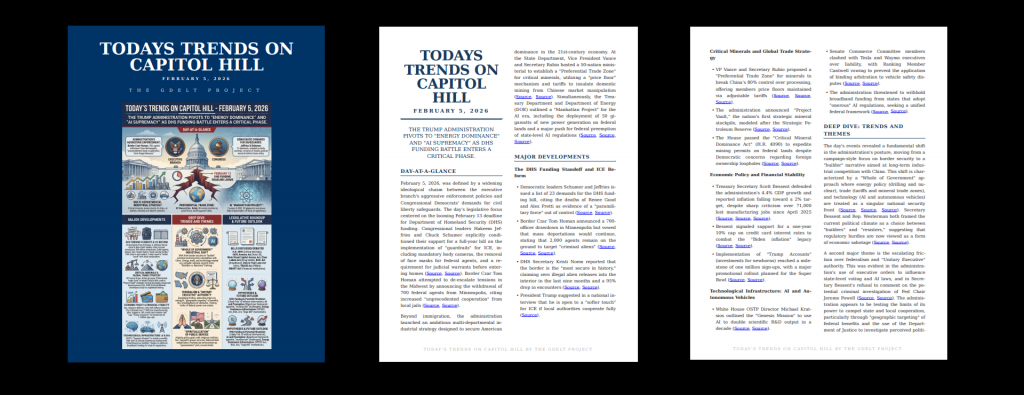
This was the question this past April that drove the launch of two immensely powerful new public interest experiments in collaboration with the Internet Archive's TV News Archive: "Today's Trends On Capitol Hill" and "Today's Media Trends". Each morning over the last six months, we have applied Google's Gemini 3 to deeply examine and reason over the previous day's coverage of each television news channel and a growing array of US Government information (starting initially with CSPAN), asking it to identify the high-level trends, insights, framings and unexpected findings and present them in a fully cited report that connects each finding back to its source broadcast/document. We also use Google's Nano Banana Pro to create a cover infographic for each report to explore the ability of advanced visualization to convey complex information to a diverse range of audiences. Only the enterprise Gemini APIs are used and no data is used to train or tune any AI model.
Today we are incredibly excited to announce that we have now completed these reports for the entire Television News Archive spanning 75 countries in more than 150 languages and dialects over portions of the past quarter-century. In all, Gemini "watched" more than 20 billion seconds of airtime (348M minutes / 5.8M hours) across 9 million broadcasts by reading their transcripts in their original native languages (ASR'ing most of them first) totaling 205.5 billion characters in 150+ languages, producing more than 195,000 individual daily trend reports totaling 6.3 billion output characters, along with 195,000 infographics (one for the cover of each report). In all, Gemini processed just over 52 billion input tokens, producing 1.6 billion output tokens and around 800M thinking tokens (around 50% thinking token overhead, capturing the immense complexity of planetary-scale reasoning).
In essence, the work here offers a first glimpse at the ultimate promise of the single most complex public interest grand challenge of the AI era: asking an AI model to reason over the entire earth. To look across decades of the human experience from every corner of the globe to understand the patterns of our shared history, then to watch the world unfold in realtime, and to use all of this to reason over human society at truly planetary scale, unveiling the hidden patterns that can help us understand our global world and the heartbeat of our planet in unprecedented new ways.
Over the coming weeks, we will be exploring what kinds of fundamentally new insights this massive new analysis of human society reveals about the evolution of global society, events and narratives over the past quarter century. As a reminder, no data was used to train or tune any model.