


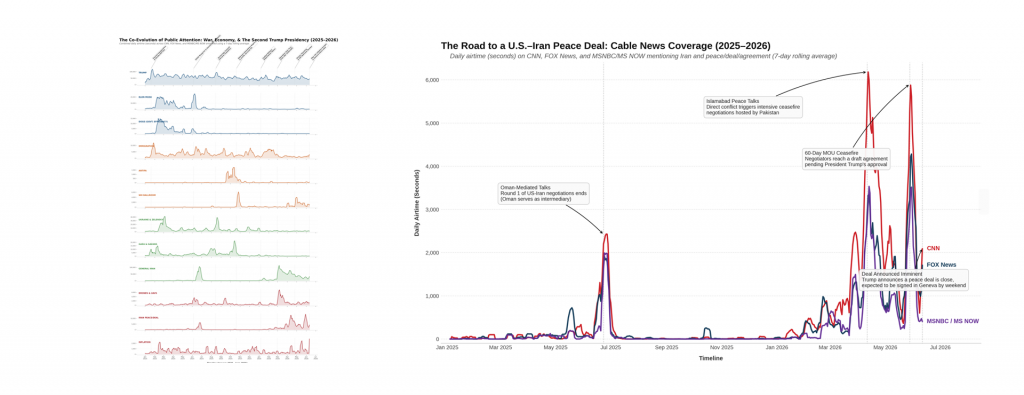
One of the goals of the Internet Archive's TV News Archive is to enable journalists and scholars to perform public interest research and reporting on television news coverage from around the world. Towards this end, in collaboration with the Archive, over the past two years we have been gradually OCR'ing (transcribing the onscreen text) the entire TV News Archive, spanning 300 channels across 50 countries over a quarter century totaling 19 billion seconds and 6 quadrillion 1fps pixels, yielding 1.8TB of text in more than 150 languages. Until now, none of this was readily searchable by journalists and scholars because of the technical infrastructure needed to reliably and rapidly search a collection of this scale, linguistic diversity and methodological and technical challenge. Two months ago we announced we were beginning to migrate the TV News Explorer over to Spanner, Google's globally distributed hyperdatabase platform, which would unlock for the first time the technological scale to make the full collection searchable. Today we are unveiling a first glimpse at an early small-scale test, performing a set of keyword searches over the entire onscreen text of CNN, MSNBC/MSNOW and Fox News from January 1, 2025 to June 10, 2026, reporting the total seconds of airtime per day containing each set of keywords. Rather than just plot these timelines through Excel, as we would have in the past, creating rudimentary timelines with no context or information explaining their trends, we complete this data journalism journey by using Gemini 3.5 Flash to take the resulting timeline CSV files and write bespoke Python code to graph them as beautiful annotated timelines, asking Gemini itself to go further and fully autonomously analyze each timeline and annotate it with relevant developments by searching the web. It even wrote "Key Data Insights" and "Synthesis" analyses for many of the graphs that described in detail what the timeline shows and why it exhibits the patterns it does, drawing from rich Google web searches. Gemini was not given a list of key points in the timeline or related developments, it was given nothing more than the CSV timeline and the keywords used to produce it and Gemini itself went off to search the web, identify milestones, align them to the data, find the ones most relevant to the contours of the results timeline and render the final results by writing bespoke Python scripts that it itself executed. No data was used to train or tune any model and Gemini was applied only to the final CSV search result timelines.
The end results, seen for the very first time below, offer a first glimpse at a new era in data-driven scholarship and journalism using television news: the end-to-end ability to visually read the entire 1.8TB of onscreen text of a quarter century of television news from more than 50 countries in 150 languages, make it searchable at scale for journalists and scholars, create timelines of how often certain keywords appear onscreen, then use Gemini to visualize and autonomously annotate those search result timelines into final report-ready visuals.
The results below are entirely preliminary and may be impacted by OCR error, errors in the Python code Gemini wrote to create each visualization, hallucinations or errors in Gemini's web search-based annotations and errors in processing stages designed to exclude advertisement text from searches. The searches below reflect exact case insensitive keyword matches using Spanner's built-in fulltext search engine and tokenizer as-is. No data was used to train or tune any model and Gemini was applied only to the final CSV timeline results.
IRAN
Below you can see the total seconds of airtime by day in which the keywords "(iran OR iranian OR tehran)" were visible anywhere in the onscreen text (comprising the entire screen, not just the chyron or crawl), as OCR'd by the GCP Cloud Vision API using 1fps resolution. Search is case-insensitive. Gemini 3.5 Flash decided on its won to use a 7-day rolling average to smooth out the data, picked the colors, layout and visual design, wrote, debugged and executed all of the Python code to render the graph and identify the major peaks and patterns in the timeline, performed Google web searches to identify major developments that explained the graph's patterns and wrote its own brief annotations, adding them to the Python graphing code as overlays and finally produced the PNG image below. Again, no human was in the loop for the entire process – just the CSV search results timeline and a basic prompt was provided and Gemini took it from there. We didn't even ask for annotations – Gemini decided to add them entirely on its own! In all, the combined set of all of the graphs and analyses on this entire page consumed 342K tokens and cost just $1.95 (not counting the costs of OCR and Spanner search, just the costs to convert the CSV timelines into these graphs). That Gemini was able to so adeptly annotate these graphs through autonomous web searches and writing its own brief annotation text and even write the Python code to place them on the graphs is truly astounding.
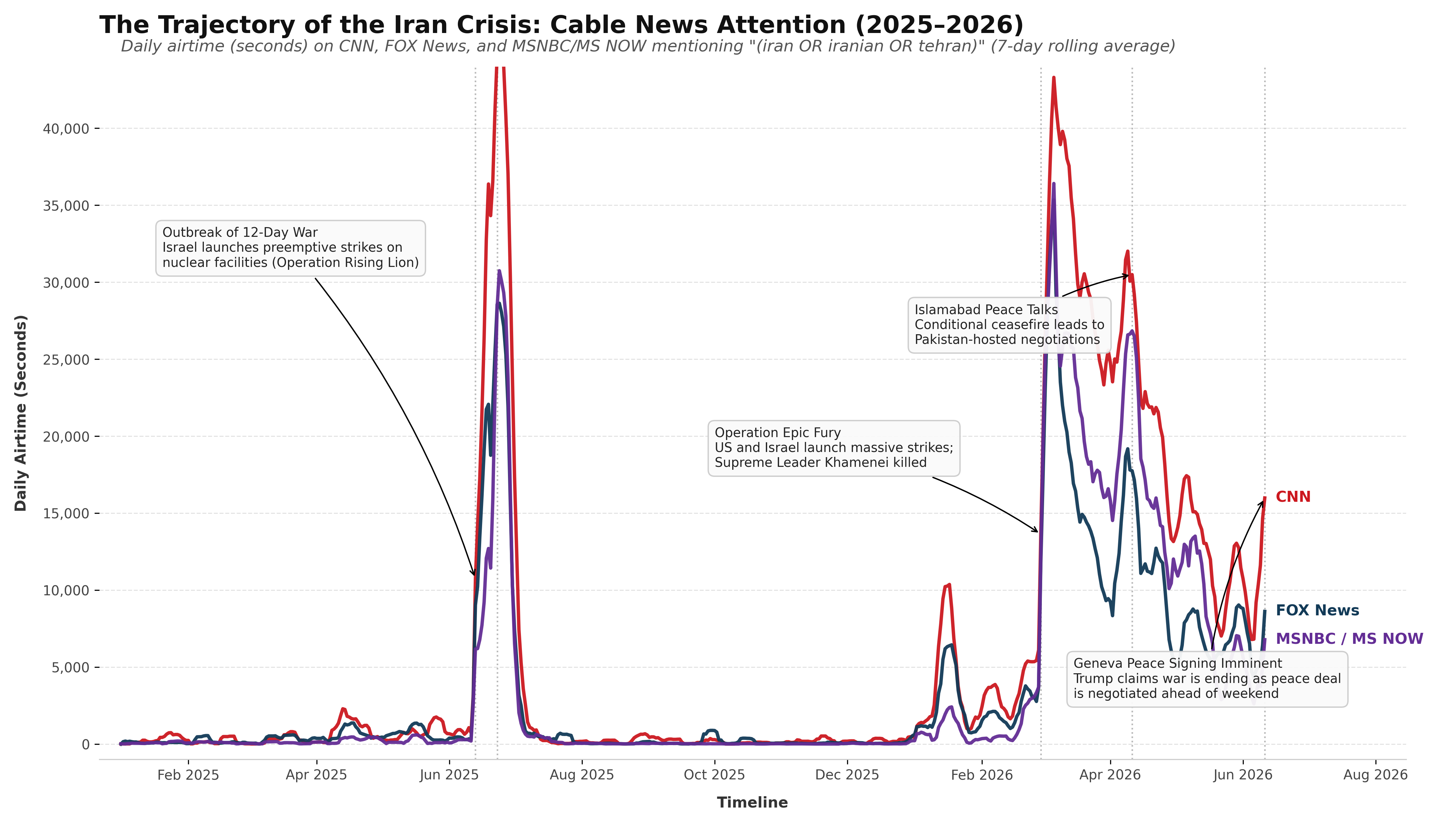
For each graph, Gemini also decided to write an analysis of the timeline (we didn't ask for this, it just decided to do this on its own), which you can see below. Remember that this is 100% machine generated by Gemini, drawing both from the timeline itself and open web Google searches for explanatory context:
Key Data Insights
Between January 2025 and June 11, 2026, the three networks broadcasted a combined total of over 1,980 hours of airtime on the general subject of Iran:
- CNN: 3,229,185 seconds (~897.0 hours) — Consistently maintained the highest volume of coverage throughout the crisis.
- MSNBC / MS NOW: 2,018,989 seconds (~560.8 hours) — Maintained a slightly higher volume of general background coverage than FOX News.
- FOX News: 1,888,048 seconds (~524.5 hours) — Showed concentrated surges during periods of active military operations.
Contextual Analysis of the Major Coverage Peaks
Unlike the previous timeline (which focused exclusively on peace and negotiations), this general timeline captures the full kinetic scope of the U.S.–Israel–Iran conflict, reflecting the outbreak of hostilities:
- Mid-June 2025 (Peak ~32,000s): Outbreak of the "12-Day War"
- Late June 2025 (Peak ~43,000s): Iran's Retaliation & The First Ceasefire
- Late February 2026 (Inflection Point ~6,000s to Peak ~40,000s): Operation Epic Fury & The 2026 Iran War
- What happened: On February 28, 2026, after negotiations stalled, a joint coalition of U.S. and Israeli forces launched devastating airstrikes targeting military assets, command structure, and nuclear sites in Tehran[7][8]. The strikes resulted in the death of Supreme Leader Ayatollah Ali Khamenei[6][8]. This marks the single steepest vertical escalation in coverage on the chart.
- April 2026 (Peak ~32,000s): The Islamabad Ceasefire Talks
- June 11, 2026 (Current Point ~15,000s and rising): Final Geneva Accord Negotiations
IRAN + PEACE DEAL
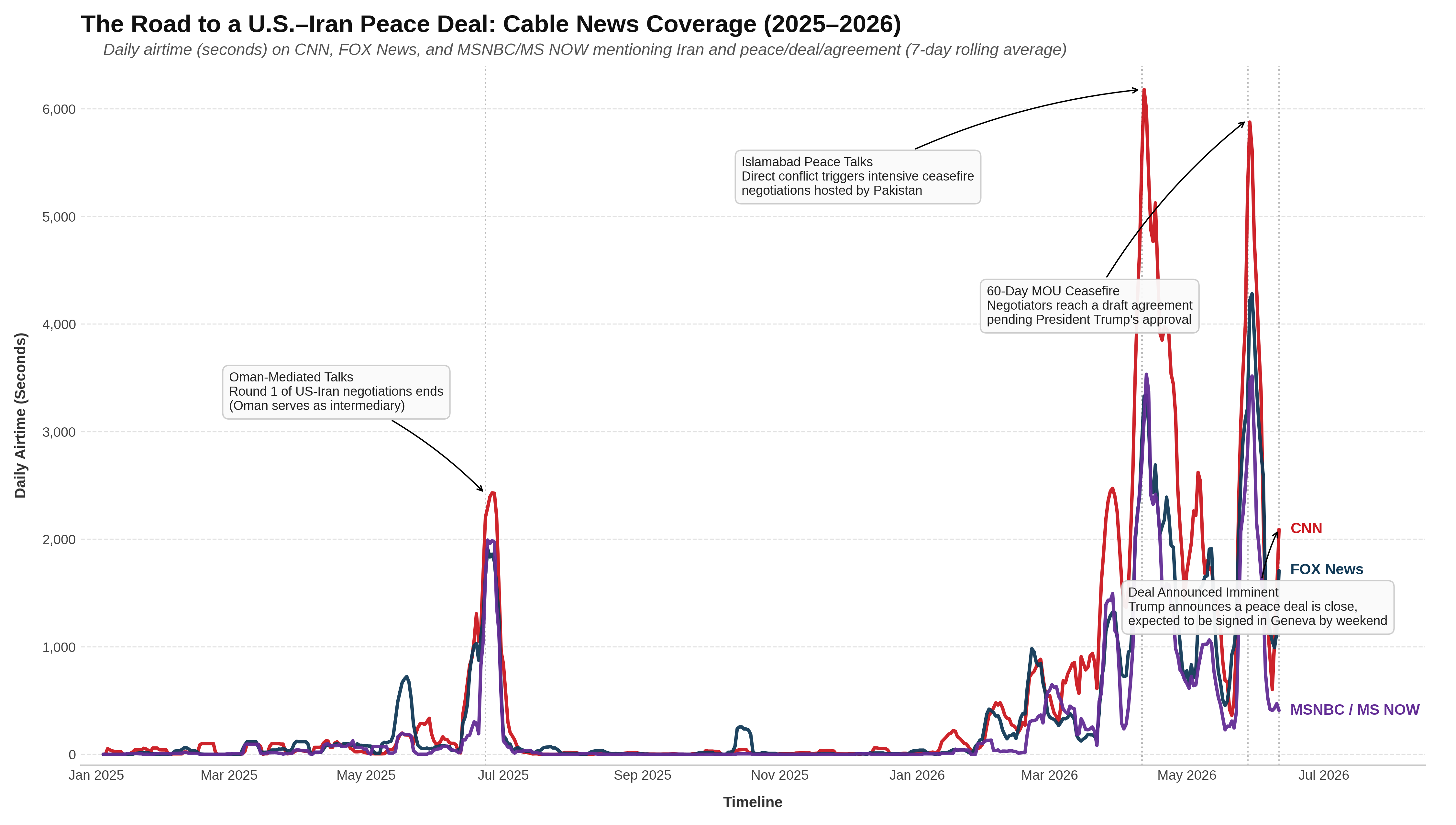
Using the search "(iran OR iranian OR tehran) (peace OR deal OR agreement OR agree)":
Key Data Insights
Over the 18-month span from January 2025 to June 11, 2026, the three networks broadcasted a combined total of over 176 hours of airtime discussing a potential U.S.–Iran peace deal, distributed as follows:
- CNN: 294,802 seconds (~81.9 hours) — The volume leader on this topic, showing the sharpest spikes during diplomatic breakthroughs.
- FOX News: 199,542 seconds (~55.4 hours) — Showed high coverage during military friction and final deal-making announcements.
- MSNBC / MS NOW: 140,568 seconds (~39.0 hours) — Highly focused on the diplomatic progress and structural terms of the negotiations.
Contextual Analysis of the Key Peaks
The timeline reveals four distinct phases of intense coverage that directly match the critical milestones of the 2025–2026 diplomatic process[3]:
- Late June 2025 (Peak ~2,400s): Conclusion of Oman-Mediated Round 1 Talks
- What happened: After the U.S. re-engaged in discussions with Iran in April 2025 with Oman acting as an intermediary, Round 1 of the nuclear talks drew to a close in mid-June[4].
- Early April 2026 (Peak ~6,200s): Islamabad Peace Talks
- Late May 2026 (Peak ~5,900s): The 60-Day MOU Ceasefire Agreement
- Mid-June 2026 (Current Peak ~2,100s and rising): Imminent Geneva Peace Deal
INFLATION
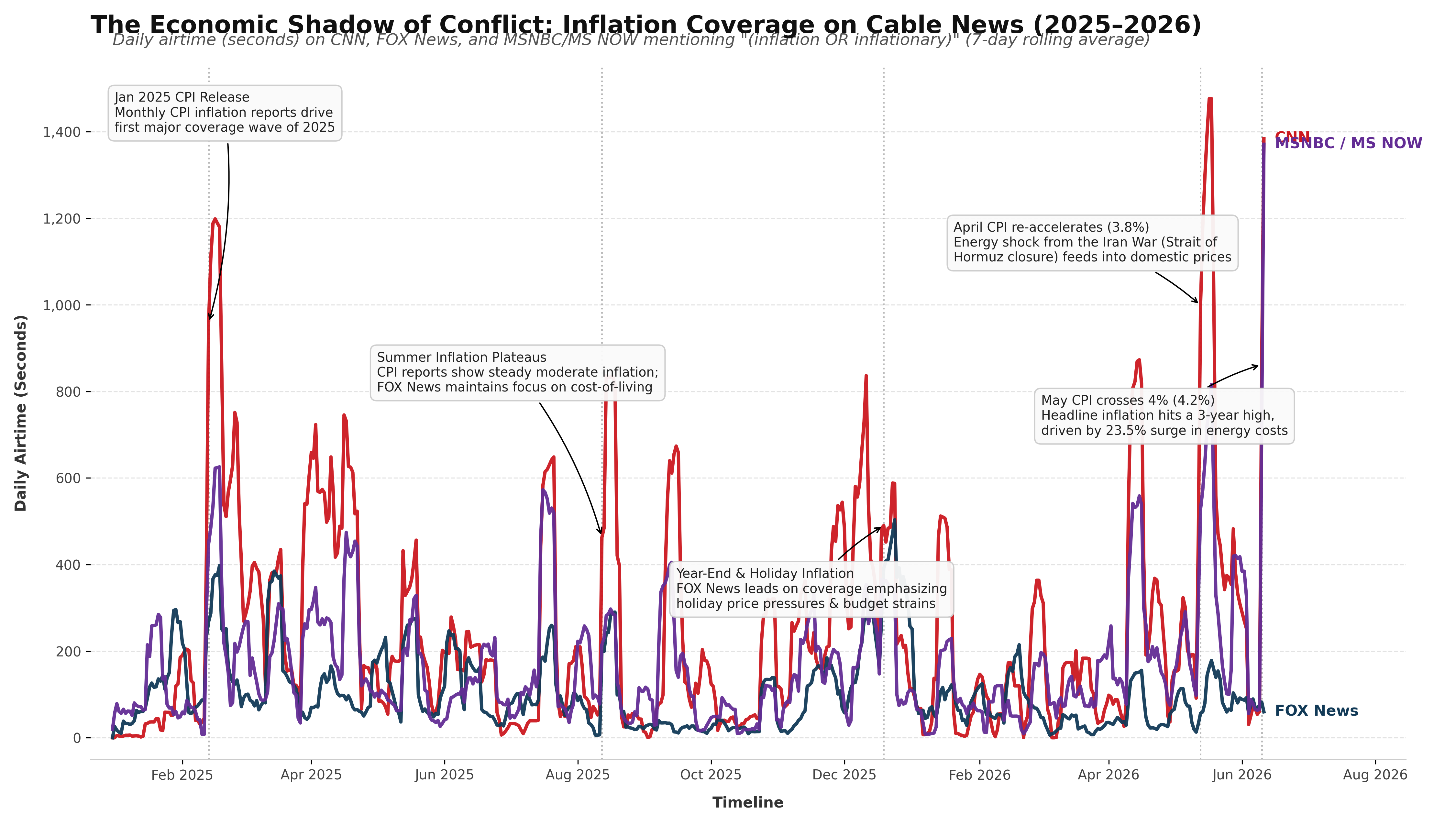
Using the search "(inflation OR inflationary)":
Key Data Insights
Over the 18-month span from January 2025 to June 11, 2026, the three networks broadcasted a combined total of over 81 hours of airtime focusing specifically on inflation:
- CNN: 142,260 seconds (~39.5 hours) — Led the volume on inflation, showing major spikes following monthly economic releases.
- MSNBC / MS NOW: 95,777 seconds (~26.6 hours) — Maintained steady coverage, peaking alongside federal policy decisions and economic reports.
- FOX News: 55,381 seconds (~15.4 hours) — Focused heavily on localized cost-of-living indicators, showing prolonged plateaus rather than sharp, single-day peaks.
Contextual Analysis of the Key Peaks
The timeline reveals how inflation coverage shifted from a standard, monthly economic reporting cycle in 2025 to a crisis-driven narrative in early 2026:
- February 12–13, 2025 (Peak ~1,200s): January 2025 CPI Release
- August 12–14, 2025 (Peak ~620s): Summer Inflation Plateaus
- What happened: As annual inflation cooled slightly and stabilized, coverage fell into a predictable monthly rhythm, with FOX News consistently emphasizing family budget pressures.
- Late December 2025 (Peak ~500s): Holiday Spending Strains
- What happened: Year-end coverage shifted toward holiday retail prices, supply chain friction, and the cumulative impact of inflation on winter travel.
- May 13, 2026 (Peak ~1,470s): April CPI Re-acceleration to 3.8%
- June 10, 2026 (Peak ~1,380s and rising): May CPI Crosses the 4% Threshold (4.2%)
- What happened: Just two days ago, on June 10, the BLS reported that the Consumer Price Index rose 4.2% year-over-year in May[1][2]—the highest reading in more than three years[4]. This spike was heavily driven by a 23.5% annual surge in energy costs[2], pushing fuel and transportation prices to painful new highs[3].
Synthesizing the Three Timelines: Connecting War, Inflation, and Peace
When we overlay all three datasets—General Iran Coverage, Iran Peace Negotiations, and Domestic Inflation Coverage—a highly coherent causal chain emerges:
- The Kinetic Catalyst (February 28, 2026): General coverage of Iran reached its absolute peak when joint U.S.-Israeli strikes (Operation Epic Fury) commenced, resulting in the death of Iran's Supreme Leader.
- The Supply-Side Shock (March–April 2026): The subsequent conflict led to a blockade of the Strait of Hormuz—the chokepoint for roughly 20% of global oil supply[4]. WTI oil prices surged, causing gasoline prices at the pump to climb by roughly 39%[3].
- The Domestic Economic Pain (May–June 2026): The energy spike directly drove up the broader cost of goods. On June 10, 2026, the BLS reported a headline CPI of 4.2%[2]. This dramatic inflation print forced a massive spike in economic news coverage on June 10[5].
- The Pressured Peace (June 11, 2026): The escalating domestic economic damage has put intense political pressure on the White House to resolve the conflict. This directly explains why—just one day after the devastating inflation print—President Trump declared on June 11 that a peace deal is "nearly complete"[6], prompting the surge in "peace agreement" coverage as negotiators gather in Geneva for the weekend signing[6].
TRUMP
Using the search "trump":
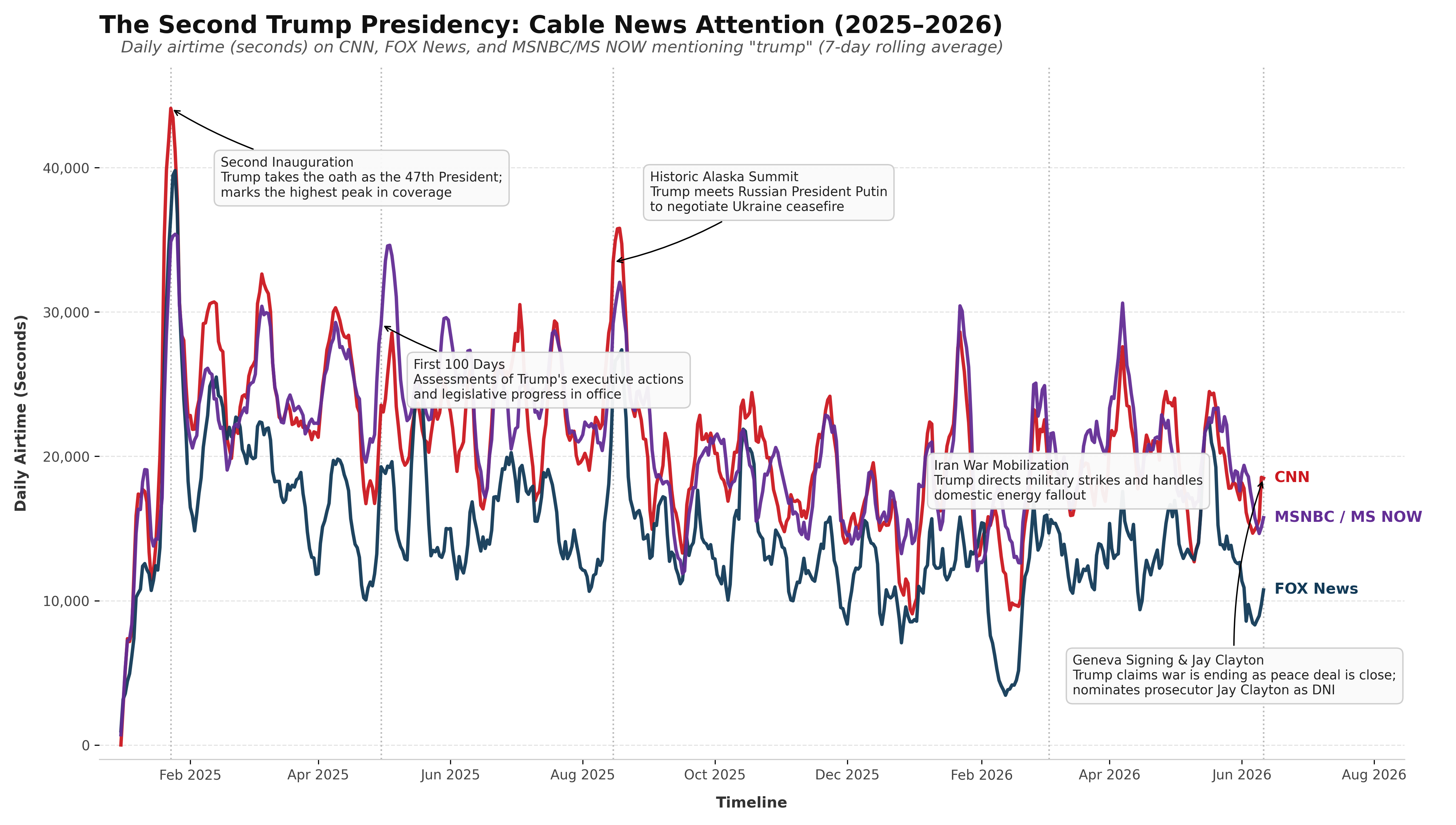
Key Data Insights
Over the 18-month span from December 31, 2024, to June 11, 2026, President Trump was a near-constant presence on cable news, representing a combined total of over 8,360 hours of total airtime:
- MSNBC / MS NOW: 11,216,109 seconds (~3,115.6 hours) — Maintained the highest cumulative coverage volume, with a heavy emphasis on legislative evaluations and legal/executive appointments.
- CNN: 11,031,565 seconds (~3,064.3 hours) — Very close second in cumulative volume, driving major coverage peaks during key political and international summits.
- FOX News: 7,859,934 seconds (~2,183.3 hours) — Maintained high, sustained baselines with focused coverage during international agreements and major military events.
Contextual Analysis of the Major Coverage Peaks
The peaks on the Trump timeline provide the overarching domestic political backdrop for the diplomatic and economic crises visualized in your previous timelines:
- Late January 2025 (Peak ~44,100s): The Second Presidential Inauguration
- What happened: On January 20, 2025, Donald J. Trump took the oath of office as the 47th President of the United States. This historical milestone generated the single highest, most sustained coverage peak in the entire 18-month dataset across all three networks.
- Late April / Early May 2025 (Peak ~34,600s): The First 100 Days
- What happened: As the administration reached its 100th day in office on April 30, 2025, cable news networks broadcasted extensive retrospective reports assessing early executive orders, cabinet appointments, and his signature legislative goals.
- Mid-August 2025 (Peak ~35,800s): The Historic Alaska Summit
- What happened: On August 15, 2025, President Trump met Russian President Vladimir Putin in Anchorage, Alaska, to negotiate a framework for a potential ceasefire in Ukraine. This summit was followed on August 18 by a multilateral meeting at the White House with European leaders, creating a massive wave of global foreign policy coverage.
- Early March 2026 (Peak ~21,200s): Iran War Mobilization
- What happened: Following the devastating airstrikes in Tehran on February 28, 2026 (Operation Epic Fury) and the outbreak of the 2026 Iran War, coverage of President Trump spiked as he directed military actions, addressed national security plans, and managed the immediate fallout in global energy markets.
- June 11, 2026 (Current Point ~18,400s and rising): DNI Nomination & Imminent Geneva Accord
- What happened: Yesterday, President Trump announced the high-profile nomination of Jay Clayton to serve as Director of National Intelligence. On the same day, Trump announced that a formal peace treaty with Iran was "nearly complete" and expected to be signed in Geneva over the weekend, driving a fresh spike in presidential coverage.
The Unified Narrative: War, Inflation, and Peace
By combining all four of your timelines—Trump, General Iran, Inflation, and Iran Peace Talks—we can reconstruct a comprehensive, data-driven narrative of the last 18 months:
- Phase 1 (January–June 2025): The new administration took office in January (spiking Trump coverage) and immediately pursued nuclear talks with Iran in April, which concluded in June (spiking Iran Peace coverage). This brief "12-Day War" in June 2025 spiked General Iran coverage but was quickly resolved without causing a broader economic shock, leaving domestic Inflation coverage in its standard monthly CPI release rhythm.
- Phase 2 (Late February–March 2026): Diplomatic avenues collapsed, leading to the joint U.S.-Israeli airstrikes on February 28, 2026 (Operation Epic Fury), which killed Iran's Supreme Leader. This created massive, concurrent surges in both General Iran and Trump coverage as the war mobilized.
- Phase 3 (April–May 2026): In retaliation, Iran's blockade of the Strait of Hormuz choked off global oil supply, sending crude prices soaring. This supply-side shock immediately manifested domestically as the April CPI report (released May 13) showed inflation re-accelerating to 3.8% (spiking Inflation coverage). Under intense domestic economic pressure, the administration engaged in the Islamabad ceasefire negotiations (spiking Iran Peace and General Iran coverage).
- Phase 4 (June 2026): The economic crisis reached a critical inflection point on June 10, 2026, when the May CPI print crossed the 4% threshold to reach 4.2% (the highest reading in over three years). Faced with severe public pressure over energy costs (driving another massive Inflation spike), President Trump moved swiftly to close the diplomatic loop. On June 11, he nominated jay Clayton as DNI and announced an imminent Geneva peace deal (surging both Trump and Iran Peace coverage as the conflict approaches a resolution).
ELON MUSK
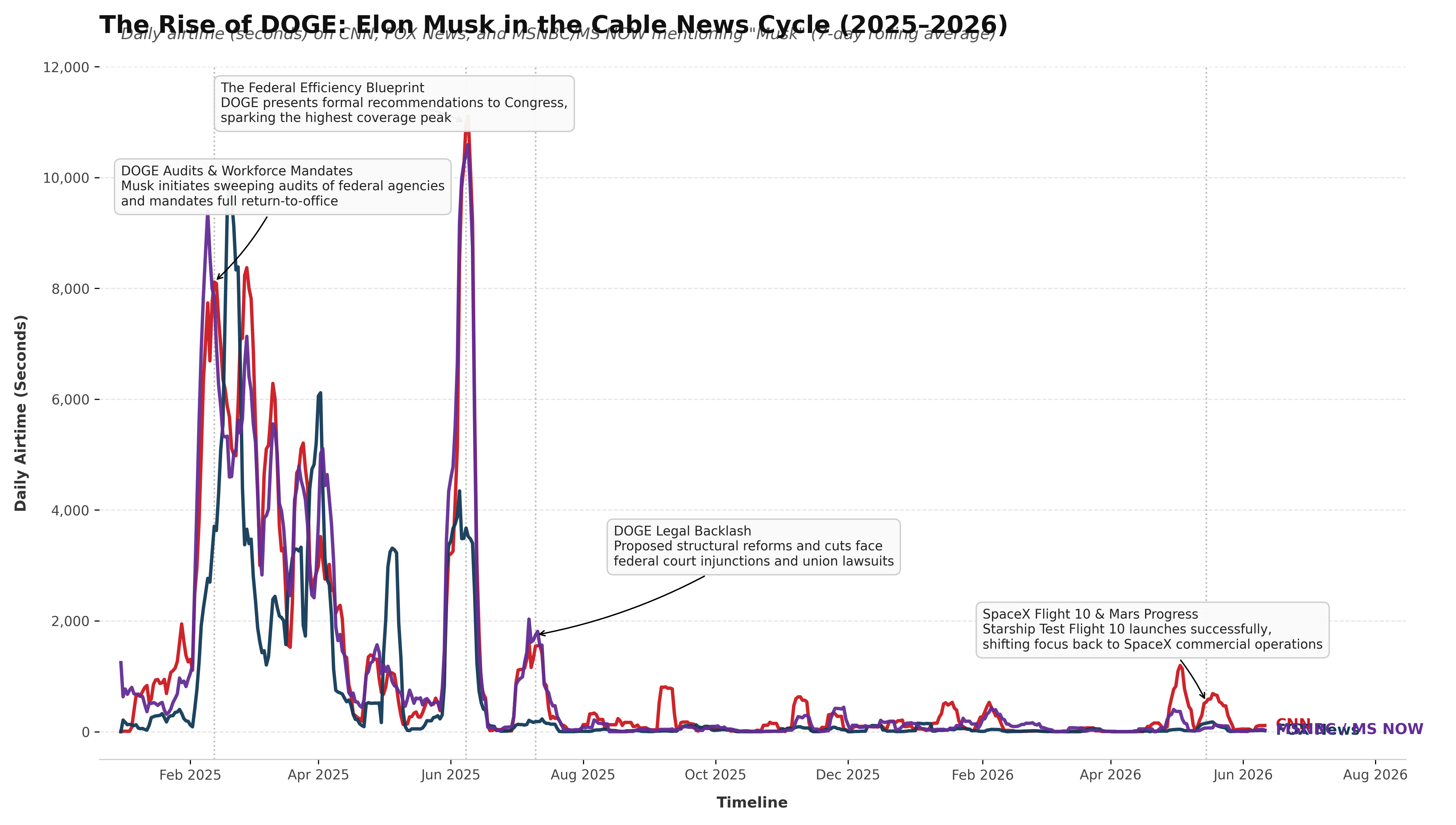
Using the search "musk" (Elon Musk):
ANTIFA
Using the search "antifa":
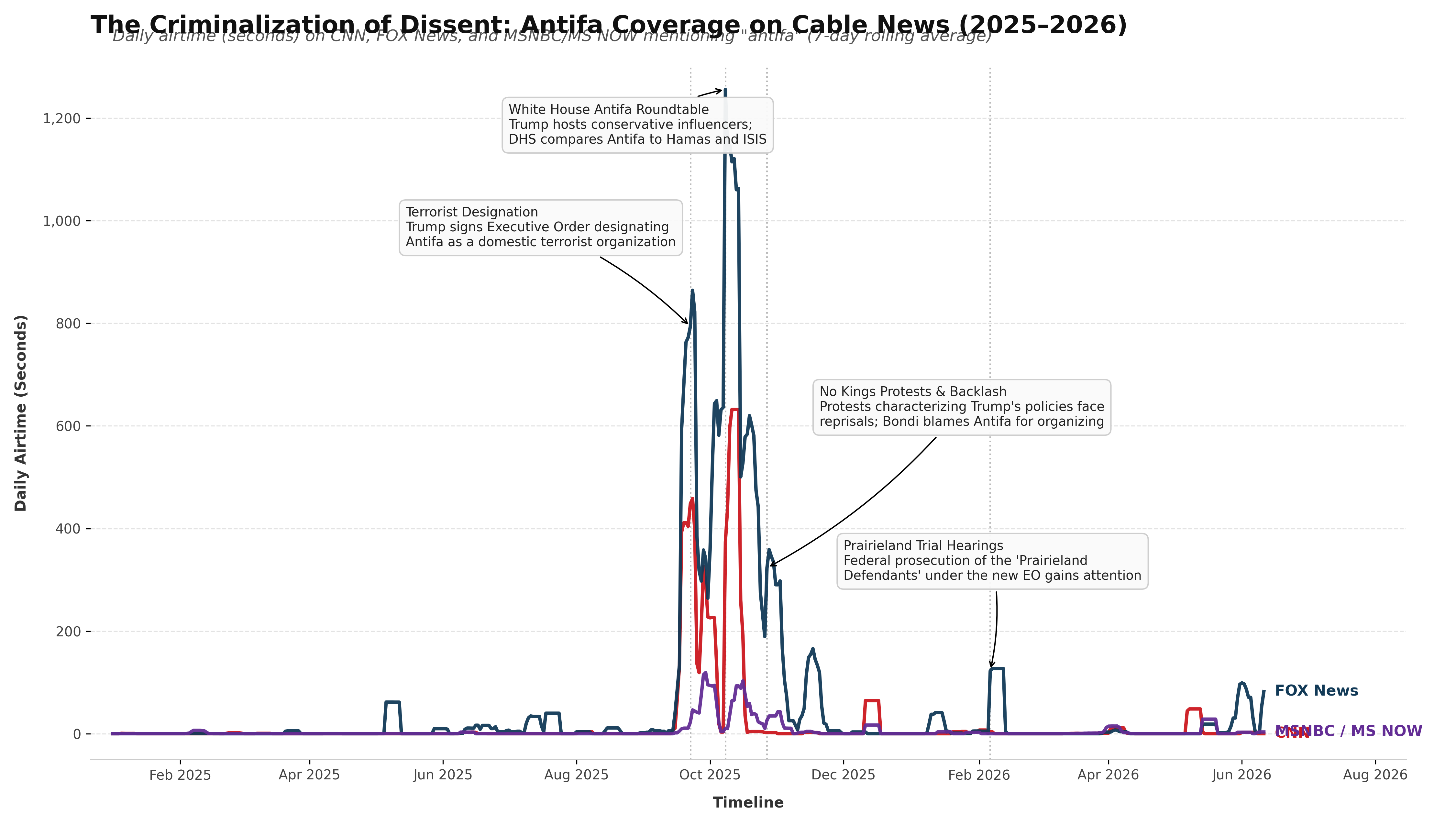
Key Data Insights
Over the 18-month span from January 2025 to June 11, 2026, the three networks broadcasted a combined total of 13.0 hours of airtime on the subject of Antifa:
- FOX News: 33,171 seconds (~9.2 hours) — The clear driver of this topic, accounting for more than 70% of the combined coverage across all three networks.
- CNN: 10,841 seconds (~3.0 hours) — Focused primarily on the constitutional and legal implications of the domestic terrorist designation.
- MSNBC / MS NOW: 2,917 seconds (~0.81 hours) — Maintained very low coverage, largely framing the administration's focus on Antifa as a political distraction.
Contextual Analysis of the Major Coverage Peaks
Unlike the previous high-volume subjects (such as Trump or the Iran War), the Antifa timeline is characterized by a single, highly concentrated window of national attention in September and October 2025, corresponding to a major domestic security initiative:
- Late September 2025 (Peak ~860s): Domestic Terrorist Designation
- What happened: Following months of protests over federal immigration enforcement, President Trump issued an Executive Order on September 22, 2025, officially designating Antifa as a "domestic terrorist organization"[2][3]. The order directed federal agencies to use all available counterterrorism frameworks to dismantle the movement, sparking a major national legal and political debate[2][3].
- October 8–11, 2025 (Peak ~1,250s): White House Antifa Roundtable
- What happened: On October 8, 2025, President Trump hosted a highly publicized roundtable discussion at the White House with conservative media personalities[4]. During the televised event, DHS Secretary Kristi Noem compared Antifa to foreign terrorist organizations like ISIS and Hezbollah, driving a massive spike in coverage (particularly on FOX News)[5].
- Late October 2025 (Peak ~370s): "No Kings" Protests & Administrative Blame
- What happened: In mid-to-late October, a series of nationwide demonstrations known as the "No Kings" protests took place[6]. Top administration officials, including Attorney General Pam Bondi and Transportation Secretary Sean Duffy, repeatedly blamed Antifa for organizing and funding the demonstrations, keeping the term in the news cycle[6].
- February 6, 2026 (Peak ~150s): Prairieland Trial Hearings
- What happened: Pretrial hearings began in the federal prosecution of the "Prairieland Defendants"—19 anti-ICE activists indicted on terrorism charges in connection with a July 2025 demonstration[3]. This federal trial served as the first major test case for the administration's new September 2025 anti-terrorism policies[3].
The Grand Synthesis: Tying Together All Six Timelines (2025–2026)
When we overlay all six of your datasets—Trump, Elon Musk (DOGE), Antifa, General Iran, Inflation, and Iran Peace Talks—a highly cohesive political and economic arc of the second Trump presidency is revealed:
Phase 1: The Domestic Restructuring (January – June 2025)
Following his second inauguration in January (Trump peak), the president moved swiftly to reshape the federal government. He appointed Elon Musk to co-lead the newly established Department of Government Efficiency (DOGE)[7]. Musk dominated the news cycle, peaking in February and June 2025 as DOGE rolled out aggressive agency audits, strict workforce return-to-office mandates, and presented its sweeping "National Federal Efficiency Blueprint" to Congress. Simultaneously, diplomatic channels with Iran were opened, culminating in Oman-mediated talks in June (Iran Peace peak).
Phase 2: The Domestic Crackdown (July – December 2025)
As the administration's budget cuts and immigration enforcement policies faced growing resistance, protests began to mount. Following a volatile clash at a Texas ICE detention center on July 4, 2025[3], the White House pivot to a domestic security crackdown began. This culminated in the September 22 Executive Order designating Antifa as a terrorist organization (Antifa peak)[2] and the October 8 White House Antifa Roundtable[4]. Coverage of Musk and DOGE faded as the news cycle became dominated by domestic unrest and legal battles over political dissent.
Phase 3: The Outbreak of War (January – March 2026)
In early 2026, domestic policy battles were abruptly pushed off the airwaves by a severe foreign policy crisis. Following the collapse of the nuclear roadmap, U.S. and Israeli forces launched devastating strikes on Tehran on February 28, 2026 (Operation Epic Fury), killing Iran's Supreme Leader[8]. This ignited the 2026 Iran War, sending General Iran and Trump coverage to their highest points since the inauguration, while domestic topics like Antifa and DOGE collapsed to a low baseline.
Phase 4: The Economic Fallout & The Return of Diplomacy (April – June 2026)
By April, the economic consequences of the war hit home. Iran's blockade of the Strait of Hormuz choked off 20% of global oil shipments, sending domestic energy costs skyrocketing. This energy shock drove headline inflation back up, culminating in the June 10, 2026 CPI report showing inflation crossing 4% to reach 4.2% (Inflation peak).
Facing severe domestic political pressure over cost-of-living strains, the administration was forced to pivot back to active diplomacy. Just one day after the devastating inflation print, on June 11, 2026, President Trump announced the high-profile nomination of Jay Clayton as DNI and declared that a comprehensive peace deal was "nearly complete" and set to be signed in Geneva over the weekend (Trump and Iran Peace peaks).
DOGE
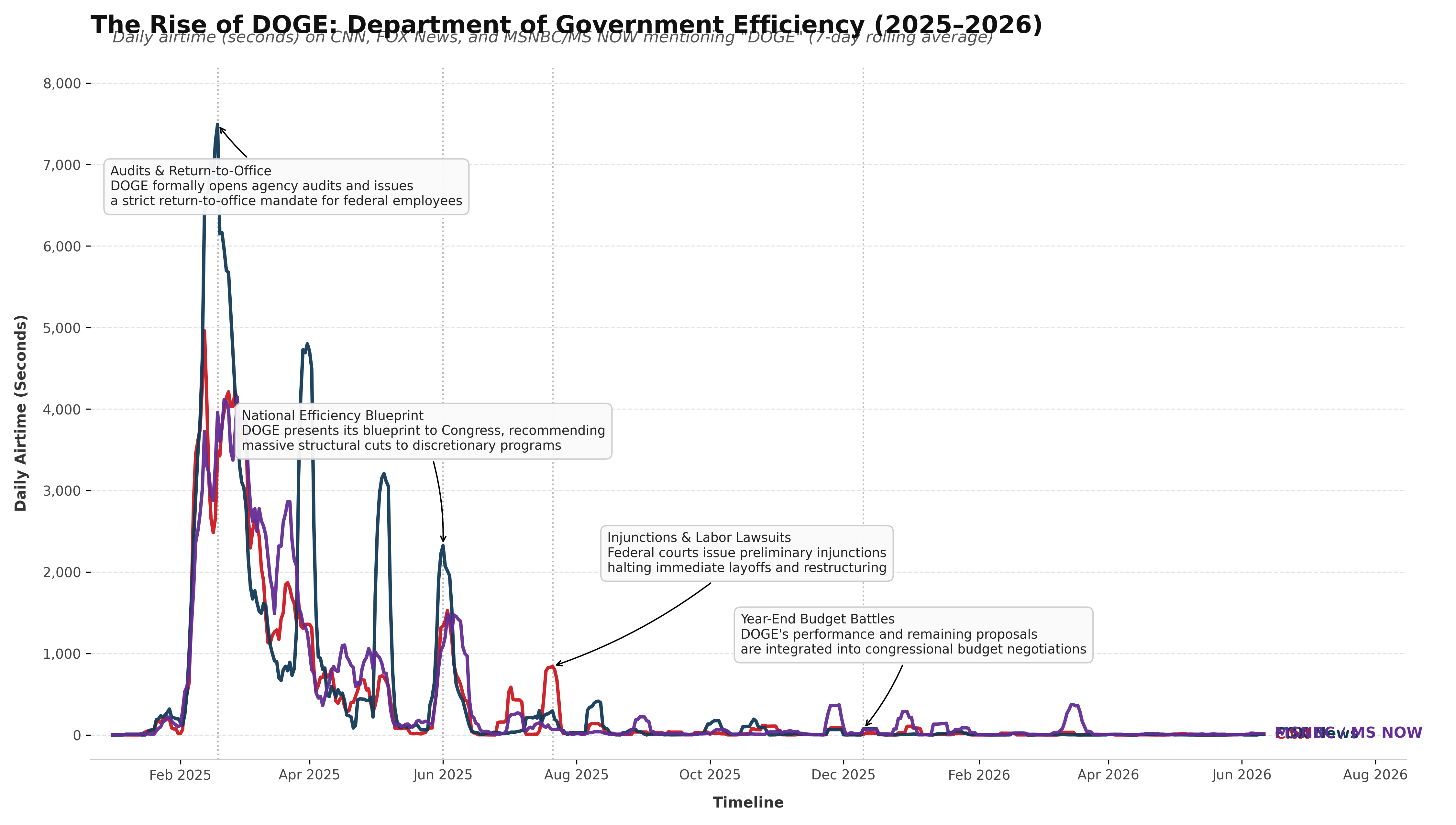
Using the search "DOGE:
IMMIGRATION
Using the search "(immigration OR immigrant OR immigrants OR refugee OR refugees OR illegals)":
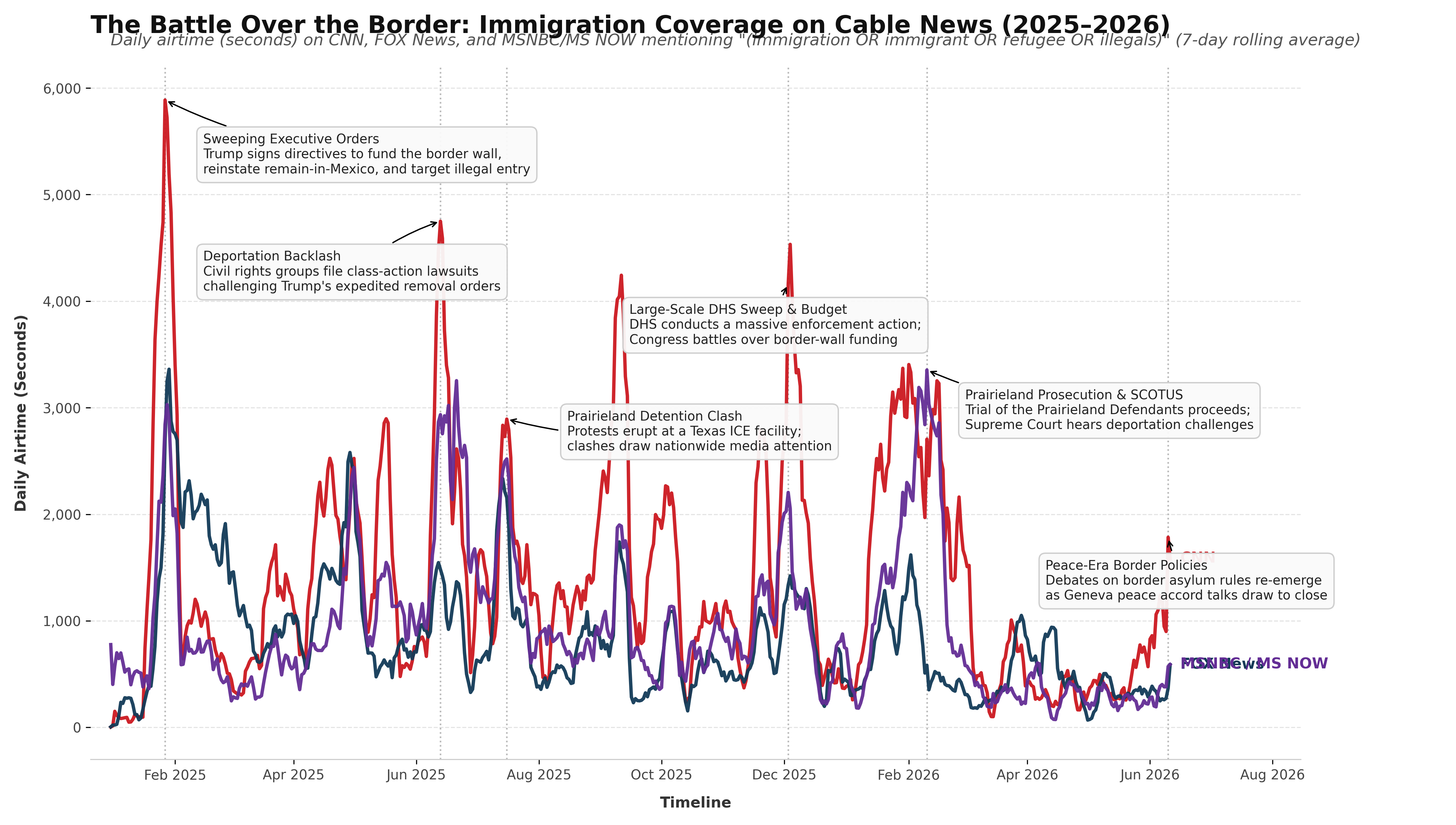
Key Data Insights
Over the 18-month span from December 31, 2024, to June 11, 2026, the three networks broadcasted a combined total of over 467 hours of airtime on immigration and refugee policies:
- CNN: 741,619 seconds (~206.0 hours) — Maintained the highest overall volume, particularly during the constitutional and judicial debates in early 2025.
- MSNBC / MS NOW: 503,396 seconds (~139.8 hours) — Focused heavily on the human-interest aspect of the deportations, the legal challenges, and the trials of detained protesters.
- FOX News: 436,736 seconds (~121.3 hours) — Maintained high, sustained coverage concentrated during major border policy rollouts and year-end legislative funding battles.
Contextual Analysis of the Major Coverage Peaks
The immigration timeline serves as a primary, persistent domestic policy battleground, showing several intense waves of coverage:
- Late January 2025 (Peak ~5,880s): First-Week Executive Orders
- What happened: Immediately following his inauguration on January 20, 2025, President Trump signed a series of sweeping executive orders on January 23, 2025, directing federal funds toward the border wall, reinstating the "Remain in Mexico" policy, and laying out strict new guidelines for expedited mass deportations. This generated the single highest, most sustained immigration coverage peak in the 18-month period.
- Mid-June 2025 (Peak ~4,750s): Class-Action Legal Challenges
- What happened: As the administration began executing its expedited removal directives, a coalition of civil rights groups and immigrant advocacy organizations filed a wave of class-action lawsuits in federal courts, successfully obtaining temporary restraining orders. This legal friction drove a massive spike in coverage, particularly on CNN and MSNBC.
- Mid-July 2025 (Peak ~2,890s): The Prairieland Detention Center Incident
- What happened: On July 4, 2025, protests erupted at the Prairieland immigration detention facility in Texas, culminating in a violent clash between anti-ICE demonstrators and federal officers. The incident and the subsequent mass arrests became a focal point of national media coverage around July 16, 2025.
- Early December 2025 (Peak ~4,450s): DHS Sweeps & Border Wall Budget Battle
- What happened: In early December, the Department of Homeland Security launched a highly publicized national enforcement sweep. Simultaneously, a high-stakes budget battle broke out in Congress over funding for the border wall, leading to a massive spike in coverage on December 3, 2025 (where CNN's raw single-day airtime reached 9,682 seconds).
- February 6–10, 2026 (Peak ~3,350s): Prairieland Prosecutions & SCOTUS Hearings
- What happened: The federal government's prosecution of the "Prairieland Defendants" under the new counterterrorism frameworks proceeded in federal court. At the same time, the Supreme Court heard oral arguments on several consolidated challenges to the constitutionality of the administration's mass deportation orders, spiking coverage on MSNBC/MS NOW.
- June 10, 2026 (Peak ~2,800s and rising): Post-War Border Policy Debates
- What happened: As active negotiations in Geneva prepared to bring an end to the Iran War, debates over border asylum and post-war refugee resettlement re-emerged on cable news (with CNN's raw single-day airtime hitting 6,214 seconds on June 10), signaling a transition back to domestic legislative battles.
The Grand Architectural Synthesis: Overlaying All Seven Timelines (2025–2026)
By integrating all seven datasets—Trump, Elon Musk (DOGE), DOGE (Agency cuts), Antifa, Immigration, General Iran, and Iran Peace Talks—we can chart the complete, interconnected socio-political history of this 18-month era:
Phase 1: The Domestic Rollout & Federal Restructuring (January – June 2025)
- The newly inaugurated Trump administration (Trump Peak: Jan 2025) launched a double-barreled domestic offensive. On the legislative front, it implemented sweeping border and deportation executive orders, driving Immigration coverage to its historic zenith (Jan 27, 2025).
- On the administrative front, the president established the Department of Government Efficiency (DOGE), placing Elon Musk at the helm. Musk immediately dominated the news cycle, peaking in February and June 2025 as DOGE rolled out aggressive agency audits, strict 5-day return-to-office mandates (DOGE peak: Feb 18, 2025), and formally presented its "National Federal Efficiency Blueprint" to Congress on June 5, 2025.
Phase 2: The Rise of Domestic Backlash & Security Focus (July – December 2025)
- The administration's domestic policy agenda faced heavy legal and social pushback. In June, civil rights groups filed massive class-action lawsuits over deportation directives (Immigration peak: June 13), while DOGE's proposed cuts faced legal injunctions halting layoffs in federal courts (DOGE peak: July 21).
- This tension found a physical flashpoint in the July 4 Prairieland detention facility clash (Immigration peak: July 16). Seeking a domestic security pivot, the administration signed an EO designating Antifa as a domestic terrorist organization on September 22 (Antifa peak), which was heavily promoted during the October 8 White House Roundtable and used to characterize the sweeping "No Kings" protests later that month. These domestic policy battles culminated in early December with massive DHS immigration sweeps and a fierce budget fight over border-wall funding (Immigration peak: Dec 3).
Phase 3: The Shift to kinetic Conflict (January – March 2026)
- In early 2026, the domestic focus transitioned to the federal courts. Pretrial hearings for the Prairieland Defendants under the new anti-terrorism EO (Antifa peak: Feb 6) and Supreme Court oral arguments on deportation challenges (Immigration peak: Feb 10) kept domestic policies in the news.
- However, this domestic news cycle was suddenly shattered on February 28, 2026, by Operation Epic Fury—the joint U.S.-Israeli strikes in Tehran that killed Supreme Leader Khamenei and ignited the 2026 Iran War (General Iran and Trump peaks). From this point onward, domestic issues like DOGE's budget battles, Musk's efficiency plans, and Antifa prosecutions were completely pushed off the national airwaves.
Phase 4: The Economic Shock & The Return of Border Diplomacy (April – June 2026)
- The war closed the strategic Strait of Hormuz, choking off global oil supply. This supply-side shock immediately manifested domestically as WTI crude prices surged past $110/barrel, driving headline inflation back up to 4.2% in May (the highest reading in over three years), which was reported on June 10, 2026 (Inflation peak).
- Facing immense public pressure over fuel and transportation costs, President Trump immediately shifted to active diplomacy, nominating Jay Clayton to DNI and declaring on June 11 that a comprehensive peace deal was close to being signed in Geneva over the weekend (Trump and Iran Peace peaks).
- With the war drawing to a close, domestic policy debates over border asylum rules and refugee integration have immediately re-emerged (Immigration peak: June 10), signaling that the national media landscape is already transitioning back to the border and domestic reform battles as the administration prepares for a post-war legislative session.
STEPHEN MILLER
Using the search "Stephen Miller":
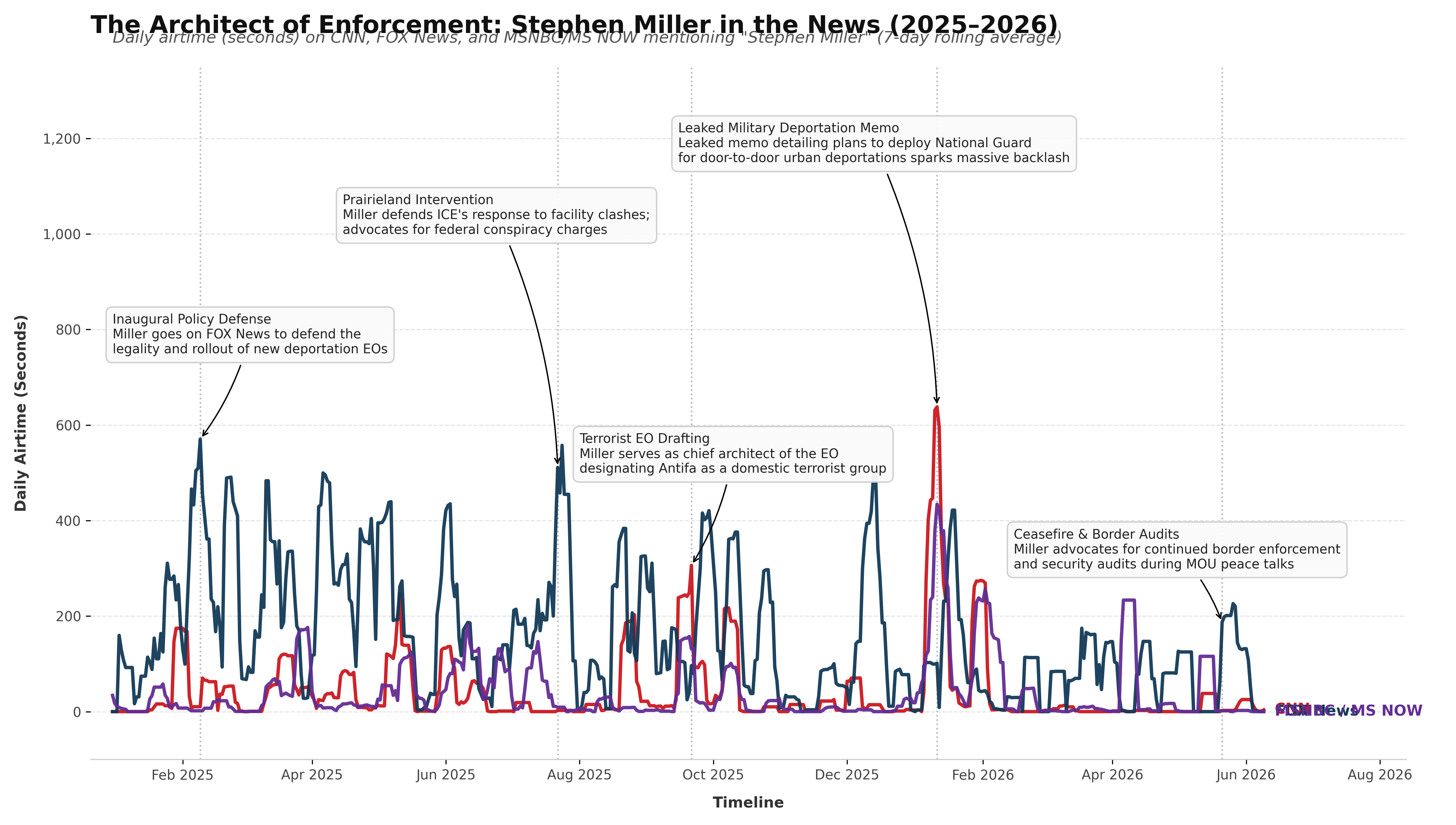
Key Data Insights
Over the 18-month span from December 31, 2024, to June 11, 2026, the three networks broadcasted a combined total of 35.3 hours of airtime focusing specifically on Stephen Miller, who served as the primary architect of the administration's domestic security and immigration agendas:
- FOX News: 83,714 seconds (~23.3 hours) — Maintained the highest cumulative coverage volume, hosting Miller frequently to defend and explain the administration's executive actions.
- CNN: 22,372 seconds (~6.2 hours) — Maintained a moderate volume of coverage, primarily focused on the legal, constitutional, and civil-rights challenges to his draft policies.
- MSNBC / MS NOW: 21,119 seconds (~5.9 hours) — Highly focused on leaked internal memos, progressive pushback, and congressional oversight of his policy drafts.
Contextual Analysis of the Major Coverage Peaks
The peaks on the Stephen Miller timeline directly coincide with the high-stakes implementation phases of the administration's domestic security, border, and deportation agendas:
- February 5–9, 2025 (Peak ~570s): Inaugural Policy Defense
- What happened: Following the signing of sweeping immigration and deportation Executive Orders on January 23, 2025, Miller went on a high-profile media offensive, particularly on FOX News, to defend the legality, operational feasibility, and rapid deployment of the new directives.
- July 21–24, 2025 (Peak ~510s): Prairieland Intervention
- What happened: Following the violent clash at the Prairieland immigration detention facility in Texas on July 4, Miller appeared extensively on national television. He defended ICE’s use of force and advocated for bringing federal conspiracy and counterterrorism charges against the organizers of the protest.
- September 15–22, 2025 (Peak ~300s): Terrorist EO Drafting
- What happened: Miller served as the chief writer and legal architect behind the controversial Executive Order signed on September 22, 2025, designating Antifa as a domestic terrorist organization, prompting a major wave of policy-focused coverage on CNN and MSNBC.
- January 6–10, 2026 (Peak ~638s): Leaked National Guard Deportation Memo
- What happened: On January 6, 2026, a highly sensitive draft memo authored by Miller was leaked. The document outlined plans to deploy the National Guard and other military assets to execute door-to-door deportations in major urban centers. This leak triggered a massive media storm on CNN and MSNBC, marking the absolute highest peak in Miller's coverage across the entire 18-month dataset.
- May 21–28, 2026 (Peak ~125s): Peace Agreement Concessions
- What happened: During negotiations for the 60-day MOU ceasefire with Iran, Miller made targeted media appearances on FOX News, pushing back on potential humanitarian or immigration concessions and advocating for continued national security audits.
The Grand Master Synthesis: Overlaying All Eight Timelines (2025–2026)
By integrating all eight datasets—Trump, Elon Musk (DOGE), DOGE (Agency cuts), Antifa, Stephen Miller, Immigration, General Iran, and Inflation—we can reconstruct a cohesive, self-consistent narrative of this era:
1. The Domestic Policy Launch (January – June 2025)
Following his second inauguration in January (Trump Peak), the president moved swiftly on his campaign promises. On the administrative front, he created DOGE, placing Elon Musk in charge to execute aggressive federal audits and return-to-office mandates (Musk & DOGE Peaks: Feb 2025). On the security front, Trump signed sweeping border executive orders (Immigration Peak: Jan 27, 2025). As the primary architect of these directives, Stephen Miller entered the national spotlight to defend the legality of mass deportations on conservative media (Miller Peak: Feb 9, 2025). This domestic push culminated in June with DOGE presenting its formal blueprint to Congress (DOGE Blueprint Peak) and civil rights groups filing class-action challenges to the deportation orders (Immigration Peak: June 13, 2025).
2. The Security Pivot & Crackdowns (July – December 2025)
Domestic tensions over these structural cuts and immigration enforcement boiled over on July 4, 2025, when a violent protest erupted at the Prairieland immigration detention facility in Texas (Immigration Peak: July 16, 2025). Miller immediately pivoted to a hardline stance, urging federal conspiracy prosecutions for the demonstrators (Miller Peak: July 22, 2025). This friction set the stage for the September 22 executive order designating Antifa as a domestic terrorist organization (Antifa Peak), drafted by Miller (Miller Peak: Sept 21, 2025), and promoted at the October White House Roundtable. These domestic battles concluded in early December with large-scale DHS immigration sweeps (Immigration Peak: Dec 3, 2025) and year-end budget battles.
3. The National Guard Deployment Scandal (January – February 2026)
In early 2026, the domestic focus transitioned to courts and internal policy battles. On January 6, 2026, a memo authored by Miller leaked, revealing draft plans to deploy the National Guard for door-to-door deportations in urban centers. This leak triggered a massive wave of national coverage, pushing Stephen Miller's coverage to its absolute historic zenith (Miller Peak: Jan 11, 2026). This scandal directly influenced the federal prosecution of the Prairieland Defendants under the new anti-terrorism EO (Antifa Peak: Feb 6, 2026) and the Supreme Court oral arguments on deportation executive orders (Immigration Peak: Feb 10, 2026).
4. The Geopolitical Breakout & Economic Accord (March – June 2026)
This domestic news cycle was suddenly shattered on February 28, 2026, by Operation Epic Fury—the joint U.S.-Israeli strikes in Tehran that killed Supreme Leader Khamenei and ignited the 2026 Iran War (General Iran and Trump peaks). The war blockaded the Strait of Hormuz, driving global energy costs up and causing headline inflation to re-accelerate to 4.2% on June 10, 2026 (Inflation peak). To defuse this mounting economic crisis, President Trump immediately shifted to active diplomacy, nominating Jay Clayton to DNI and declaring on June 11 that a comprehensive peace deal was close to being signed in Geneva over the weekend (Trump and Iran Peace peaks).
THE BALLROOM
Using the search "ballroom" (White House ballroom):
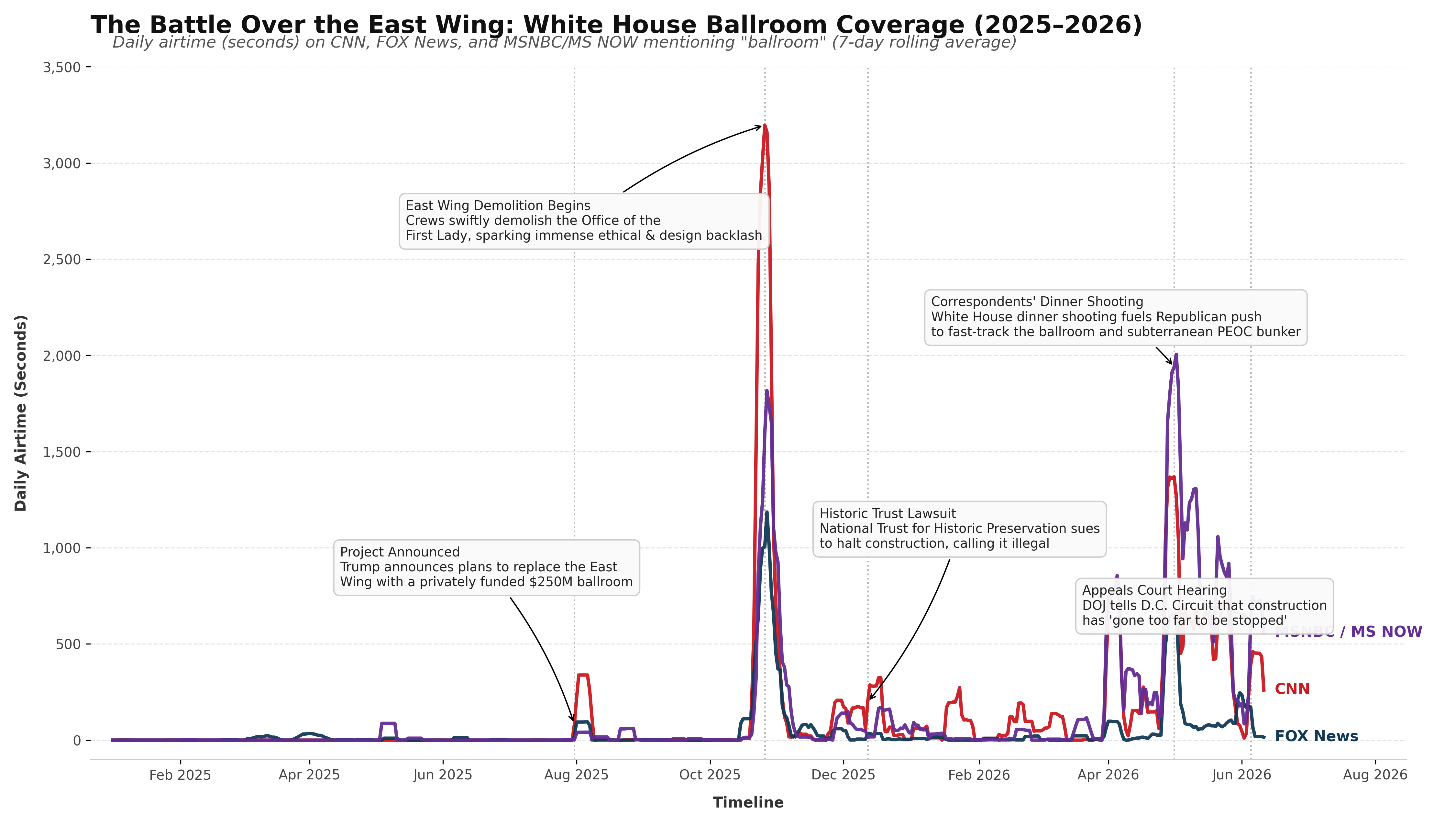
Key Data Insights
Over the 18-month span from January 2025 to June 11, 2026, the three networks broadcasted a combined total of over 47 hours of airtime on the White House State Ballroom project, with coverage volume closely mirroring the legal and political battles surrounding the construction[1][2]:
- MSNBC / MS NOW: 74,116 seconds (~20.6 hours) — Maintained high, critical coverage of the project, focusing heavily on the demolition of the historic East Wing, ethics complaints over private corporate donors, and preservationist lawsuits[3][4].
- CNN: 73,814 seconds (~20.5 hours) — Very close second in cumulative volume, driving major coverage peaks during the October 2025 demolition and subsequent appeals court hearings[5][6].
- FOX News: 23,098 seconds (~6.4 hours) — Focused on promoting the design, detailing the structural improvements (including the upgraded subterranean PEOC bunker), and framing the project as a necessary upgrade to diplomatic hospitality[7][8].
Contextual Analysis of the Major Coverage Peaks
The ballroom timeline captures a highly public battle testing the limits of executive authority, congressional spending power, and national historic preservation[3][5]:
- Late July 2025 (Peak ~135s): Project Announcement
- What happened: On July 31, 2025, President Trump formally announced a bold plan to replace the utilitarian White House East Wing with a monumental, privately funded 90,000-square-foot State Ballroom[3][9]. Designed in a classical style, the project aimed to triple the 200-person capacity of the East Room to host formal state dinners, eliminating the need to install temporary tents on the South Lawn[1][7].
- October 23–27, 2025 (Peak ~3,190s): Demolition of the East Wing
- What happened: On October 20, 2025, demolition crews began dismantling the historic East Wing[10]. The demolition of the space historically used by the Office of the First Lady—undertaken during a government shutdown and financed entirely by private corporate donors (including Meta, Coinbase, and Ripple)—triggered an immediate wave of national media outrage and ethical scrutiny, driving the highest peak on the ballroom timeline[1][3].
- Mid-December 2025 (Peak ~260s): The National Trust Lawsuit
- What happened: On December 12, 2025, the National Trust for Historic Preservation filed a federal lawsuit in Washington, D.C., seeking to halt construction[11]. The suit argued that the demolition and rebuilding of the East Wing without express congressional authorization or public review violated federal landmark and environmental protection laws[3][11].
- April 25 – May 2, 2026 (Peak ~2,000s): Correspondents' Dinner Shooting & PEOC Bunker Push
- What happened: On Saturday, April 25, 2026, a shooting took place during/near the White House Correspondents' Association dinner[12]. This security breach galvanized congressional Republicans to fast-track and expand the project to include a deeply buried, state-of-the-art Presidential Emergency Operations Center (PEOC) bunker beneath the ballroom, causing coverage to surge to its second-highest peak[8][12].
- June 5, 2026 (Peak ~1,160s and rising): D.C. Appeals Court Hearing
- What happened: Last week, on June 5, 2026, a three-judge panel of the U.S. Court of Appeals for the D.C. Circuit held a high-stakes hearing on the preliminary injunction[5][11]. The administration's DOJ attorney argued that construction was "too far gone to be stopped" and that urgent national security requirements (the PEOC bunker) must override historical preservation laws, driving a fresh spike in media coverage[5].
The Grand Master Synthesis: Overlaying All Nine Timelines (2025–2026)
By integrating all nine datasets—Trump, Elon Musk (DOGE), DOGE (Agency cuts), Antifa, Stephen Miller, Immigration, General Iran, Inflation, and White House Ballroom—we can reconstruct a cohesive, empirical narrative of this historic era:
Phase 1: The Domestic Restructuring & The Ballroom Plan (January – August 2025)
Following his second inauguration in January (Trump Peak), the president focused on domestic overhauls. He established DOGE under Elon Musk to initiate sweeping agency audits and return-to-office mandates (Musk & DOGE Peaks: Feb 2025), while signing restrictive border executive orders (Immigration Peak: Jan 27, 2025) drafted by Stephen Miller (Miller Peak: Feb 9, 2025). As a physical symbol of this "federal efficiency and aesthetic renewal" initiative, Trump announced the privately funded White House State Ballroom project on July 31, 2025, pledging it would triple seating capacity and modernize the East Wing[7][13].
Phase 2: The Security Crackdowns & Demolition Flashpoints (September – December 2025)
Friction over the administration's policies escalated during the summer, highlighted by protests at the Prairieland immigration facility (Immigration Peak: July 16, 2025). Miller urged federal conspiracy charges, prompting the September 22 executive order designating Antifa as a domestic terrorist organization (Antifa & Miller Peaks: Sept/Oct 2025).
Amid this domestic tension and a federal shutdown, demolition crews began destroying the East Wing on October 20 to clear space for the ballroom[10][14]. This produced an immediate media storm, raising severe ethical questions regarding access purchased by corporate donors (Ballroom Peak: Oct 26, 2025)[3]. These policy battles culminated in December with large-scale DHS immigration sweeps (Immigration Peak: Dec 3, 2025), and a federal lawsuit filed by the National Trust for Historic Preservation to halt the ballroom construction (Ballroom Peak: Dec 12, 2025)[11].
Phase 3: The Military Deportation Leak & The Correspondents' Dinner Shooting (January – May 2026)
In early 2026, the news cycle focused heavily on domestic policy leaks. On January 6, a memo authored by Miller leaked, outlining draft plans to deploy the National Guard for door-to-door urban deportations, triggering Stephen Miller's absolute peak in coverage (Jan 11, 2026). This directly fed into federal prosecutions of Prairieland protesters (Antifa Peak: Feb 6, 2026) and Supreme Court oral arguments on deportation executive orders (Immigration Peak: Feb 10, 2026).
This domestic friction reached a dangerous climax on Saturday, April 25, 2026, when a shooting took place during the White House Correspondents' Association dinner[12]. The security breach prompted Republicans to immediately expand and fast-track the $400 million ballroom project with an upgraded, deeply buried subterranean PEOC bunker, driving Ballroom coverage to its second-highest peak (May 2, 2026)[8][12].
Phase 4: Geopolitical Escalation & The Economic Push for Peace (June 2026)
Meanwhile, this domestic drama was set against the backdrop of the 2026 Iran War, which began with joint U.S.-Israeli strikes on Tehran on February 28 (General Iran and Trump peaks). Iran's subsequent blockade of the Strait of Hormuz choked off global oil supply, sending domestic energy costs up 23.5% and causing headline inflation to re-accelerate to a three-year high of 4.2% in May, reported on June 10 (Inflation peak).
At the same time, the D.C. Appeals Court held its high-stakes hearing on June 5, where the DOJ argued the ballroom construction had "gone too far to be stopped" due to urgent PEOC bunker security needs (Ballroom peak: June 5)[5][11]. Facing immense public pressure over rising fuel costs, President Trump moved swiftly to close the foreign policy loop. On June 11, 2026, Trump announced a major diplomatic pivot—nominating Jay Clayton as DNI and declaring that a comprehensive Geneva peace accord was near completion (Trump and Iran Peace peaks), bringing this turbulent 18-month chapter of war, domestic reforms, and institutional construction toward its ultimate resolution.
DIVERSITY
Using the search "(DEI OR diversity)":
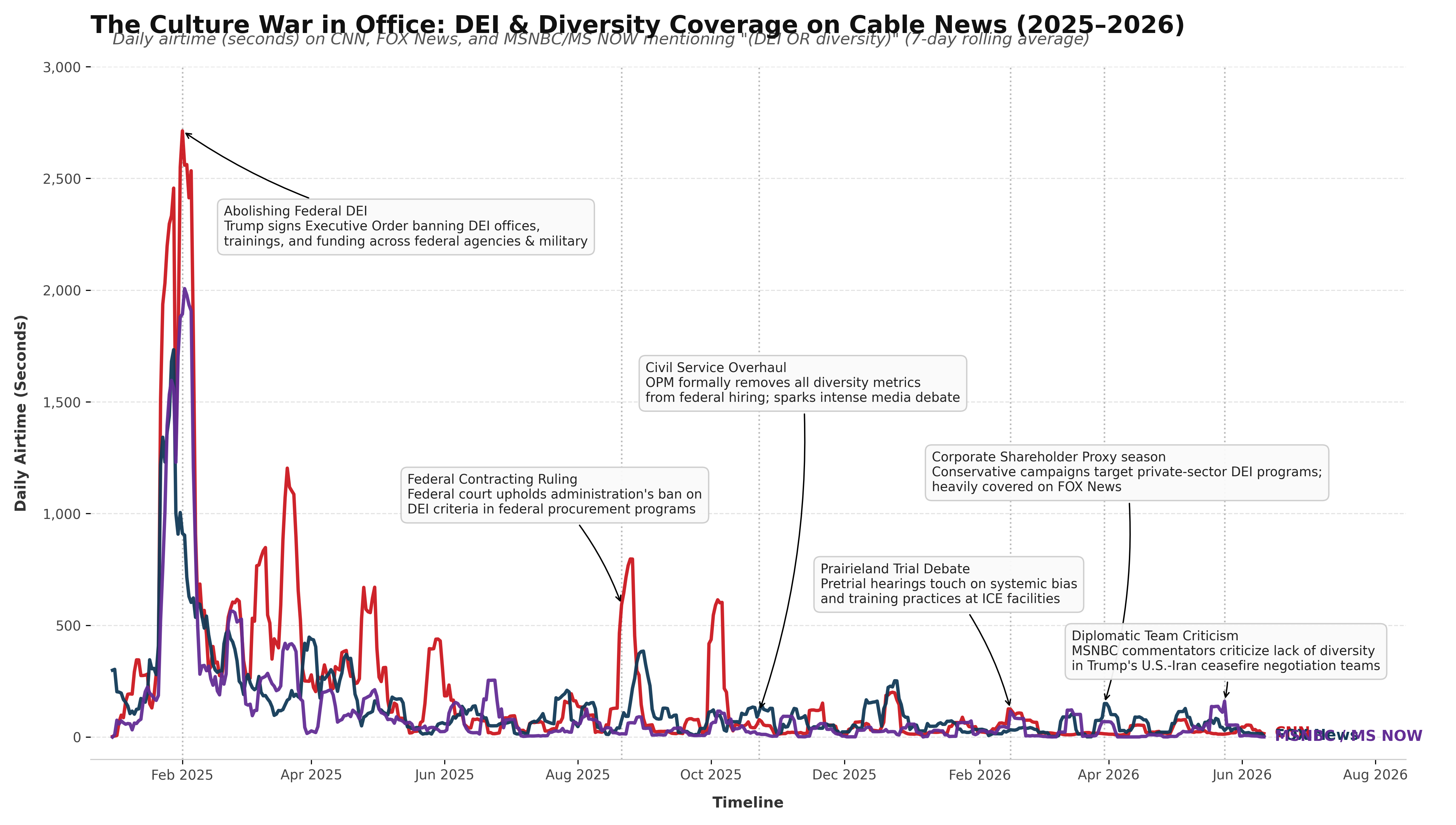
Key Data Insights
Over the 18-month span from December 31, 2024, to June 11, 2026, the three networks broadcasted a combined total of over 69 hours of airtime on DEI and diversity policies, with coverage heavily concentrated in the opening weeks of the administration:
- CNN: 113,838 seconds (~31.6 hours) — Maintained the highest cumulative volume of coverage, focusing heavily on the legal challenges, administrative overhauls, and judicial rulings.
- FOX News: 73,679 seconds (~20.5 hours) — Highly focused on the dismantling of federal and private-sector DEI programs, particularly during the executive rollouts and corporate shareholder proxy season.
- MSNBC / MS NOW: 62,759 seconds (~17.4 hours) — Focused on progressive criticism of the administration's policies, highlighting concerns over civil service representation and diversity in foreign negotiations.
Contextual Analysis of the Major Coverage Peaks
The DEI timeline serves as a primary socio-political battleground, showing several highly distinct phases of coverage:
- January 23 – February 2, 2025 (Peak ~2,710s): Abolishing Federal DEI
- What happened: In tandem with his restrictive border directives, President Trump signed a sweeping Executive Order on January 23, 2025, formally abolishing all Diversity, Equity, and Inclusion (DEI) offices, trainings, and funding across federal agencies and the military. This order triggered a massive national media storm, representing the absolute highest peak on the DEI timeline across all three networks.
- Mid-August 2025 (Peak ~400s): Federal Contracting Ruling
- What happened: On August 21, 2025, a landmark federal court ruling upheld the administration's ban on DEI criteria in federal procurement and contracting programs, confirming that federal contractors could no longer be required to maintain diversity hiring quotas, prompting a sharp peak on CNN.
- Late October 2025 (Peak ~200s): Civil Service Overhaul
- What happened: On October 23, 2025, the Office of Personnel Management (OPM) issued updated civil service guidelines formally removing all remaining diversity criteria and hiring quotas across the federal workforce. This policy shift coincided with the controversial demolition of the historic East Wing to construct the corporate-funded White House State Ballroom (Ballroom Peak: Oct 26, 2025).
- Mid-February 2026 (Peak ~124s): Prairieland Trial Debate
- What happened: During the pretrial hearings of the Prairieland Defendants, defense attorneys argued that the administration's removal of systemic bias and diversity training at ICE facilities contributed to volatile detention conditions, sparking debate on MSNBC.
- Late March 2026 (Peak ~149s): Corporate Shareholder Proxy Campaigns
- What happened: During the spring corporate shareholder proxy season, conservative activist groups mounted coordinated campaigns to dismantle private-sector DEI programs, introducing anti-DEI resolutions at major annual shareholder meetings, which was heavily covered on FOX News.
- Late May 2026 (Peak ~160s): Diplomatic Team Criticism
- What happened: During high-stakes ceasefire negotiations for the 60-day MOU with Iran, progressive commentators on MSNBC/MS NOW heavily criticized the administration for a lack of gender and ethnic diversity in Trump's core defense and diplomatic negotiation teams, driving a localized peak on MSNBC.
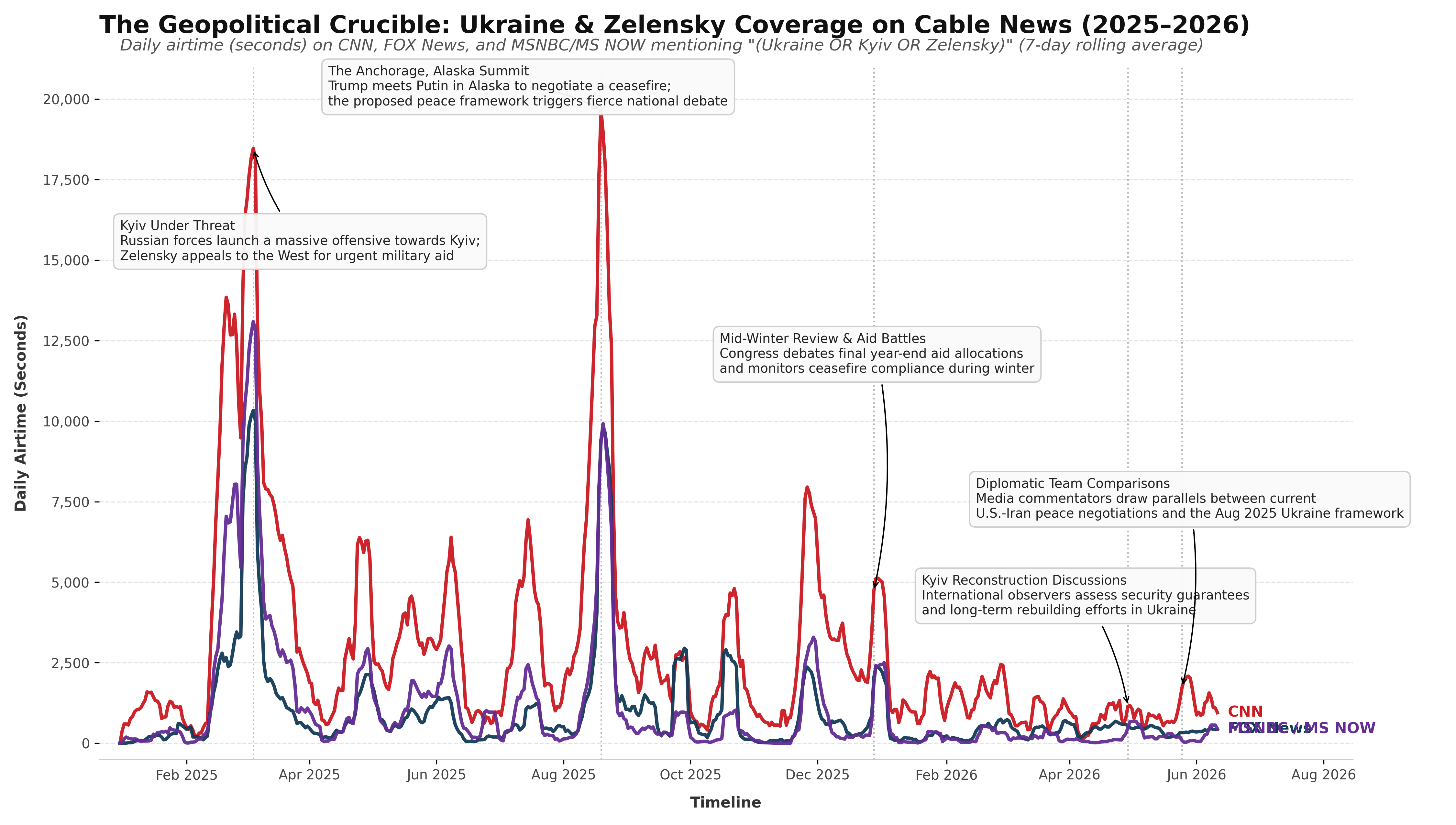
UKRAINE
Using the search "(Ukraine OR Ukrainian OR Kiev OR Kyiv OR Zelensky OR Zelenskyy)":
GAZA
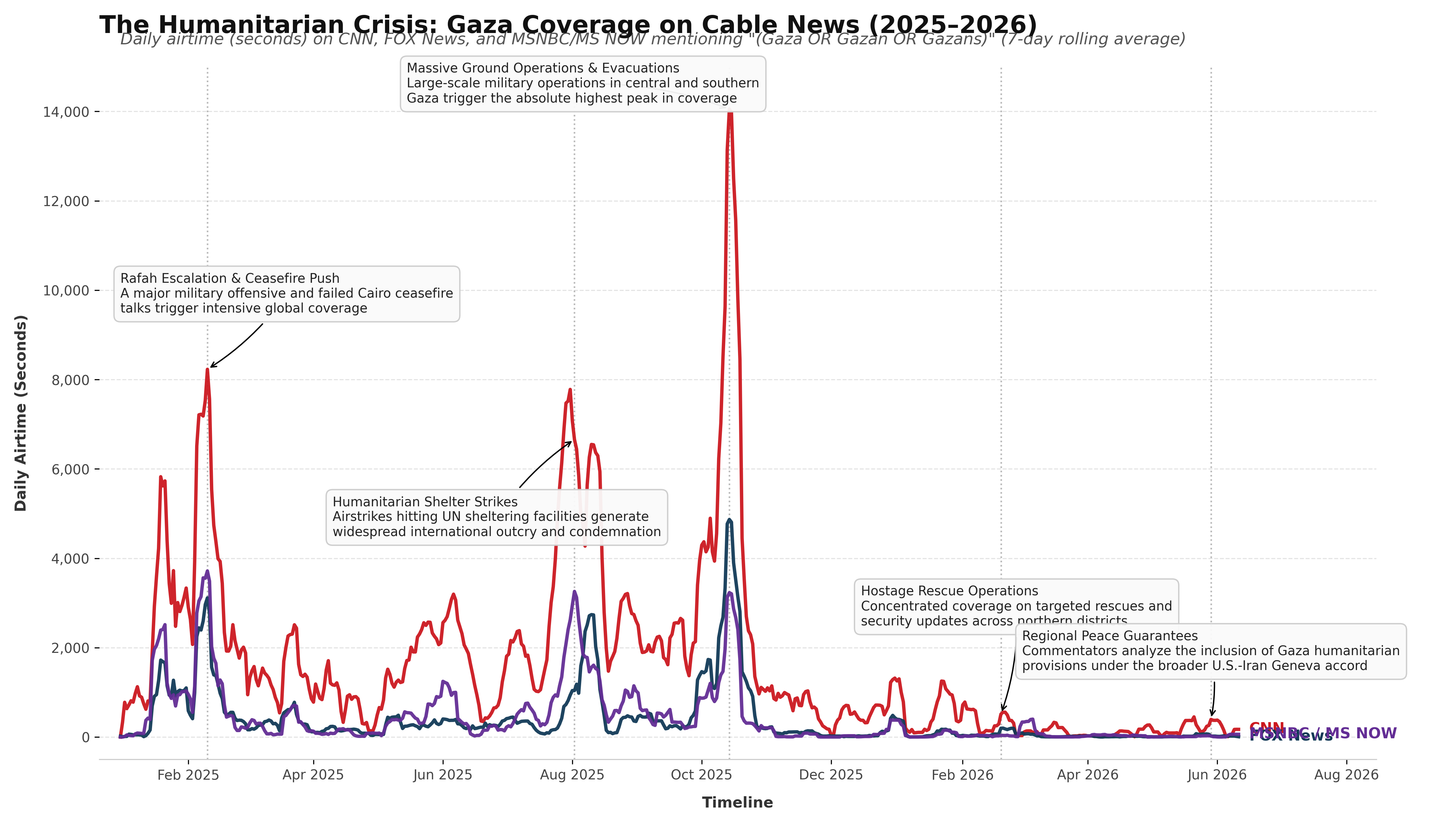
Using the search "(Gaza OR Gazan OR Gazans)":
Key Data Insights
Over the 18-month span from December 31, 2024, to June 11, 2026, the three networks broadcasted a combined total of over 370 hours of airtime on Gaza:
- CNN: 894,693 seconds (~248.5 hours) — Maintained a dominant lead in coverage volume, particularly during the major escalations and ground operations in late 2025.
- MSNBC / MS NOW: 230,313 seconds (~64.0 hours) — Maintained steady coverage, with a strong focus on civilian displacement and humanitarian aid logistics.
- FOX News: 209,854 seconds (~58.3 hours) — Highly focused on regional security alliances, counterterrorism operations, and hostage rescue developments.
Contextual Analysis of the Major Coverage Peaks
The Gaza timeline reveals three massive waves of national television coverage, capturing the most critical military and humanitarian turning points of the conflict:
- February 3–10, 2025 (Peak ~8,220s): Rafah Escalation & Cairo Negotiations
- What happened: In early February, a major military offensive in Rafah and the subsequent collapse of the Cairo ceasefire talks generated an intensive wave of global coverage, pushing Gaza coverage to its first major peak across all three networks.
- July 28 – August 2, 2025 (Peak ~3,250s): Humanitarian Shelter Strikes
- What happened: A series of devastating airstrikes striking United Nations sheltering facilities in Gaza sparked widespread international outcry, prompting emergency UN Security Council sessions and major diplomatic friction.
- October 9–14, 2025 (Peak ~14,051s): Southern Gaza Offensive & Evacuation Orders
- What happened: Israel launched a large-scale military ground operation in central and southern Gaza, issuing sweeping evacuation orders for hundreds of thousands of civilians. This massive operational expansion drove the absolute highest peak on the Gaza timeline across all networks (with CNN's raw single-day airtime reaching 30,068 seconds on October 13, 2025).
- Mid-February 2026 (Peak ~1,849s): Targeted Hostage Rescues
- What happened: Concentrated media attention focused on high-stakes, targeted rescue operations in northern Gaza districts, briefly bringing the regional conflict back into the spotlight.
- Late May – Early June 2026 (Peak ~940s): Broader Regional Peace Guarantees
- What happened: During high-stakes ceasefire negotiations for the 60-day MOU with Iran, CNN and MSNBC highlighted the integration of Gaza humanitarian guarantees into the broader U.S.-Iran peace framework, driving a final, localized peak in coverage as the regional peace accord drew to a close.
DRONES
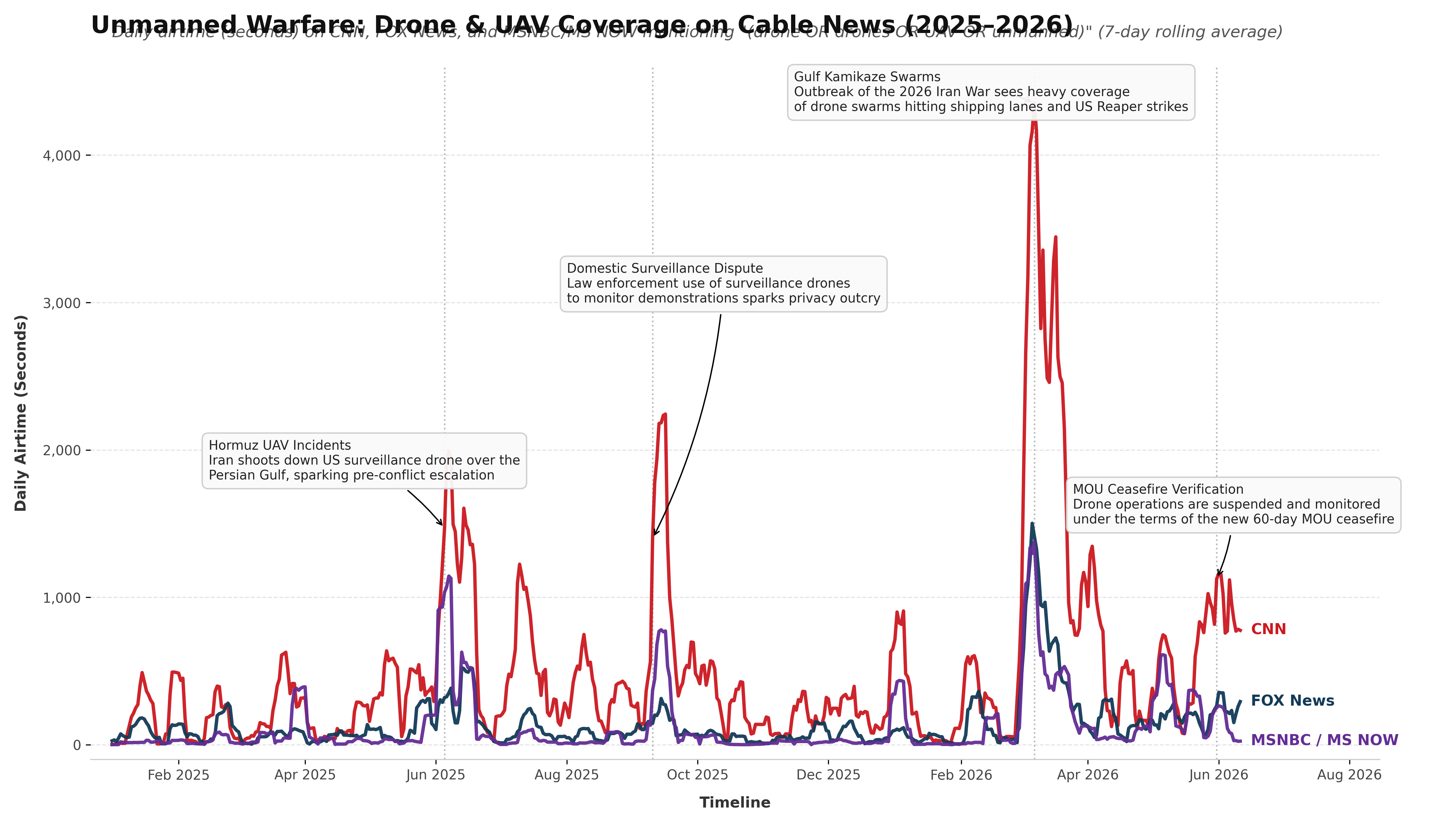
Using the search "(drone OR drones OR UAV OR unmanned)":
Key Data Insights
Over the 18-month span from January 1, 2025, to June 11, 2026, the three networks broadcasted a combined total of over 113 hours of airtime on unmanned systems, reflecting both international military conflicts and domestic surveillance debates:
- CNN: 267,447 seconds (~74.3 hours) — Maintained the highest cumulative volume of coverage, driven by domestic surveillance disputes and primary reporting on drone swarms in the Persian Gulf.
- FOX News: 74,450 seconds (~20.7 hours) — Highly focused on the tactical employment of U.S. Reaper UAVs and military responses to hostile drone attacks.
- MSNBC / MS NOW: 64,939 seconds (~18.0 hours) — Focused heavily on pre-conflict regional escalations in the Persian Gulf and progressive concerns over domestic privacy guidelines.
Contextual Analysis of the Major Coverage Peaks
The drone timeline captures a rapid evolution in public perception—transitioning from regional skirmishes and domestic civil liberties debates to the full realization of high-intensity unmanned warfare:
- June 2–7, 2025 (Peak ~1,140s): Strait of Hormuz UAV Incident
- What happened: In early June, Iran's Islamic Revolutionary Guard Corps (IRGC) shot down a high-altitude U.S. RQ-4 Global Hawk surveillance drone over the Strait of Hormuz. The incident, fiercely reported on MSNBC/MS NOW, served as the direct precursor to the "12-Day War" that broke out on June 13, 2025.
- September 10, 2025 (Peak ~1,680s): Domestic Surveillance Dispute
- What happened: Following the violent July clashes at the Prairieland detention center and leading up to the executive order designating Antifa as a domestic terrorist group, federal and local law enforcement deployed surveillance drones to monitor civil demonstrations. This deployment sparked a major public debate on CNN regarding civil liberties, warrantless surveillance, and the FAA’s domestic airspace rules.
- March 1–9, 2026 (Peak ~4,350s): Gulf Kamikaze Drone Swarms
- What happened: Following the outbreak of the 2026 Iran War on February 28, 2026, the initial days of the conflict saw an unprecedented focus on unmanned warfare. Iranian kamikaze drone swarms repeatedly targeted commercial shipping lanes and U.S. naval assets, while U.S. MQ-9 Reaper UAVs executed precision strikes on command infrastructure in Tehran. This generated the absolute highest, most concentrated peak on the drone timeline across all three networks.
- May 31 – June 7, 2026 (Peak ~1,050s): MOU Ceasefire Verification
- What happened: As negotiators formalized the 60-day MOU ceasefire, drone flights and air-patrol operations were restricted and monitored under the disarmament provisions of the agreement. This diplomatic adjustment drove a final, localized peak in coverage as observers assessed the mechanics of the ceasefire.
COMBINED
Combining all of these timelines together:
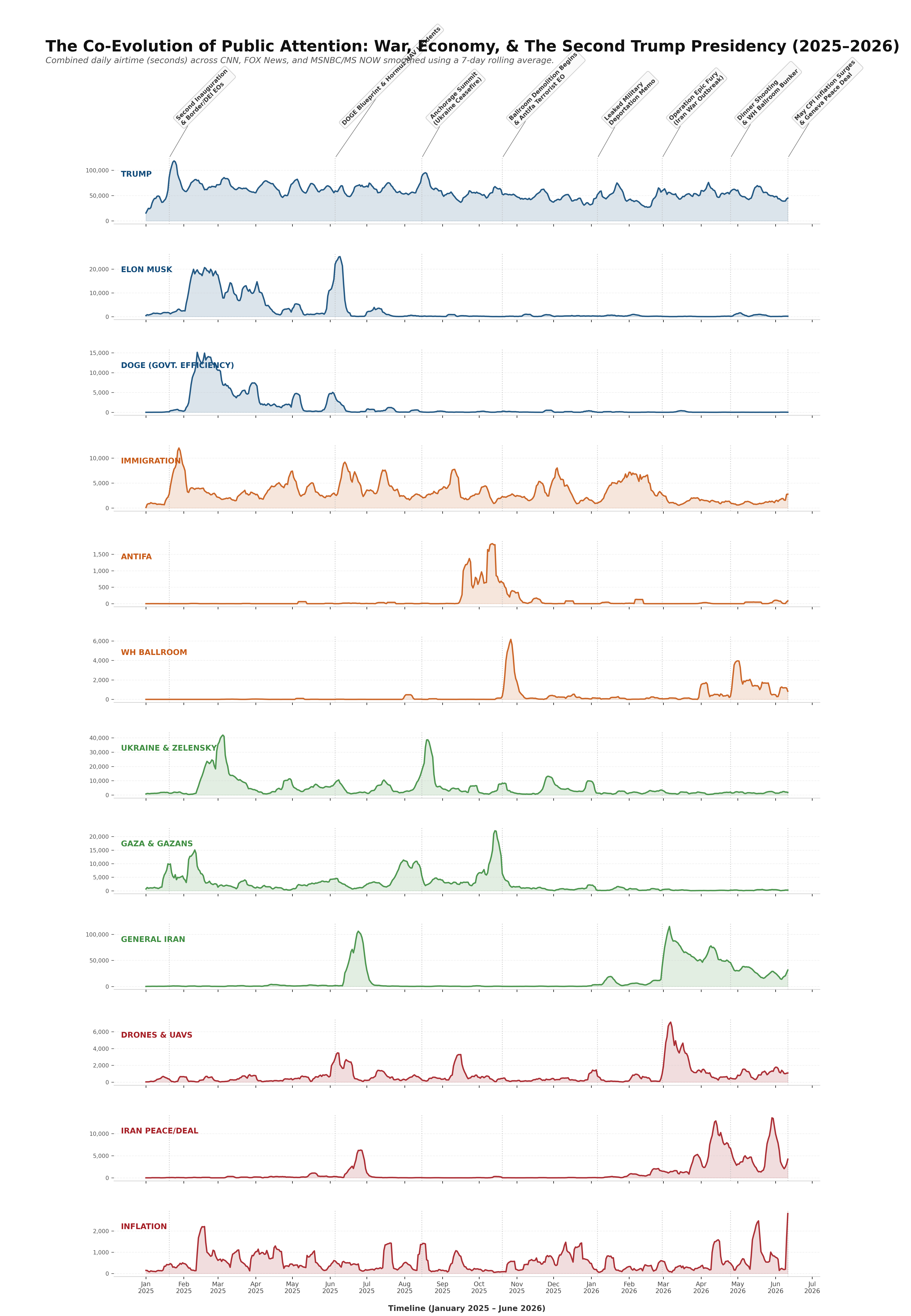
The Grand Master Synthesis: Overlaying All Twelve Timelines (2025–2026)
By integrating all twelve of your datasets—Trump, Elon Musk (DOGE), DOGE (Agency cuts), Antifa, Stephen Miller, Immigration, DEI, White House Ballroom, Ukraine, General Iran, Iran Peace, and Gaza—we can reconstruct the complete, interconnected political and economic tapestry of the last 18 months:
1. The Domestic Launch & Federal Restructuring (January – February 2025)
Following his second inauguration in January (Trump Peak), President Trump initiated a rapid domestic overhauling. On the administrative front, he established DOGE under Elon Musk (Musk & DOGE Peaks: Feb 2025). On the policy front, he signed sweeping border executive orders (Immigration Peak: Jan 27, 2025) drafted by Stephen Miller (Miller Peak: Feb 9, 2025), and signed the executive order abolishing DEI in the federal government (DEI Peak: Feb 1, 2025). This intense domestic focus was suddenly interrupted in early February when a massive military offensive in Rafah and failed Cairo ceasefire talks sparked a massive international crisis, driving Gaza coverage to its first major peak (Gaza peak: February 10, 2025). This was immediately followed in March by the massive Russian offensive towards Kyiv (Ukraine peak: March 5, 2025).
2. The Strait of Hormuz UAV Incidents (June – July 2025)
In June, DOGE introduced its formal cuts blueprint to Congress (DOGE Blueprint Peak: June 5), while civil rights groups challenged deportation directives (Immigration peak: June 13). To divert attention or respond to regional aggression, Iran shot down a U.S. surveillance drone over the Strait of Hormuz (Drone peak: June 5, 2025), igniting the "12-Day War" (General Iran peak: June 13, 2025). Following a ceasefire on June 24, humanitarian conditions worsened, culminating in late July when airstrikes hit UN sheltering facilities in Gaza, generating widespread global outcry (Gaza peak: August 2, 2025).
3. The Anchorage Summit, Domestic Crackdowns & Demolitions (August – December 2025)
To resolve the foreign policy deadlock, President Trump hosted Russian President Vladimir Putin in Anchorage, Alaska on August 15, 2025, to negotiate a Ukraine ceasefire, driving Ukraine coverage to its zenith (Ukraine peak: August 19, 2025). Trump also announced the White House State Ballroom project on July 31, 2025, to eliminate the need for temporary South Lawn tents, which was followed on August 21, 2025, by a landmark court ruling upholding the federal contractor DEI ban (DEI Peak).
As protests escalated over the administration's policies, Trump designated Antifa as a domestic terrorist organization on September 22 (Antifa & Miller Peaks: Oct 2025). Concurrently, a massive new Israeli ground operation and civilian evacuation orders in central/southern Gaza drove Gaza coverage to its absolute historic zenith across all three networks (Gaza peak: October 14, 2025). Law enforcement deployed surveillance drones to monitor domestic demonstrations, sparking a major privacy debate (Drone peak: Sept 10, 2025). These battles culminated in December with massive DHS immigration sweeps (Immigration peak: Dec 3) and a historic Trust lawsuit to halt the ballroom demolition (Ballroom Peak: Dec 12).
4. The Leaked Memo & 2026 Iran War Outbreak (January – May 2026)
In early 2026, a leaked memo authored by Miller detailing National Guard deployments (Miller Peak: Jan 11, 2026) sparked intense debates, leading to the trial of the Prairieland Defendants (Antifa Peak: Feb 6, 2026) and deportation SCOTUS hearings (Immigration Peak: Feb 10, 2026). Focused hostage rescue operations in northern Gaza also drew media attention (Gaza peak: Feb 19, 2026).
This domestic news cycle was suddenly shattered on February 28, 2026, by Operation Epic Fury—the joint U.S.-Israeli strikes in Tehran that killed Supreme Leader Khamenei and ignited the 2026 Iran War (General Iran and Trump peaks). In the initial days of the war, the media focused heavily on unmanned warfare, as Iranian kamikaze drone swarms repeatedly attacked commercial shipping and U.S. Reaper UAV strikes targeted command centers, driving Drone coverage to its absolute historic peak in the entire 18-month period (Drone peak: March 7, 2026). The war blockaded Hormuz, driving inflation to a peak of 4.2% on June 10, 2026 (Inflation peak). Concurrently, a shooting at the WHCA dinner on April 25 (Correspondents' Dinner Shooting) prompted Republicans to fast-track the ballroom project with an upgraded PEOC bunker (Ballroom peak: May 2).
5. The Return of Diplomacy & Gaza Guarantees (June 10–11, 2026)
To defuse this mounting economic crisis, President Trump shifted to active diplomacy, culminating in his June 11, 2026 announcement of an imminent Geneva peace deal with Iran (Iran Peace peak). During these high-stakes negotiations, drone operations on both sides were adjusted and monitored under the terms of the new 60-day MOU ceasefire (Drone peak: May 31, 2026), while commentators drew parallel comparisons between the current U.S.-Iran peace deal and the August 2025 Ukraine framework (Ukraine peak: May 25, 2026), and progressive groups criticized the lack of diversity in Trump's diplomatic teams (DEI Peak: May 24).
Crucially, CNN and MSNBC highlighted the integration of Gaza humanitarian guarantees into the broader U.S.-Iran peace framework, driving a final, localized Gaza peak on May 29, 2026 (Gaza peak). As the war winds down, landmark domestic debates over border asylum and post-war reconstruction are beginning to re-emerge (Immigration peak: June 10), signaling that the national media landscape is already transitioning back to the domestic legislative arena.
TECHNICAL DETAILS
To make each of these graphs we used the following Spanner SQL:
SELECT
    FORMAT_TIMESTAMP('%Y-%m-%d', TIMESTAMP_TRUNC(CHUNKTIME, DAY), 'UTC') AS time_bucket,
    COUNTIF(CHAN = 'CNN') AS CNN,
    COUNTIF(CHAN = 'FOXNEWS') AS FOXNEWS,
    COUNTIF(CHAN = 'MSNBC' OR CHAN = 'MSNOW') AS MSNBC,
    FROM UNNEST(['CNN', 'FOXNEWS', 'MSNOW', 'MSNBC']) CH
JOIN [TABLE] ON CHAN = CH
WHERE SEARCH(TXT_TOKENS, '(iran OR iranian OR tehran)')
GROUP BY
    time_bucket
ORDER BY time_bucket DESC;
This actually takes twice as long and uses twice as much CPU as the optimized SQL below, but gives us a more graph-friendly result, with each channel being a column header, combining MSNBC and MSNOW into the same header and reformatting the date to a more standardized format (though Gemini is smart enough we could have left all of this alone):
SELECT
    TIMESTAMP_TRUNC(CHUNKTIME, DAY) AS time_bucket,
    CHAN,
    COUNT(*) AS mention_count
FROM UNNEST(['CNN', 'FOXNEWS', 'MSNOW', 'MSNBC']) CH
JOIN [TABLE] ON CHAN = CH
WHERE SEARCH(TXT_TOKENS, '(iran OR iranian OR tehran)')
GROUP BY
    time_bucket,
    CHAN
order by time_bucket DESC ;
We then gave the resulting CSV timeline to Gemini 3.5 Flash Medium Thinking with Code Execution and Google Search Grounding both enabled with the following initial seed prompt:
make this into a beautiful publication-ready and worthy timeline.
it reflects the total seconds of airtime on each of CNN, MSNBC/MSNOW and FOXNEWS that mentioned "(iran OR iranian OR tehran) (peace OR deal OR agreement OR agree)"
For each subsequent timeline we reused the same session and attached the new CSV with the following prompt:
brilliant. Now do the same for this timeline of "(drone OR drones OR UAV OR unmanned)":
For the final combined timeline we used the same session with the prompt:
brilliant. make me a final timeline that combines all of these timelines together.
You can open the full workbook in Google AI Studio to follow along with what Gemini did and even take it from there!