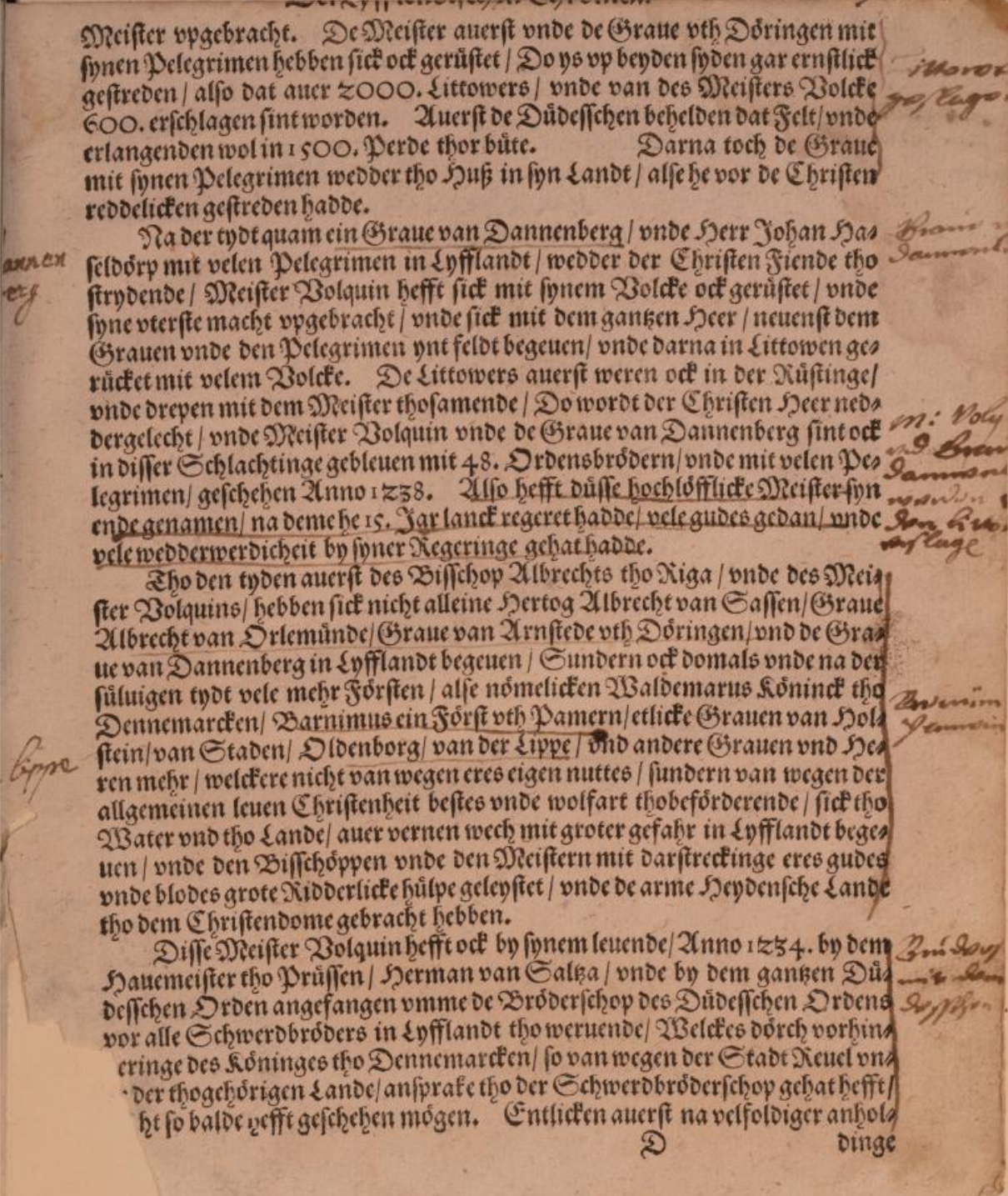
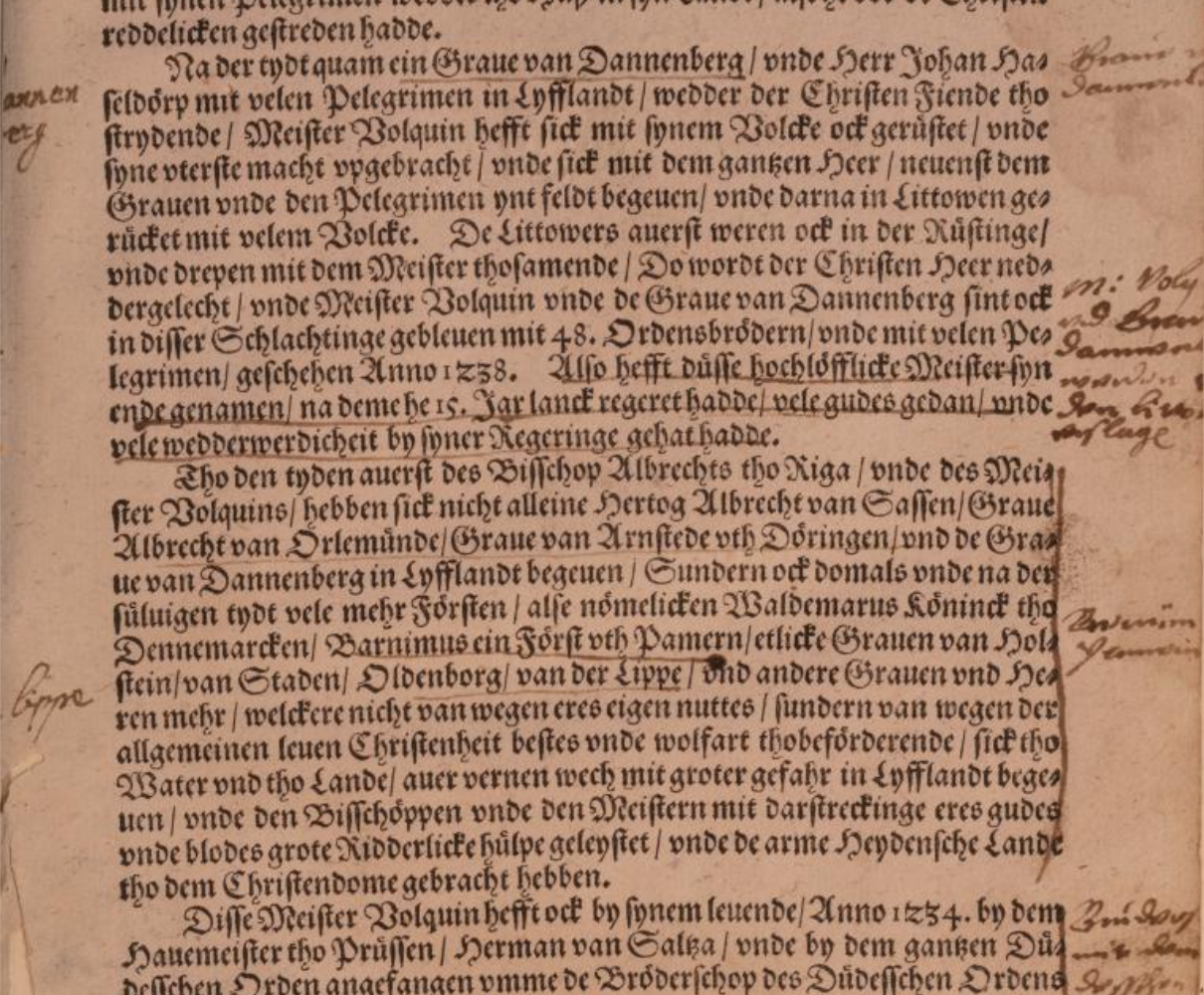
One of the most remarkable findings of Gemini's marginalia analysis of a page from the Collection's copy of the Russow is that Gemini correctly deduced that the margin annotations were essentially handwritten summarizing section headings that directly referenced the underlined / sidelined passages beside each and used this information to decipher the handwriting by using the context of the highlighted passages to narrow the possible transcriptions of the hardest-to-read words. In other words, instead of simply trying to read the handwriting by itself in isolation, Gemini figured out that it essentially summarized the nearby highlighted text and then used that text to figure out what the handwriting said, allowing it to decipher several complex shorthands and nearly unintelligible words! The page in question has two sets of annotations, one on the right and one on the left that appear to be in different hands, as well as a mixture of underlining and sidelining. Let's ask Gemini to help us sort all of this out.
Why are there handwritten annotations on both sides of the page and a mix of underlining and sidelining? Which is connected to which?
This page—folio D1 recto (marked by the printed signature D and catchword dinge at the bottom) of Balthasar Russow’s 16th-century Low German Chronica der Prouintz Lyfflandt (Livonian Chronicle)—shows two classic features of early modern active reading: marginal notes spilling across both margins because of recto page geometry, line-level crowding, and two distinct layers of annotation, alongside a two-tier system of sidelining for whole passages and underlining for specific names and clauses.
1. Why Annotations Appear on Both Sides of the Page
-
Recto layout (wide outer margin vs. tight inner gutter): Because signature marks like D only appear on recto (right-hand) leaves, the right margin is the wide outer fore-edge (you can see the stacked edges of later pages on the far right, slightly trimmed by a bookbinder’s plough after the notes were written), while the left margin is the narrow inner gutter curving into the spine. Early modern readers treated the outer (right) margin as their primary workspace, which is why all five historical summaries sit on the right.
-
Line-level crowding in the right margin: In the third paragraph (lines 25–26), two noble names of interest appear on consecutive lines: Barnimus ein Först vth Pamern (line 25) and van der Lippe (line 26). Because the two-line note Barnim / Pamern (plus a vertical sideline) already filled the right margin across lines 25–26, placing lippe in the left margin kept it aligned directly with line 26 (and closer to van der Lippe near the middle-left of the line) without colliding with Pamern.
-
Evidence of two different hands (or a later genealogical pass): Comparing ink, nib width, and script points to two separate passes through the text:
-
Right-margin historical digest (German Kurrentschrift, broader nib): Five multi-word notes summarize the narrative of Livonian crusades, battles, and Pomeranian/Teutonic Order history (using Latin letters only for names like M: Volq and Barnim, standard early modern German Zweischriftigkeit or two-script practice).
-
Left-margin family catchwords (pure humanist italic, finer nib, paler ink): Both left-margin notes—[D]annen / [b]erg (lines 9–10, its first letters lost in the inner gutter/crop) and lippe (line 26)—are bare comital house names written in neat italic script. Notably, [D]annen / [b]erg on the left duplicates the faded, fore-edge-trimmed Graue v[an] / Dannenb[erg] already sitting in the right margin on lines 8–9. A single reader in one sitting would have no reason to label the same name twice on opposite sides of the same sentence; a second reader (or later pass) scanning specifically for Lower Saxon/Westphalian noble families (Dannenberg, Holstein, Stade, Oldenburg, Lippe) used the open left margin where the right margin was already occupied or rubbed faint.
-
2. Why Underlining and Sidelining Are Mixed
Early modern readers used horizontal and vertical strokes for different scales of attention rather than interchangeably:
-
Sidelining (vertical strokes along the text edge) = Macro-level passage bracketing: Drawing one vertical stroke down the margin was much faster and cleaner than underlining ten lines of dense Fraktur blackletter type. Here, sidelining marks off entire multi-line episodes or thematic blocks (the battle casualties in Paragraph 1, the full roll-call of crusading princes in Paragraph 3, and the Teutonic Order merger negotiations in Paragraph 4).
-
Underlining (horizontal strokes under words) = Micro-level spotlighting: Underlining isolates individual proper names, territories, or a memorable concluding verdict inside a paragraph.
-
Nested hierarchy (Paragraph 3, lines 20–31): Both techniques work together in the third paragraph. A bold vertical sideline down the right edge flags the entire 12-line paragraph as a key catalogue of crusaders, while horizontal underlining inside lines 25–26 zooms in on the specific rulers and counties extracted into the margins.
3. Which Is Connected to Which (Top-to-Bottom Mapping)
| Lines | Printed Text Passage (Low German & Meaning) | In-Text Mark | Left Margin (Inner Gutter) | Right Margin (Outer Fore-Edge) |
| 1–7 (Para. 1) | …also dat auer 2000. Littowers / vnde van des Meisters Volcke 600. erschlagen sint worden… Darna toch de Graue… wedder tho Huß… (Over 2,000 Lithuanians and 600 of Master Volquin's men slain; the Count of Thuringia then returned home.) | Sidelining along right edge of lines 1–4 and 5–7 (no underlining) | — | Littower / geschlage[n] ("Lithuanians defeated/slain") — linked to the sidelined casualty report on lines 2–4. |
| 8–10 (Para. 2a) | Graue van Dannenberg / vnde Herr Johan Hasseldörp mit velen Pelegrimen in Lyfflandt / wedder der Christen [Fiende tho] strydende (Count of Dannenberg and Sir Johann Hasseldörp arrived in Livonia with many pilgrims to fight the enemies of the Christians.) | Underlining across lines 8–10 (no sidelining) | [D]annen / [b]erg ("Dannenberg," italic hand, left edge cropped in gutter) — linked to the underlined Graue van Dannenberg. | Graue v[an] / Dannenb[erg] ("Count of Dannenberg," faded Kurrent, trimmed at right) — also linked to Graue van Dannenberg on line 8. |
| 14–19 (Para. 2b) |
Lines 14–17 (unmarked): Meister Volquin vnde de Graue van Dannenberg sint ock in disser Schlachtinge gebleuen… Anno 1238. (Volquin & Dannenberg killed in battle.) Lines 17–19: …Meister syn ende genamen / na deme he 15. Jar lanck regeret hadde / vele gudes gedan / vnde vele wedderwerdicheit… (How the Master met his end after ruling 15 years, doing much good amid much adversity.) |
Underlining on lines 17–19 (no sidelining) | — | M: Volq[uin] / v[nd] Grau[e] / Dannenb[erg] / worden v[an] / den Litto[wern] / erschlage[n] ("Master Volquin & Count Dannenberg were slain by the Lithuanians") — starts beside their death in battle (line 15) and runs down beside Volquin's underlined obituary (lines 17–19). |
| 20–32 (Para. 3) |
Whole paragraph: Catalogue of princes and counts who crusaded in Livonia. Line 25: Barnimus ein Först vth Pamern (Barnim, a Prince from Pomerania) Line 26: [Hol-]stein / van Staden / Oldenborg / van der Lippe (Counts of Holstein, Stade, Oldenburg, and Lippe) |
Both: Long sideline down right edge of lines 20–31 + underlining of specific names on lines 25–26 | lippe ("Lippe," italic hand) — aligned with line 26 and linked directly to underlined van der Lippe. | Barnim / Pamern ("Barnim / Pomerania") — outside the sideline at lines 25–26, linked directly to underlined Barnimus ein Först vth Pamern. |
| 33–39 (Para. 4) | Disse Meister Volquin hefft ock… Anno 1234. by dem Hauemeister tho Prüssen / Herman van Saltza… angefangen vmme de Bröderschop des Düdesschen Ordens vor alle Schwerdbröders in Lyfflandt tho weruende… (Volquin's 1234 negotiations with Grand Master Hermann von Salza to unite the Livonian Swordbrothers with the Teutonic Order, delayed by the King of Denmark's claim to Reval.) |