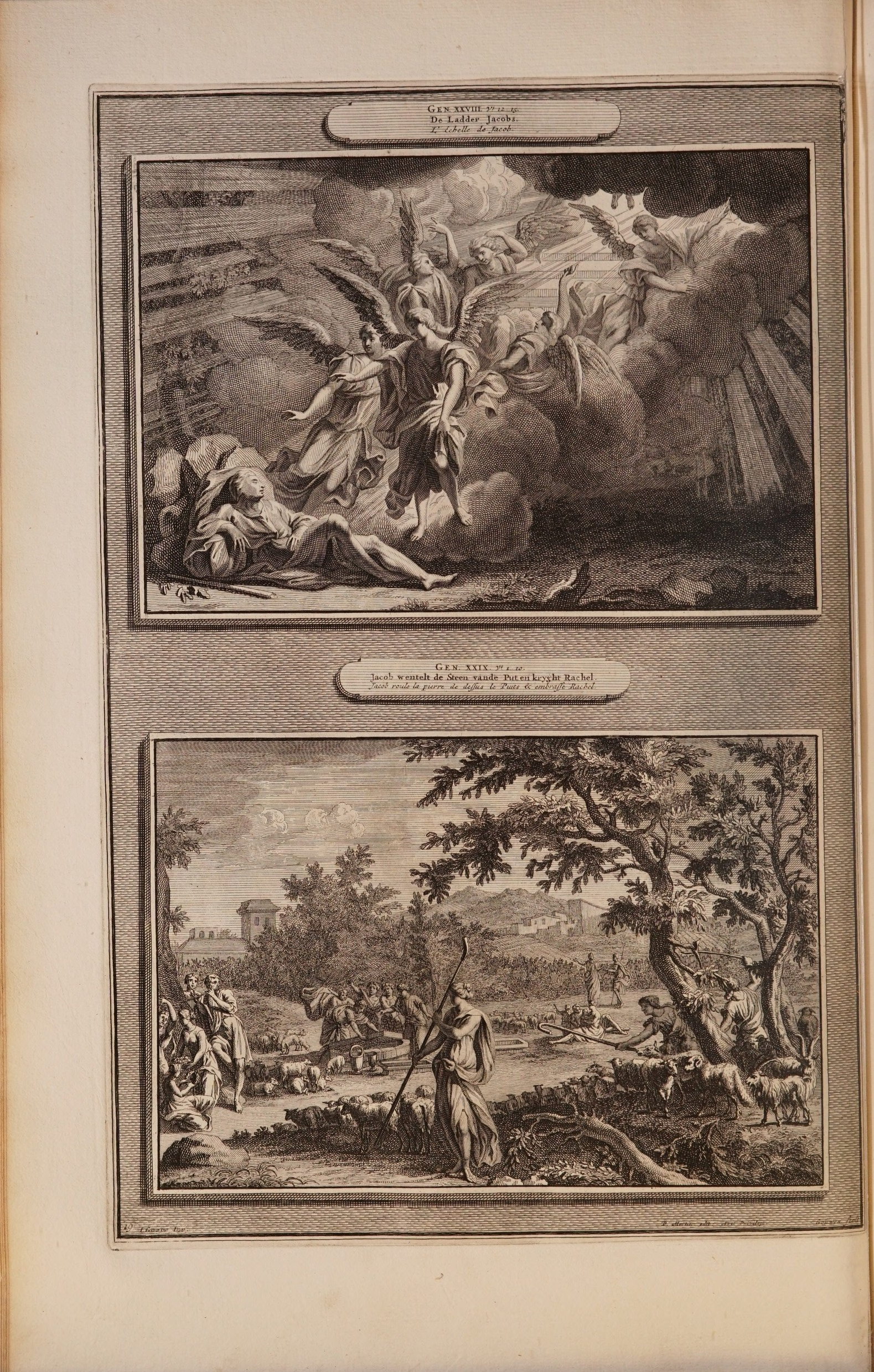
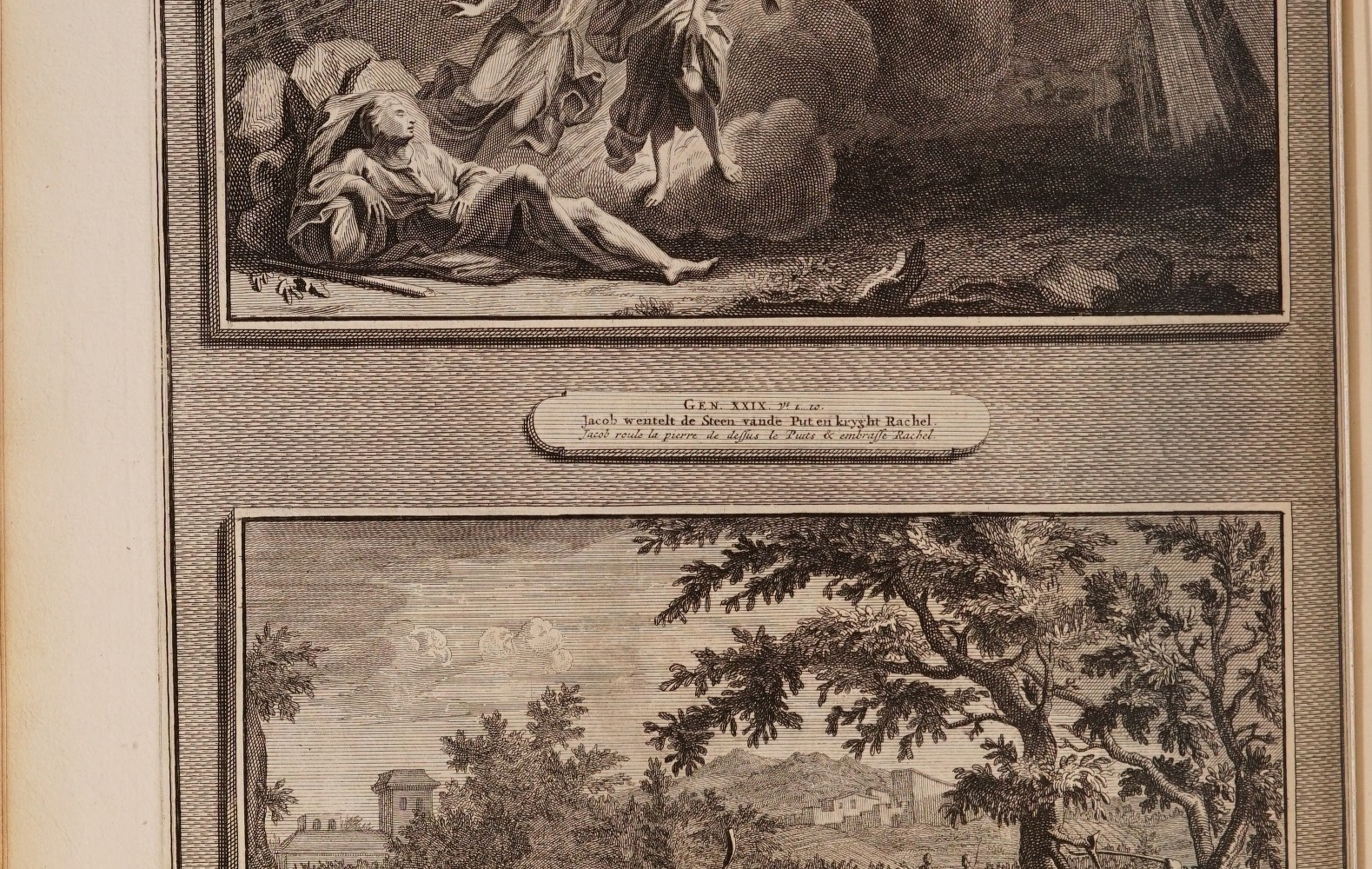
How does our new Gemini Carbon-powered rare book analysis workflow work on a full-page illustration from the 1700 Great Mortier Bible? Here we apply our illustration cataloging module to a full-page plate from the book, resulting in the JSON annotations below. Note how in this case we provided Gemini only the single image below without any other information, but Gemini was able to definitively identify the plate as from the 1700 Great Mortier Bible based solely on a visual analysis of the plate! While it is unable in this case to read the artist, engraver and publisher credits at the bottom of the plate, it identifies that they are present – flagging this for subsequent human review (though even as a human viewer, it is nearly impossible to make out any of the three other than Mortier's publisher credit).
{
  "records": [
    {
      "medium": "copperplate_engraving",
      "element_type": "marginal_border",
      "bbox_0_to_1000": [55, 105, 913, 986],
      "width_pct_of_page": 88.1,
      "height_pct_of_page": 85.8,
      "caption_transcription": null,
      "caption_translation": null,
      "visible_creator_credits": "[illegible micro-inscriptions at lower left and lower right of outer border]",
      "coloring": "uncolored (black/brown ink only)",
      "style_commentary": "Dutch late Baroque passe-partout architectural frame executed with crisp burin-ruled horizontal parallel hatching and trompe-l'oeil cast shadows. Characteristic of Amsterdam luxury folio Bible production around 1700.",
      "description": "Full-page ornamental architectural border enclosing two stacked rectangular biblical compartments and two oval-ended bilingual title cartouches. Molded outer and inner frames cast simulated shadows across a horizontally hatched ground.",
      "confident_identification": "Pieter Mortier, Historie des Ouden en Nieuwen Testaments (Histoire du Vieux et du Nouveau Testament), Amsterdam, 1700"
    },
    {
      "medium": "copperplate_engraving",
      "element_type": "half_page",
      "bbox_0_to_1000": [103, 146, 459, 940],
      "width_pct_of_page": 79.4,
      "height_pct_of_page": 35.6,
      "caption_transcription": "GEN. XXVIII. Vs. 12. &c. / De Ladder Jacobs. / L'Echelle de Jacob.",
      "caption_translation": "Genesis 28, verse 12, etc. / Jacob's Ladder. / Jacob's Ladder.",
      "visible_creator_credits": null,
      "coloring": "uncolored (black/brown ink only)",
      "style_commentary": "Franco-Dutch late seventeenth-century intaglio combining etched tonal modeling with burin cross-hatching for dramatic chiaroscuro between dark storm clouds and celestial light rays.",
      "description": "Jacob reclines asleep on rocky ground at lower left with his walking staff beside him. Six winged angels ascend and descend a cloud-wrapped celestial pathway bathed in diagonal sunbeams breaking through dark clouds.",
      "confident_identification": "Pieter Mortier, Historie des Ouden en Nieuwen Testaments (Histoire du Vieux et du Nouveau Testament), Amsterdam, 1700 — Genesis 28:12 (Jacob's Ladder)"
    },
    {
      "medium": "copperplate_engraving",
      "element_type": "half_page",
      "bbox_0_to_1000": [533, 160, 875, 949],
      "width_pct_of_page": 78.9,
      "height_pct_of_page": 34.2,
      "caption_transcription": "GEN. XXIX. Vs. 9. 10. / Jacob wentelt de Steen vande Put en kuscht Rachel. / Jacob roule la pierre de dessus le Puits & embrasse Rachel.",
      "caption_translation": "Genesis 29, verses 9, 10. / Jacob rolls the stone from the well and kisses Rachel. / Jacob rolls the stone from atop the well and embraces Rachel.",
      "visible_creator_credits": null,
      "coloring": "uncolored (black/brown ink only)",
      "style_commentary": "Classicizing Dutch-French pastoral landscape combining free etching in the foliage and sheep with fine burin engraving in the classical drapery and distant hills.",
      "description": "Continuous pastoral narrative in a wooded landscape framed by large trees at right and distant buildings at left. A shepherd stands centrally with a crook among sheep while background figures roll the stone from a circular well and Jacob embraces Rachel near seated companions at far left.",
      "confident_identification": "Pieter Mortier, Historie des Ouden en Nieuwen Testaments (Histoire du Vieux et du Nouveau Testament), Amsterdam, 1700 — Genesis 29:9–10 (Jacob and Rachel at the Well)"
    }
  ]
}