
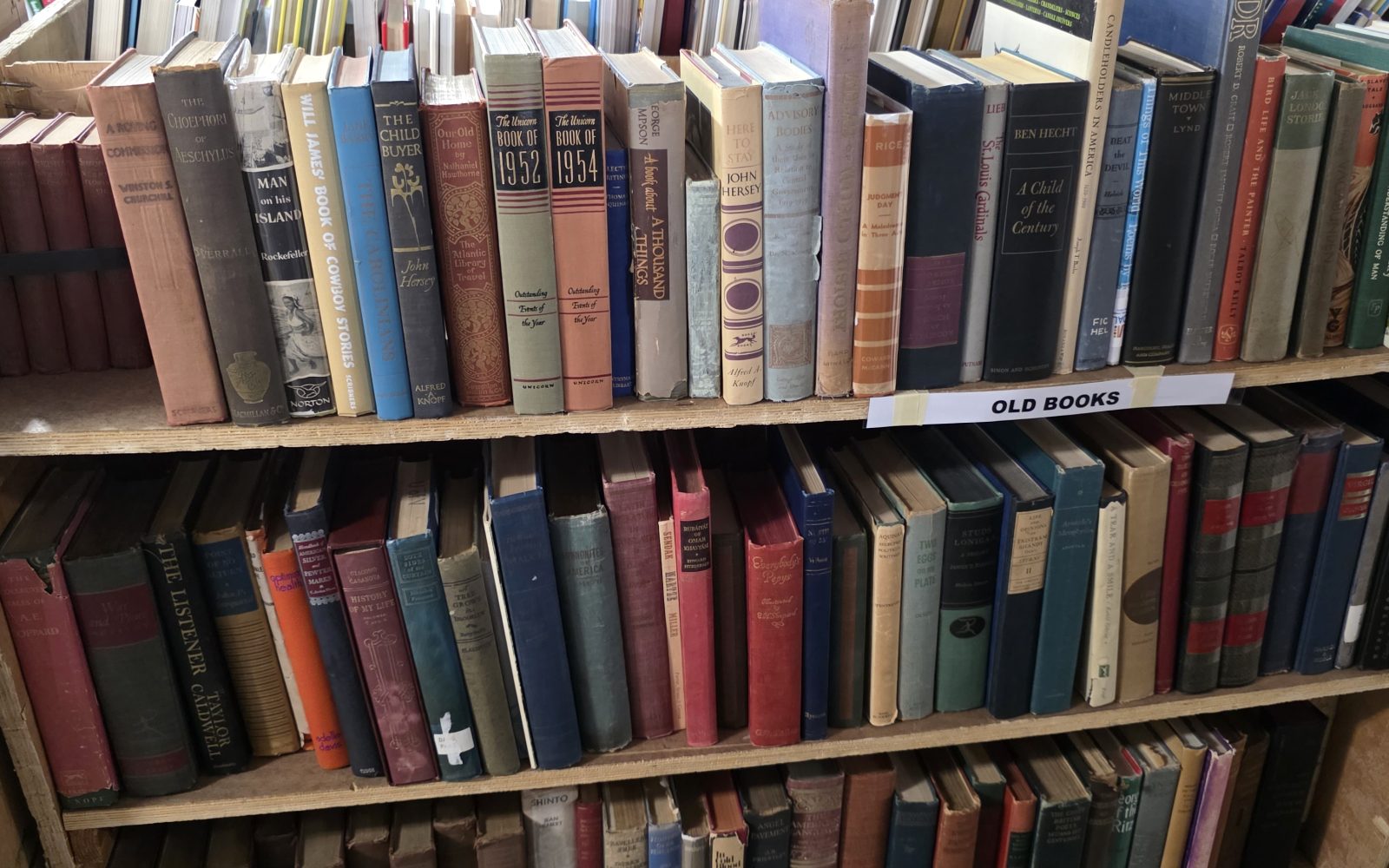
Last week we attended a local library fundraiser book sale in which they filled an entire level of their parking garage with bookcases filled with old books at bargain prices. This got us wondering how accurate Gemini might be at scanning an entire bookcase of books marked only "Old Books" and making a catalog of everything on the shelf. For patrons attending the fair, could they use Gemini to hunt for obscure old books they've been looking for and might otherwise miss visually scanning an entire parking garage level of books in dim lighting? Instead of trying to divine books they might like from decades-old obscure titles, could they ask Gemini to scan the shelves for them and recommend books they might like? For the library itself, could they use this workflow to quickly scan the final booksale inventory for any higher-value works they might have accidently missed and move those to their "special collections" room and reprice them accordingly to maximize their fundraising? It turns out Gemini is able to do all of this and more!
Here is one of the sample photos we took at the book fair quickly with our cellphone in the dark dim light (the photo looks much brighter due to the long exposure):
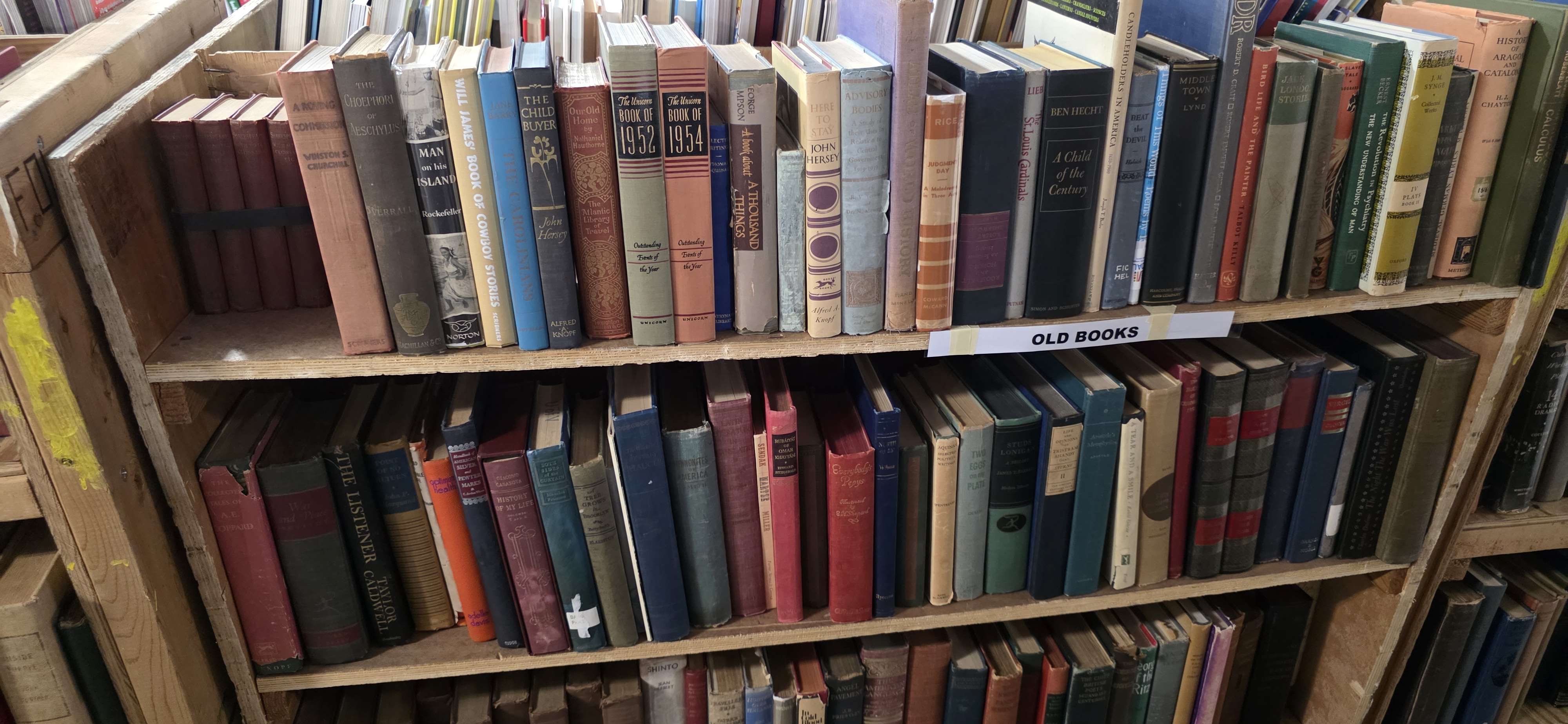
Now let's ask Gemini to catalog everything it sees there:
Make a bulleted list of every book you see here in order from top to bottom left to right,
with the brief title/author/year and an estimate of its fair sales price/value based on recent sales and other data.
Which Gemini does in a few seconds:
Top Shelf (Left to Right)
-
-
Set of 4 Matching Brown Cloth Volumes (bundled with black band): Unmarked/faded spines (typical of early-to-mid 20th-century multi-volume sets such as encyclopedias or collected works) — $10–$20 for the set
-
Tan Spine ("A Second…"): Faded title by a partially obscured author (c. 1940s–1950s hardcover) — $3–$6
-
Dark Grey Spine ("The Golden Age of…"): Faded gilt lettering with an urn motif on the lower spine (c. 1930s–1950s) — $5–$10
-
Man on His Island — James S. Rockefeller Jr. (1957): W.W. Norton hardcover (partially torn dust jacket on spine) — $8–$15
-
Will James' Book of Cowboy Stories — Will James (1951/1952): Charles Scribner's Sons, yellow cloth spine — $15–$25
-
Bright Blue Spine: Unmarked/faded title next to The Child Buyer (c. 1950s–1960s) — $3–$5
-
The Child Buyer — John Hersey (1960): Alfred A. Knopf, dark blue cloth — $6–$12
-
Red Ornate Gilt Spine ("One Hundred…"): Vintage literary anthology or history volume (c. 1940s–1950s) — $5–$10
-
The Unicorn Book of 1952: Outstanding Events of the Year — Joseph Laffan Morse, ed. (1953): Grolier / Unicorn Press, grey cloth — $5–$10
-
The Unicorn Book of 1954: Outstanding Events of the Year — Joseph Laffan Morse, ed. (1955): Grolier / Unicorn Press, salmon/tan cloth — $5–$10
-
Thin Dark Blue Spine (wedged between 1954 and A Thousand Things): Partially hidden pocket/slim volume — $2–$5
-
A Book About a Thousand Things — George Stimpson (1946): Harper & Brothers, grey cloth — $8–$15
-
Small Pale Blue Spine: Short worn hardcover (c. 1940s–1950s) — $3–$5
-
The Wall (or A Single Pebble / The Marmot Drive) — John Hersey (c. 1950–1956): Alfred A. Knopf, tan cloth with purple circular motifs — $8–$15
-
Light Blue Spine: Faded gilt lettering (c. 1940s–1950s novel or biography) — $3–$6
-
Tall Lavender/Tan Spine: Unmarked tall volume — $3–$6
-
Orange Banded Spine: Mid-century hardcover with horizontal white/gold bands — $4–$8
-
Dark Blue Cloth Spine (purple spine label): Classic mid-century biographical or historical printing — $5–$8
-
Grey Spine ("St. Louis…" / regional or historical title): Vertical red/brown lettering — $5–$10
-
A Child of the Century — Ben Hecht (1954): Simon & Schuster, black cloth with gilt lettering — $10–$18
-
Conservatism in America — Clinton Rossiter (1955 / 1962 rev.): Tall slim paperback/hardcover — $6–$12
-
Thin Blue/White Spine: Slim paperback or booklet wedged beside Middletown — $2–$4
-
Middletown: A Study in Modern American Culture — Robert S. & Helen Merrell Lynd (1929): Harcourt, Brace & Co., black cloth — $10–$20
-
Tall Grey/Blue Spine ("…DIR" at top): Tall reference or directory volume — $5–$10
-
Red Spine ("Mind, Life and the…"): Mid-century science/philosophy hardcover — $6–$12
-
Olive Grey Spine & Thin Brown Spine (2 volumes): Faded titles on cloth bindings — $3–$6 each
-
Reddish-Orange Patterned Spine: Mid-century hardcover — $4–$8
-
The Revolution in Psychiatry: The New Understanding of Man — Ernest Becker (1964): Free Press of Glencoe, green cloth — $15–$25
-
Yellow Spine (in intact dust jacket): 1960s academic/non-fiction hardcover — $8–$15
-
Thin Dark Grey Spine: Slim dark hardcover — $3–$6
-
A History of American… (Peach/Tan Spine): 1950s–1960s historical survey — $6–$12
-
Two Dark Green Spines (far right edge): Mid-century hardcovers with gilt spine titles — $5–$10 each
-
Middle Shelf ("OLD BOOKS" — Left to Right)
-
-
Worn Red Cloth Spine (frayed top edge): Early 20th-century novel or history (c. 1910s–1930s) — $3–$6
-
Dark Charcoal/Green Cloth Spine (red/brown spine panel): Vintage hardcover (c. 1920s–1940s) — $4–$8
-
The Listener — Taylor Caldwell (1960): Doubleday, black cloth — $6–$12
-
Tan Spine (blue title box): Mid-century hardcover (c. 1940s–1950s) — $4–$8
-
Bright Orange Spine: Mid-century cloth edition — $3–$6
-
Dark Blue Spine (red/white lettering): 1950s hardcover — $4–$8
-
Maroon Cloth Spine (gilt rules): Classic mid-century novel or biography — $5–$10
-
Teal Cloth Spine (white taped "+" library mark at heel): Ex-library mid-century hardcover — $2–$5
-
Olive/Grey Spine: Worn vintage cloth volume — $3–$6
-
Tall Navy Blue Spine & Faded Teal/Grey Spine (2 volumes): Standard mid-century cloth bindings — $4–$8 each
-
Mauve/Brown Spine, Thin Tan Paperback, and Bright Pink/Red Spine (black label): Assorted 1940s–1960s volumes — $3–$8 each
-
Bright Red Cloth Spine (gilt script title) & Thin Navy Blue Spine: Mid-century fiction/non-fiction — $4–$8 each
-
Cluster of 7 Blue, Grey, Green, and Tan Cloth Spines (center-right): Assorted 1930s–1950s jacketless hardcovers (several with tan/black spine labels) — $4–$8 each
-
Maroon Spine & 2 Matching Dark Charcoal Spines with Red Title Bands: Uniform series or history/reference volumes (c. 1940s–1950s) — $6–$12 each
-
4 Dark Blue, Black, and Olive Green Spines (far right edge): Assorted vintage hardcovers (one with red banded spine label) — $5–$10 each
-
Bottom Shelf (Partially Visible Tops — Left to Right)
-
-
26 Assorted Vintage Cloth Hardcovers (browns, tans, blues, reds, and greens): Mostly 1930s–1960s jacketless hardcovers; only the top 1–2 inches of the spines are visible, though #6 from the left shows a white spine top ("J. B. Lippincott" / similar imprint) — Typically $3–$10 each depending on specific titles and condition.
-
What if we give Gemini a brief description of our interests? Can it scan the shelves for us and find books we might like? Let's also ask it to estimate the cost of each so we can decide if its in our budget:
i love old history books, especially westerns and highly unusual books.
are there any that might be interesting for me? Which ones and where are they on the shelf and how much do they likely cost?
Several books on the top shelf fit your exact taste—ranging from a classic illustrated Western to bizarre mid-century sci-fi, eccentric trivia, and historical time capsules:
1. The Classic Western
Will James' Book of Cowboy Stories — Will James (1951)
-
-
Why you'll like it: Will James wasn't just a writer and exceptional sketch artist of the American West; his real life was as wild as his fiction. He was actually a French-Canadian named Ernest Dufault who reinvented himself as a Montana-born drifting cowboy, worked on cattle ranches, wrangled horses for Hollywood Westerns, and won the Newbery Medal. The book is packed with his signature vernacular tales and original pen-and-ink cowboy drawings.
-
Where it is: Top shelf, 4th single book from the left (counting to the right of the bundled brown set). Look for the bright yellow/tan spine with vertical blue/black lettering.
-
Likely cost: $2–$5 on a general sale shelf (worth $15–$25 online).
-
2. The "Highly Unusual" & Offbeat Picks
A Book About a Thousand Things — George Stimpson (1946)
-
-
Why you'll like it: Before search engines existed, veteran Washington journalist George Stimpson spent decades compiling a massive, eccentric treasury of obscure historical origins, folk beliefs, and strange trivia (answering questions like why we knock on wood, where maritime superstitions came from, and obscure linguistic history). It's the ultimate mid-century cabinet-of-curiosities book.
-
Where it is: Top shelf, just left of center, right next to the peach-colored 1954 book. It has a grey cloth spine with a brown/maroon title panel stamped
"A THOUSAND THINGS". -
Likely cost: $2–$4 at a local book sale (worth $8–$15 online).
-
Man on His Island — James S. Rockefeller Jr. (1957)
-
-
Why you'll like it: If you enjoy unusual true-life adventure history, this is a fascinating read. A young scion of the Rockefeller banking dynasty turned his back on high society in the 1950s to sail a 40-foot schooner across the South Pacific, living among eccentric castaways, beachcombers, and islanders in Tahiti and Samoa. It's long out of print and has a cult following among maritime history fans (scarce first editions often list for $80–$115+ online, though reading copies average $15–$25).
-
Where it is: Top shelf, 3rd single book from the left, sitting immediately to the left of the yellow Will James cowboy book. It has a black-and-white illustrated spine.
-
Likely cost: $2–$5 at the sale.
-
The Child Buyer — John Hersey (1960)
-
-
Why you'll like it: Written by the Pulitzer Prize-winning journalist famous for Hiroshima, this is one of his weirdest and darkest books. Written entirely in the form of transcripts from a state senate investigation, it's a dystopian satire about a shadowy corporation that comes to a small New England town to literally purchase a 10-year-old boy genius and subject him to a bizarre memory-wiping mind-alteration experiment.
-
Where it is: Top shelf, 6th single book from the left (two books to the right of the yellow Will James book). It has a dark blue spine with gold lettering and a small botanical ornament.
-
Likely cost: $2–$4 at the sale (worth $6–$12 online).
-
3. Historical Time Capsules & Wild Memoirs
The Unicorn Book of 1952 & The Unicorn Book of 1954 — Joseph Laffan Morse, ed.
-
-
Why you'll like them: Instead of dry modern history textbooks, these annual yearbooks capture the early Cold War era (the Korean War, McCarthyism, early atomic tests, bizarre 1950s fads, and crime) with hundreds of contemporary photos and the exact perspective of someone living through the moment.
-
Where they are: Top shelf, left-center, standing side-by-side in matching grey (
1952) and salmon (1954) bindings with bold black boxes on the spines. -
Likely cost: $2–$5 each (worth $5–$10 each online).
-
A Child of the Century — Ben Hecht (1954)
-
-
Why you'll like it: If you like gritty 20th-century history, Ben Hecht lived nine lives. He started as a hard-boiled crime reporter in 1910s Jazz Age Chicago (covering hangings, gangsters, and brothels), served as a foreign correspondent in revolutionary Berlin, and became Hollywood's greatest golden-age screenwriter (Scarface, Notorious, The Front Page). His 650-page autobiography is packed with wild historical anecdotes.
-
Where it is: Top shelf, right-center, sitting directly above the word
"OLD"on the"OLD BOOKS"sign. It's a thick black book with gold lettering. -
Likely cost: $3–$5 at the sale (worth $10–$18 online).
-
Bonus Quick Check: Also take a quick peek at the grey spine immediately to the left of A Child of the Century (stamped "St. Louis..." vertically in red/brown) and the peach spine on the far right of the top shelf ("A History of American…"), as both look like vintage regional/American history volumes that will likely only cost $2–$4 each.
Now let's pretend we're a library volunteer doing a last-minute check for any mistaken higher-value books that should be pulled and placed in the special collections sale. In this case, we can see there isn't anything of huge value, but it would have been worth double-checking these entries:
Give me the top 5 most valuable books in this photo and where they are in the photo.
Based on both the general reading-copy estimates and first-edition collector market rates, the five most valuable identifiable books in this photo are all located on the top shelf:
-
-
The Revolution in Psychiatry: The New Understanding of Man — Ernest Becker (1964)
-
Value: $15–$25 as a standard reading copy (early 1964 Free Press first printings regularly sell for $50–$90+ due to Becker's later Pulitzer Prize-winning fame for The Denial of Death).
-
Location: Top shelf, near the right end (6th book from the right). Look for the dark green cloth spine with gold horizontal rules and vertical white/gold lettering.
-
-
Will James' Book of Cowboy Stories — Will James (1951)
-
Value: $15–$25 for a standard jacketless copy (clean early Scribner's printings with bright cover illustrations fetch $30–$75+ among Western Americana collectors).
-
Location: Top shelf, left side (5th single book to the right of the bundled brown set). It has a bright yellow/tan spine with vertical blue/black lettering.
-
-
Middletown: A Study in Modern American Culture — Robert S. & Helen Merrell Lynd (1929)
-
Value: $10–$20 for a later printing (if the copyright page shows it is a true 1929 first edition without later printing statements, jacketless copies sell for $40–$70).
-
Location: Top shelf, right-center (directly above the "KS" in the "OLD BOOKS" sign). It has a black cloth spine with
"MIDDLE-TOWN"and"LYND"stamped at the top.
-
-
A Child of the Century — Ben Hecht (1954)
-
Value: $10–$18 as a standard jacketless hardcover (stated first printings in clean condition can bring $25–$45 without the dust jacket).
-
Location: Top shelf, right-center (directly above the "OLD" in the "OLD BOOKS" sign). It is a thick black hardcover with gold lettering inside a framed box on the spine.
-
-
Man on His Island — James S. Rockefeller Jr. (1957) (tied with John Hersey's The Wall, 1950)
-
Value: $8–$15 each (first editions of Man on His Island still retaining part of their original dust jacket or signed/clean copies go for $20–$30).
-
Location:
-
Man on His Island is on the top shelf, left side (just to the left of the yellow Will James spine), featuring a white-and-black illustrated dust jacket spine.
-
The Wall (by John Hersey) is in the exact middle of the top shelf, recognizable by its cream/tan spine decorated with three vertical purple circular medallions.
-
-
-
Let's drill into this:
should any of these be moved to the "special collections" sale area for higher value items?
which ones and where are they?
For a library, estate, or charity book sale, most of the books on these shelves are standard mid-century reading copies lacking dust jackets and belong on the general $1–$5 tables. However, three specific titles have strong collector appeal and should be pulled and inspected for your "Special Collections" / Individually Priced area, along with two mystery sets that are worth a quick 10-second check:
1. Definite Pulls (Check the Copyright Page First)
-
The Revolution in Psychiatry: The New Understanding of Man — Ernest Becker (1964)
-
Where it is: Top shelf, 6th book from the right (dark green cloth spine with gold horizontal bands and vertical white/gold text).
-
Why pull it: Ernest Becker went on to win the Pulitzer Prize for The Denial of Death, and his earlier 1960s works are sought after by psychology and philosophy collectors. Even without a dust jacket, a clean 1964 Free Press first printing can easily be priced at $15–$25 in a special collections section (copies in dust jackets fetch $60–$120 online).
-
-
Will James' Book of Cowboy Stories — Will James (1951)
-
Where it is: Top shelf, 5th single book from the left (bright yellow/tan spine with vertical dark lettering, right next to the white/black spine of Man on His Island).
-
Why pull it: Will James has a dedicated Western Americana following for his illustrations. Check the copyright page: if it is a Scribner's first edition (look for the Scribner's "A" on the copyright page) and the front cover illustration isn't badly rubbed, it will reliably sell for $15–$25 in a special section.
-
-
Middletown: A Study in Modern American Culture — Robert S. & Helen Merrell Lynd (1929)
-
Where it is: Top shelf, right-center, sitting directly above the
"KS"in the"OLD BOOKS"sign (black/dark navy cloth spine stampedMIDDLE-TOWNat the top). -
Why pull it: This is a landmark work in American sociology. Because it went through dozens of printings, check the copyright page: if it simply says Copyright, 1929 without any "Second printing," "Third printing," or later dates listed underneath, it is a true first edition worth pricing at $20–$35 (online dealers ask $50–$70 for jacketless firsts). If it's a later printing from the 1930s, leave it in general stock for $3–$5.
-
2. Worth a Quick Peek on the Shelf
-
The Bundled Set of 4 Matching Brown Volumes
-
Where it is: Top shelf, far left corner (held together with a black band).
-
Why check it: Multi-volume sets from the early 1900s are either common encyclopedias/sermons (worth $5 total) or desirable complete sets of classic literature, regional history, or fine bindings that belong in Special Collections for $20–$40. Pull one out to check the title page.
-
-
A Child of the Century (Ben Hecht) & The Wall (John Hersey)
-
Where they are: Both on the top shelf — The Wall is in the exact middle (cream spine with three purple circles), and A Child of the Century is right-center directly above
"OLD"in the"OLD BOOKS"sign (thick black spine with gold box). -
Why check them: As standard unsigned copies without dust jackets, they only bring $5–$10 at a book sale (borderline for Special Collections). However, both authors signed many copies in the 1950s—flip to the front flyleaf just in case there is an inscription or signature, which would immediately bump either book into the $50–$100+ range.
-