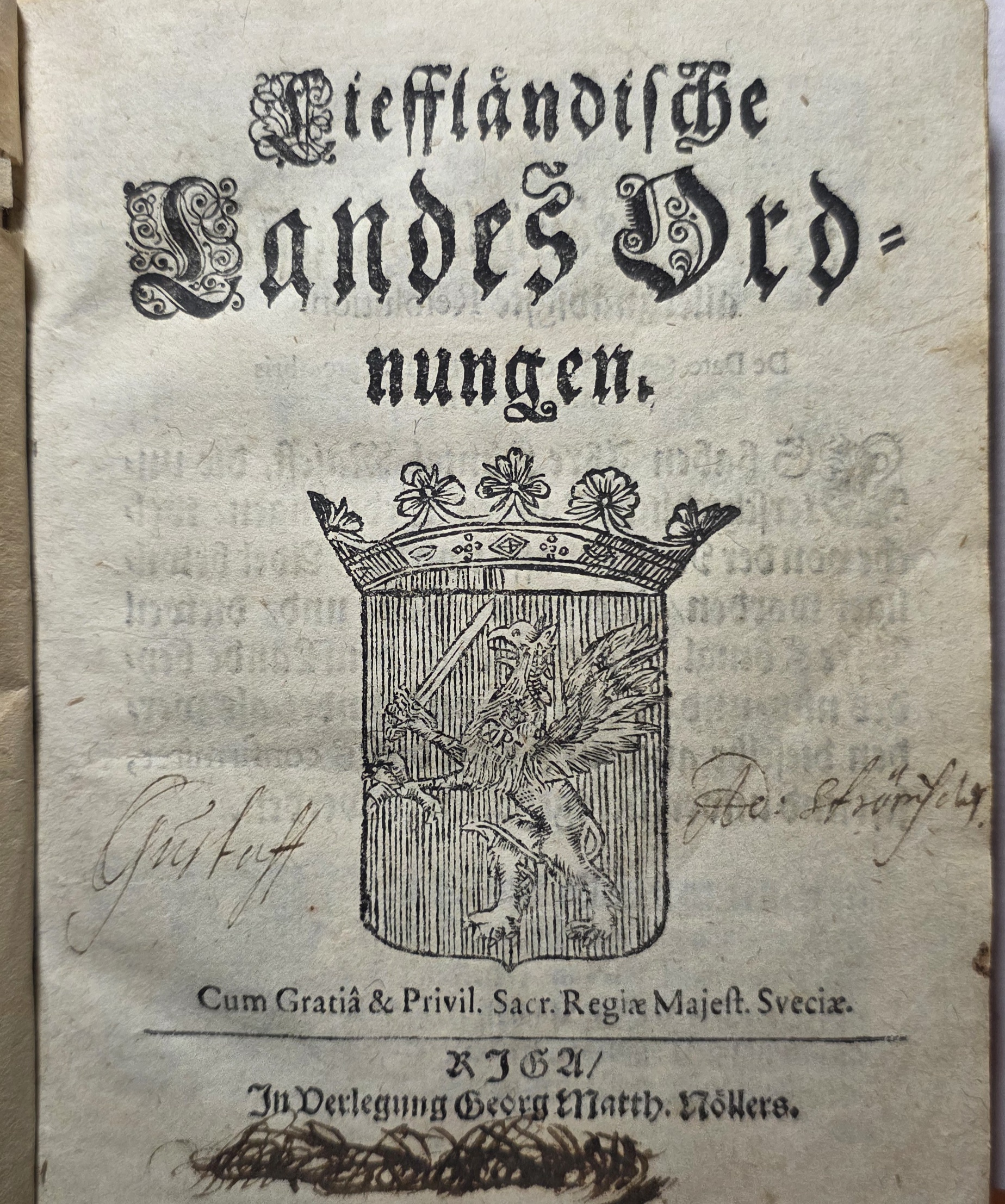
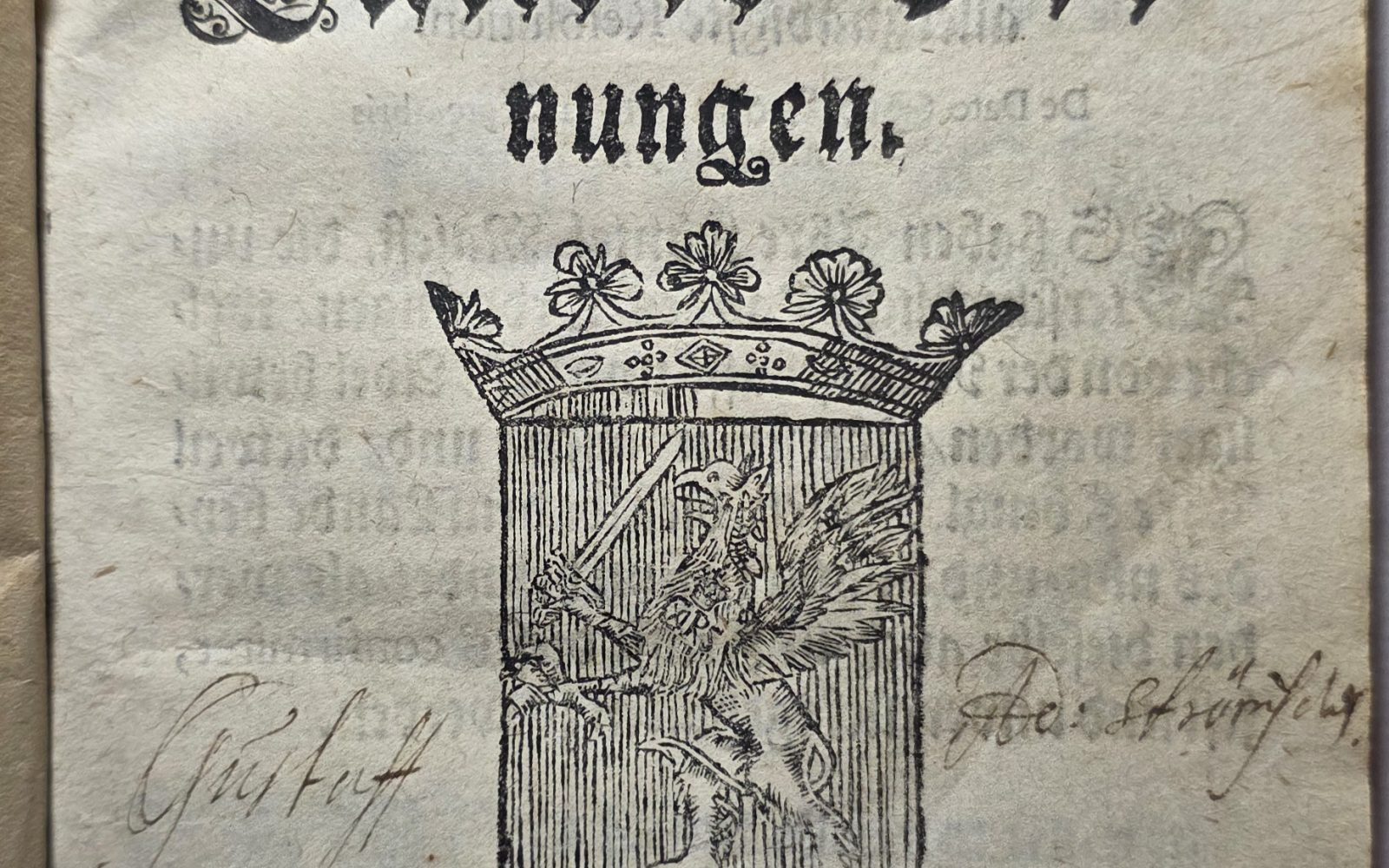
The incredible ownership history of our 1689 Livonian law book (with ownership signature of Gustav Adolf Strömfelt, the last high-ranking civilian Swedish Crown administrator in Estonia before it fell) got us wondering if we could trace more of its history and how such an incredibly unique book managed to survive the invasion. The catalog information provided to us with the work gave no hint of its former ownership, but given its highly distinctive title page signature and the extreme rarity of complete copies of this work, we wondered if Gemini could track it down for us. Indeed, with a single prompt, Gemini searched the open web and poured through auctions, dealer catalogs and other sources until it stumbled upon the original catalog where it first entered the private market and discovered that this book was part of the historic Ericsberg Castle Library and placed on the market in 2011!
Can you track down the provanance and source of this copy?
Gemini ultimately tracked down its first appearance on the private market in Centralantikvariatet's Catalog 66:
174. [The Baltic Region.] Livonian Provincial Ordinances. Riga, Georg Matthias Nöller, (1689). Quarto. (2),+ 168,+ (3) pages. Title with woodcut vignette. Worn half-calf from the early 18th century, spine with raised bands, marbled paper over wooden boards. Small holes on spine and front board with tears on the lower part. Title leaf with a crossed-out owner’s signature, and the signature of Gustaff Ad. Strömfelt(?). From the library of Ericsberg. VD17 23:240915T. Printed dedication to the Governor-General Clas Tott. The rarer first, smaller edition of the Livländische Landes-Ordnung [Livonian Provincial Ordinance], a collection of regulations. A larger edition was subsequently published in Riga in 1705 with a reprint in 1707.
The catalog itself is undated, so we asked Gemini to determine its date, which it remarkably did through a combination of identifying the most recent works listed, the known dates of surrounding catalogs and identifying that one of the listed collections was disbursed to the private market in a specific year:
what's the date of this catalog?
Centralantikvariatet Katalog 66 was published in 2011 (specifically in the second half of 2011).
While the PDF itself is an undated layout file (Katalogmall Lasse Quark) that omits a printed publication year on the title page, its exact date can be pinpointed through three pieces of evidence:
-
Internal Terminus Post Quem (2010): The newest books offered for sale inside Katalog 66 carry 2010 imprints (such as a 2010 volume published by Kungl. Skogs- och Lantbruksakademien).
-
Centralantikvariatet's Sequential Catalog Chronology:
-
Katalog 62 (Nordisk historia ur Ericsbergs bibliotek II: Trettioåriga kriget) was published in 2010.
-
Katalog 66 (featuring the Samuel Pepys collection of Ove G. Svensson alongside Varia and Ericsberg items) was issued in late 2011.
-
Katalog 67 (Nordisk historia ur Ericsbergs bibliotek III: Stormaktstid) was published at the beginning of 2012 (registered in the International League of Antiquarian Booksellers [ILAB] catalog archive on January 30, 2012).
-
-
Provenance Context (Ove G. Svensson Collection): The opening section of Katalog 66 features the Samuel Pepys collection of Farsta collector Ove G. Svensson (1925–2011), whose books and archives were dispersed and donated (including to Sigtunastiftelsen and via Centralantikvariatet) in 2011.
Just what exactly is this "library of Ericsberg"?
Tell me about the "library of Ericsberg" and why it is important. What years did it have known major sales of its books?
The Ericsberg Castle Library (Ericsbergs bibliotek) in Södermanland, Sweden, was the largest and most important private collector's library in modern Swedish history. Unlike traditional Swedish manor libraries built gradually through generations of casual family reading, Ericsberg was systematically assembled during the 19th century as an encyclopedic research collection of Nordic history, topography, jurisprudence, and rare ephemera.
How the Library Was Built & Why It Is Important
1. The Collector: Baron Carl Jedvard Bonde (1813–1895)
When the Bonde family acquired the 17th-century baroque estate of Ericsberg in 1808, its library was modest. Everything changed under Baron Carl Jedvard Bonde, Supreme Chamberlain (överstekammarherre) and an obsessive bibliophile.
-
The 1843 Foundation: In April 1843, just before the renowned library of Baron Carl Gustaf d'Albedyhll (1800–1856) was set to go under the hammer at Stockholm's Book Auction Chamber, Bonde stepped in and purchased the entire collection en bloc—well over 3,000 volumes of prime Swedish history, topography, and antiquities—even having a special new title page printed for the auction catalog bearing his own name.
-
The "Warmholtz" Blueprint: For the next 52 years, Bonde bought relentlessly at virtually every major Swedish and European book auction, assisted by Gustaf Edvard Klemming (head of the Royal Library in Stockholm). Bonde used Carl Gustaf Warmholtz's monumental 15-volume bibliography, Bibliotheca historica Sueo-Gothica (1782–1817), as a personal checklist. In Bonde's own interleaved copy of Warmholtz at Ericsberg, nearly all of its roughly 10,000 entries were checked off—including numerous copies that had belonged to Warmholtz himself.
-
Scale: By the time of Carl Jedvard Bonde's death in 1895, the library held roughly 25,000 to 30,000 volumes, alongside a massive manuscript archive (130 shelf-meters, over 1,400 volumes of medieval and early modern documents, including Queen Hedvig Elisabeth Charlotta's famous diaries) and a premier coin and medal cabinet.
2. Why Book Historians Prize Ericsberg Provenance
-
A 100-Year Time Capsule: Carl Jedvard Bonde's son, Baron Carl Carlsson Bonde (1850–1913), continued adding to the library and editing its manuscripts. However, after his death in 1913, the library sat virtually untouched for nearly a century on the top floor of the castle, preserving early bindings, ephemeral pamphlets, and provenance chains without modern rebinding or institutional stamping.
-
Unrecorded 16th- and 17th-Century Ephemera: Because Bonde collected contemporary political broadsides, royal ordinances (like your 1689 Riga Landes-Ordnungen), and Thirty Years' War propaganda pamphlets (flugschriften), the Ericsberg dispersal brought to light dozens of 17th-century printings that were completely unrecorded in the German national bibliography (VD17) or lacking even in Sweden's National Library (Kungliga biblioteket).
-
Rich Earlier Provenances: Because Bonde bought intact older collections (such as d'Albedyhll's and parts of the Rosenhane and Jennings circles), Ericsberg books frequently carry prestigious 17th- and 18th-century ownership signatures, as seen with Gustav Adolf Strömfelt's signature in your volume.
Timeline of Major Sales & Dispersals
For centuries, Ericsberg was protected under Sweden's entail system (fideikommiss), which legally prohibited the heirs from selling off the estate's collections. When Sweden passed the Abolition of Entails Act (1964) and the last holder of the entail, Carl Jedvard Carlsson Bonde, died in 1988, the estate was converted into a limited company (Ericsbergs Fideikommiss AB). Financial needs to maintain the vast estate gradually forced the dispersal of the collections in distinct waves: