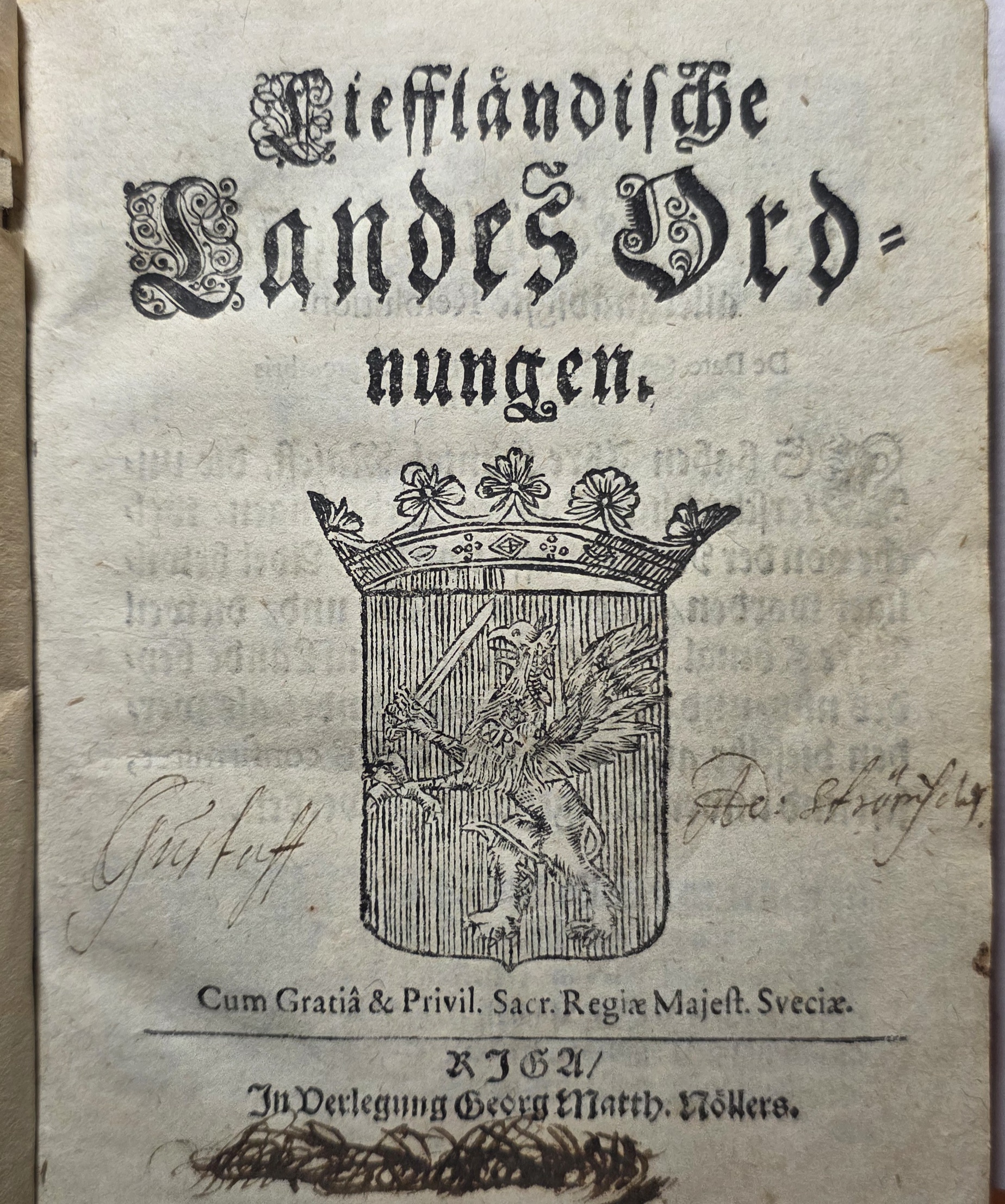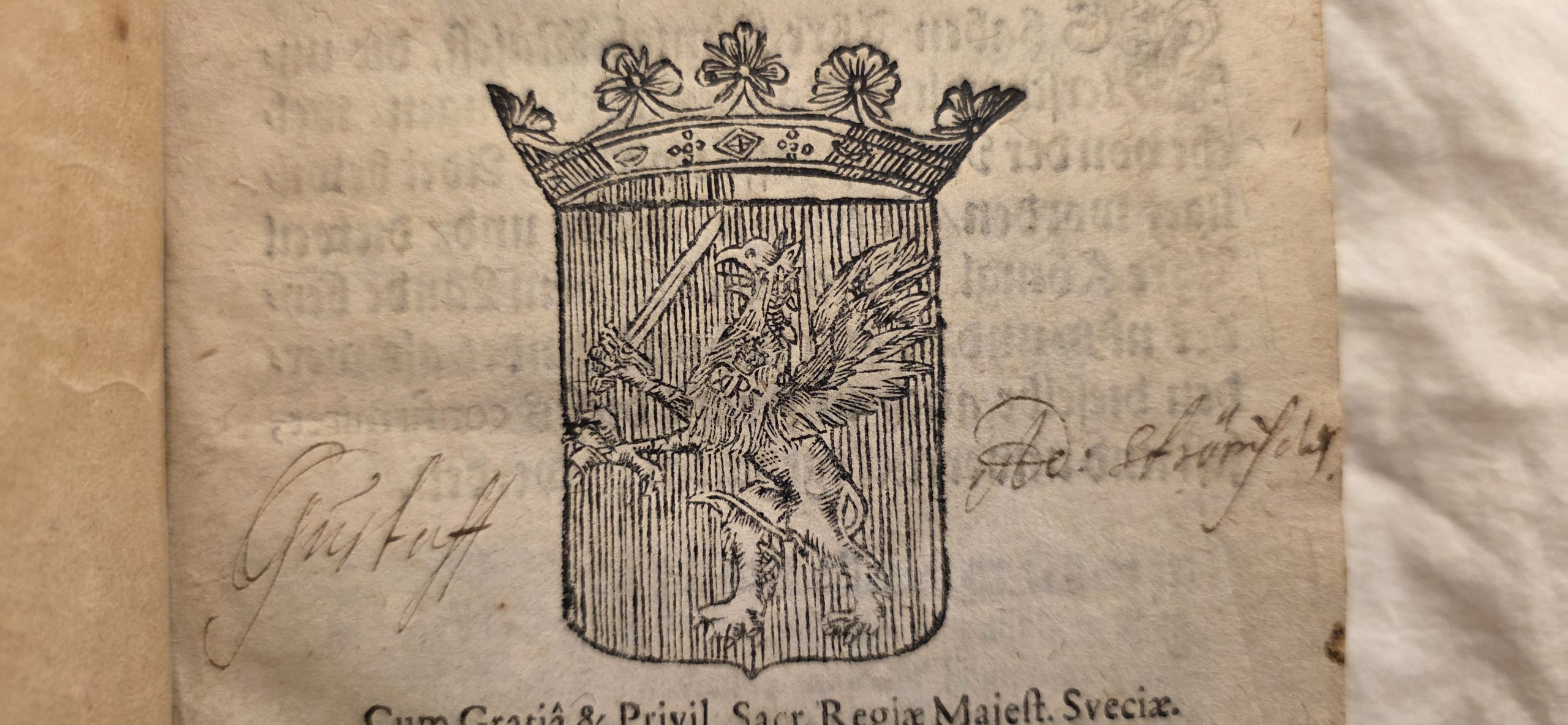
In accessioning an incredibly rare 1689 Livonian law book, one of the earliest printed books of the laws of Swedish Livonia (encompassing Southern Estonia), Gemini spotted an ownership signature scrawled across the title page. Incredibly, as you can see below, Gemini tracked down this signature and identified that this specific copy was owned by none other than Gustav Adolf Strömfelt, the Economic Governor (Ekonomiståthållare/majandusasehaldur) of the Estonian district of Livonia and a major landowner in Estonia. Most incredibly, he was likely the last high-ranking civilian Swedish Crown administrator in Estonia before it fell (Tallinn fell 7 weeks after Strömfelt fled when Parnu fell, but the remaining Swedish administrators there were dual military-civilian). The book was printed in Riga in 1689 and still has its original contemporary binding, with cover boards made from 337-year-old Baltic wood.
Whose signature is that? How confident are you? Who is he and what is his importance to Estonia?
The signature belongs to Gustav Adolf Strömfelt (1640–1717), a prominent Swedish statesman, nobleman, and the royal governor (ekonomiståthållare) of the Estonian district of Swedish Livonia from 1690 to 1710.
1. The Signature & Confidence Level
-
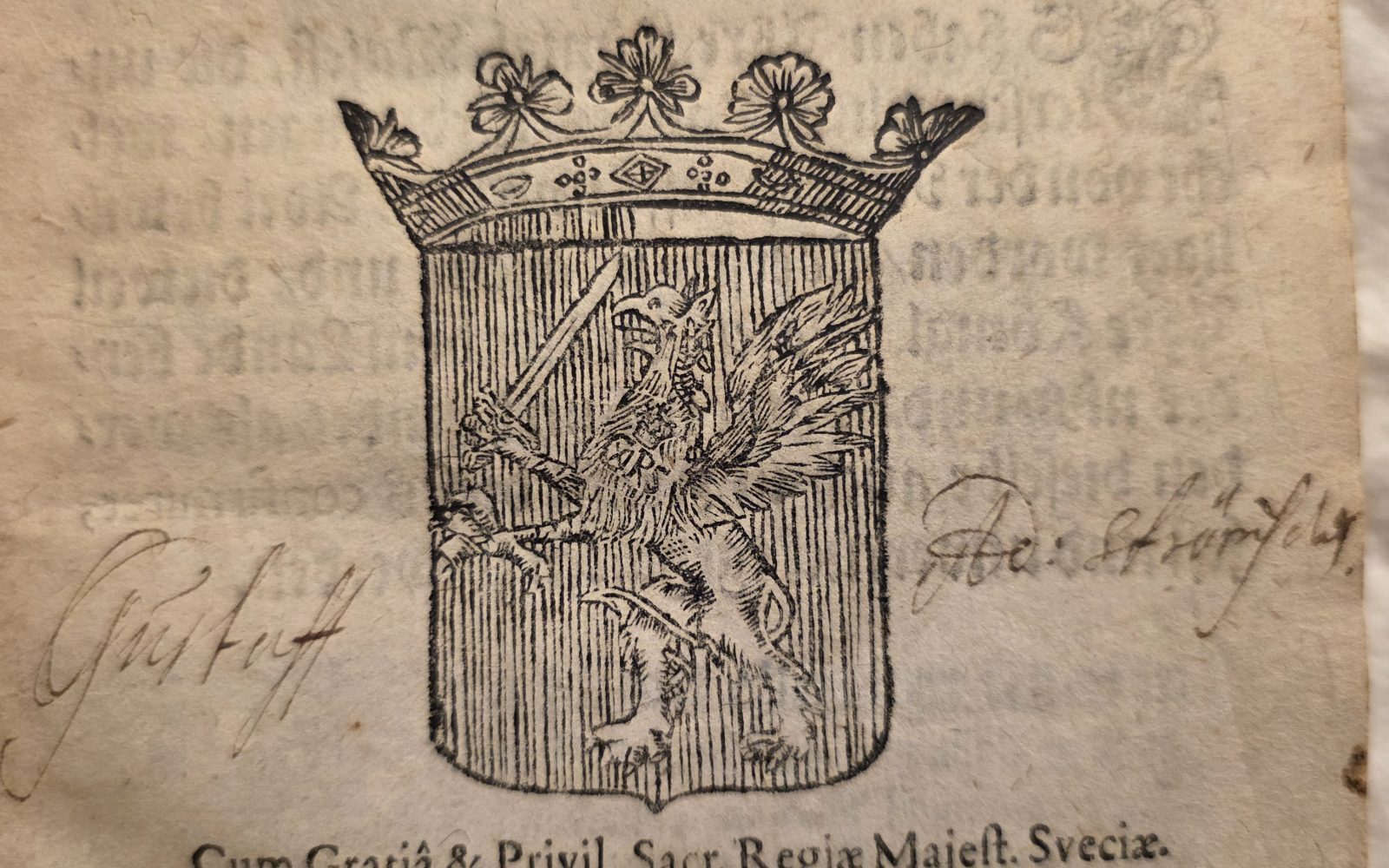
Transcription: Split across the central coat of arms of Swedish Livonia (the crowned griffin holding a sword with the monogram CRS for Carolus Rex Sveciae on its chest), the handwriting reads:
Gustaffon the left andAd: Strömfelt.(Gustaff Adolf Strömfelt) on the right. (A second ownership inscription at the very bottom below the publisher's imprint has been heavily crossed out in brown ink). -
Confidence Level: Virtually 100% (Extremely High). Both paleographically and historically, every detail aligns:
-
Script Analysis: The handwriting is a textbook late-17th/early-18th-century Swedish/German chancery script. On the left,
Gustaffis written in Latin/humanist cursive (typical for proper names of the era), while on the right,Ad: Strömfelt.uses characteristic Kurrent forms (such as the loopedAd:abbreviation, the distinctStligature, the umlaut mark over theö, and the long descendingf). -
Historical & Bibliographical Match: The book is the Lieffländische Landes-Ordnungen (Livonian Land Ordinances), published in Riga by the royal printer Georg Matthias Nöller (most notably in the 1705 and 1707 editions). Because this volume served as the foundational compilation of royal decrees, peasant regulations, church laws, and administrative ordinances for Swedish Livonia, Gustav Adolf Strömfelt—as the chief civil and economic administrator of the territory at the exact time it was printed—would have used this exact text as his daily working legal manual.
-
2. Who Was Gustav Adolf Strömfelt?
Born in 1640, Gustav Adolf Strömfelt was the son of the Swedish diplomat Johan Fegræus (ennobled as Strömfelt in 1632) and Christina Törnsköld. After studying at Uppsala University, he established deep roots in southern Estonia (then the northern part of the Governorate-General of Livonia):
-
Major Landowner: Through inheritance from his father and marriage into the Baltic-German nobility (first to Baroness Christina Elisabeth Taube, heiress of Luunja Manor, who was buried in Tartu Cathedral in 1697, and later to Brita Tungel in 1700), Strömfelt owned or administered major Estonian estates including Luua (Ludenhof), Luunja (Lunja), Mooste (Moisekatz), and Rasina (Rasin).
-
Royal Administrator: Serving initially as a judge (assessor) and local official in Tartu (Dorpat), he rose to become one of the most trusted representatives of King Charles XI and King Charles XII in the Baltic provinces. When Russia conquered Livonia in 1710, he evacuated to Sweden, where he died in 1717.
3. His Importance to Estonia
Strömfelt was the highest-ranking civil and economic official governing southern Estonia during the dramatic final two decades of the "Good Old Swedish Time" (vana hea rootsi aeg, 1690–1710):
-
Creation of an Administratively Unified Estonian District (1690):
Prior to 1690, the Estonian ethnic territory was split between the Governorate of Estonia (Northern Estonia, centered in Tallinn) and the Governorate-General of Livonia (Southern Estonia and Northern Latvia, centered in Riga). In 1690, King Charles XI reformed Livonia's administration along linguistic and ethnic lines, dividing it into two distinct economic districts: the Estonian District (comprising the Tartu and Pärnu counties plus Saaremaa) and the Latvian District. Following the death of the initially appointed Jakob Sneckensköld, Strömfelt was appointed Governor (ekonomiståthållare / majandusasehaldur) of the entire Estonian Economic District, holding the post from 1690 until the end of Swedish rule in 1710.
-
Enforcing the Great Reduction & Protecting Crown Peasants:
During the 1680s and 1690s, the Swedish Crown reclaimed the vast majority of private noble estates in Livonia (mõisate reduktsioon). As ekonomiståthållare, Strömfelt managed all Crown estates in southern Estonia. He was responsible for enforcing royal regulations (reglement) that standardized peasant taxation, curbed the arbitrary power of Baltic-German manor leaseholders, and granted Estonian peasants the right to appeal abuses directly to royal authorities.
-
Crisis Management During the Great Famine (1695–1697):
When catastrophic crop failures triggered the Great Famine (Suur nälg), which killed roughly 20% of Estonia's population (around 70,000–75,000 people), Strömfelt was at the center of the relief effort in Tartu and Pärnu. His surviving correspondence and archives document desperate attempts to distribute seed loans from royal granaries, inspect starving parishes, and defer peasant dues while still meeting Stockholm's fiscal demands.
-
Support for the University of Tartu & Rural Schools:
As the top royal official in Tartu (Dorpat)—and later in Pärnu (Pernau), where both his administrative office and the university relocated in 1699 due to the threat of war—Strömfelt oversaw the state revenues that funded the Academia Gustavo-Carolina (the University of Tartu) and the expanding network of Estonian peasant parish schools championed by Bengt Gottfried Forselius and Johann Fischer. His own son, Baron Otto Reinhold Strömfelt (1679–1746), studied at the University of Tartu for seven years before later serving as Sweden's chief negotiator at the Treaty of Nystad (1721).
-
Wartime Governance in the Great Northern War (1700–1710):
When the Great Northern War broke out in 1700, Strömfelt organized wartime logistics, troop billeting, and civil defense across Tartu and Pärnu. After Tartu fell to Russian forces in 1704, he continued governing the unoccupied western part of the district from the fortified port of Pärnu until the city's capitulation and plague outbreak in August 1710. Today, his extensive official archive (Ekonomiståthållaren i Dorpat/Pernau Gustav Adolf Strömfelts kontors arkiv) preserved in the National Archives of Estonia (Rahvusarhiiv) in Tartu remains one of the single most important primary sources for late-17th and early-18th-century Estonian social and economic history.