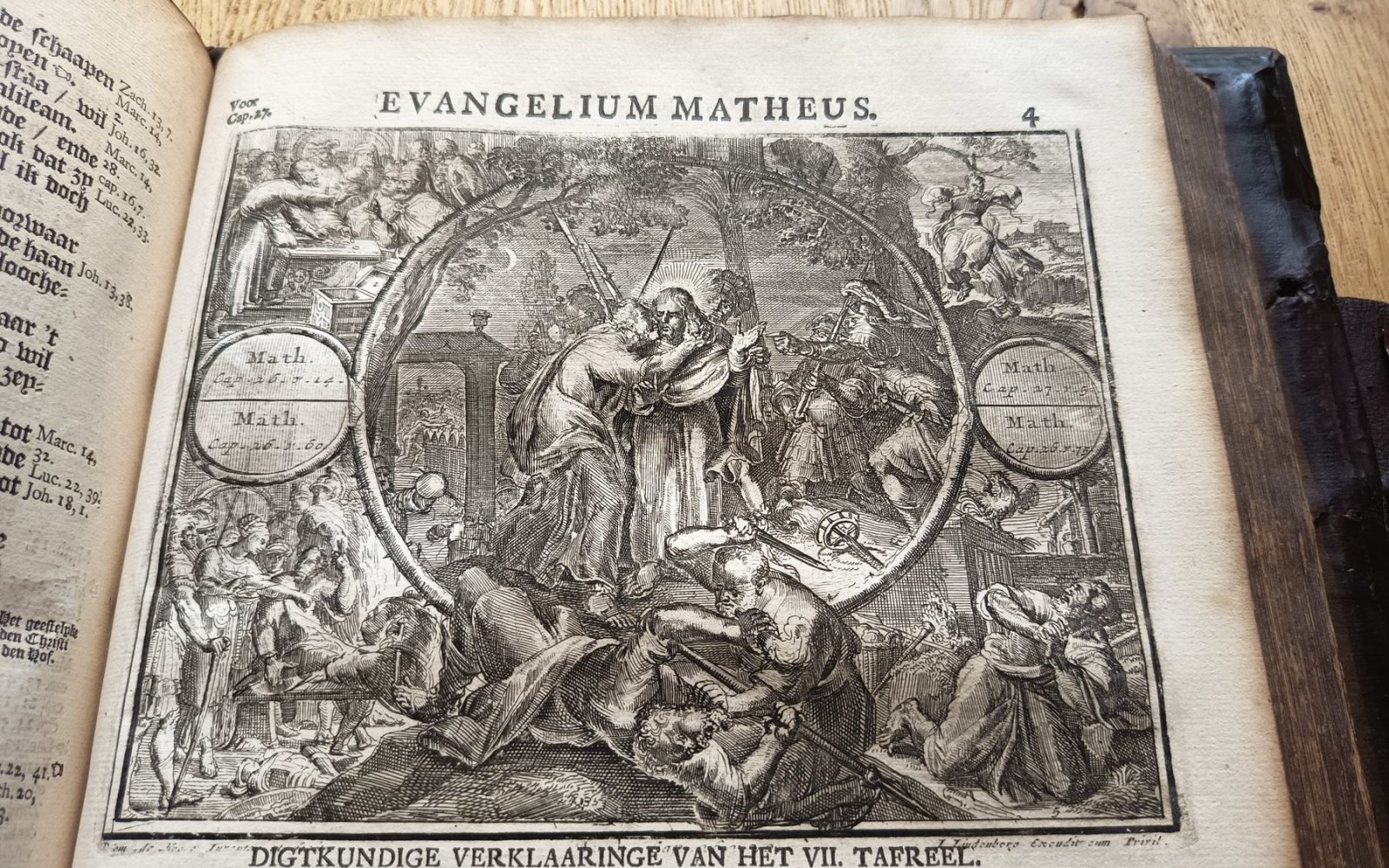
We recently found ourselves attempting to distinguish between several editions of Romeyn de Hooghe's famed Biblical series in order to place the copy we were researching amongst the known editions and variants. In our initial research, we used signals like the ordering of the plates on the pages, the page numbers, titles and signatures, the plate captions, plate inscriptions and even the visual device used to separate the caption columns. Yet even this rich combination of signals failed to properly distinguish the editions, leaving us at a loss of what to do, especially given that some plates appeared as-is in unexpected places – a common occurrence in these kinds of extra-illustrated works.
Finally, we asked Gemini to help us sort the copies and it spotted something instantly that we had missed: the presence of the text "Voor cap" (Dutch for "before chapter") at the top-left of the two-plate pages. Since we don't speak Dutch, we had entirely missed the significance of this apparent binders instruction. Not only had Gemini spotted these two critical distinguishing words, but it searched the open web for all other digitized copies and photographs it could find of copies with known edition information and was able to provide us a breakdown and inventory of editions where it appears that allowed us to finally confirm the details of the copy we were examining.
Once again – the power of AI for cultural heritage research: the ability of AI to spot something that in retrospect is so obvious, but that we had entirely looked past in our fixation on more traditional and obvious indicators like image ordering and page numbering, titling and signatures.