
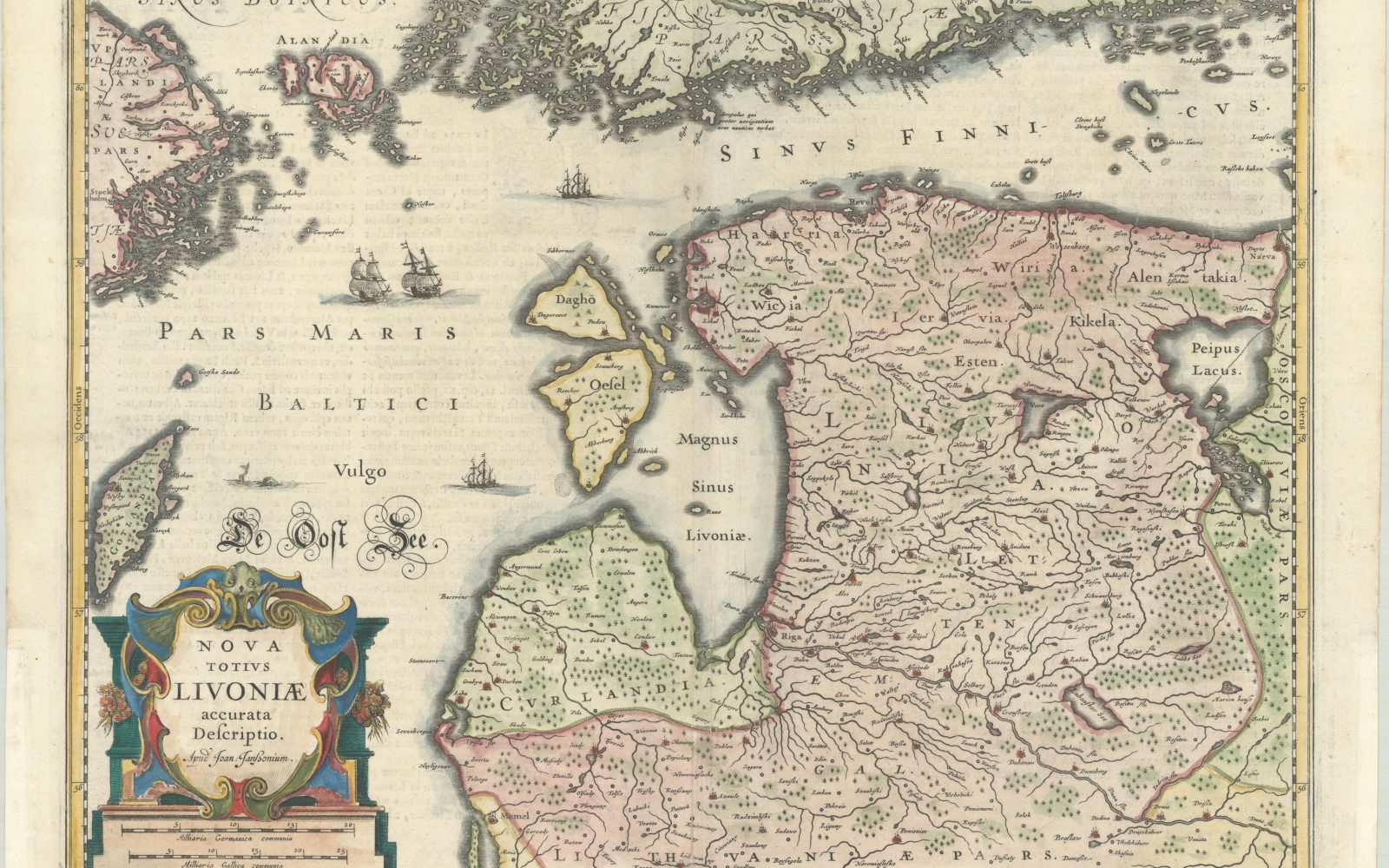
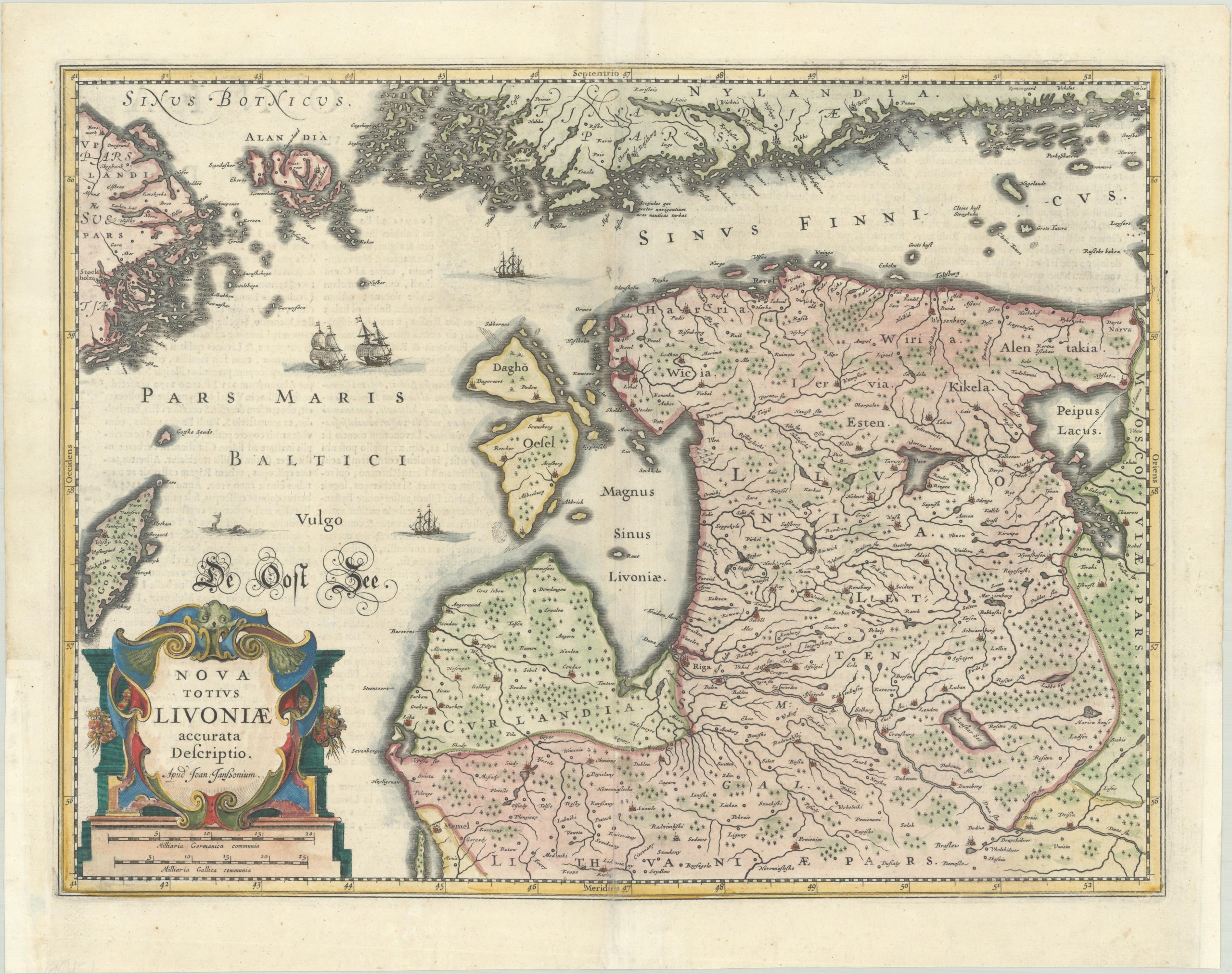
Johannes Janssonius's's 1646 edition of "Nova Totius Livoniae Accurata Descriptio" offers an early mid-17th-century look at the cartographic knowledge of Estonia. On the verso (back of the map) is an equally fascinating brief textual history of the country to that point. But, the text is entirely in Latin. Let's ask Gemini to transcribe and translate it for us, including the margin sectional headers!
Below is the map itself:
The verso (back) has text in Latin describing Livonia:
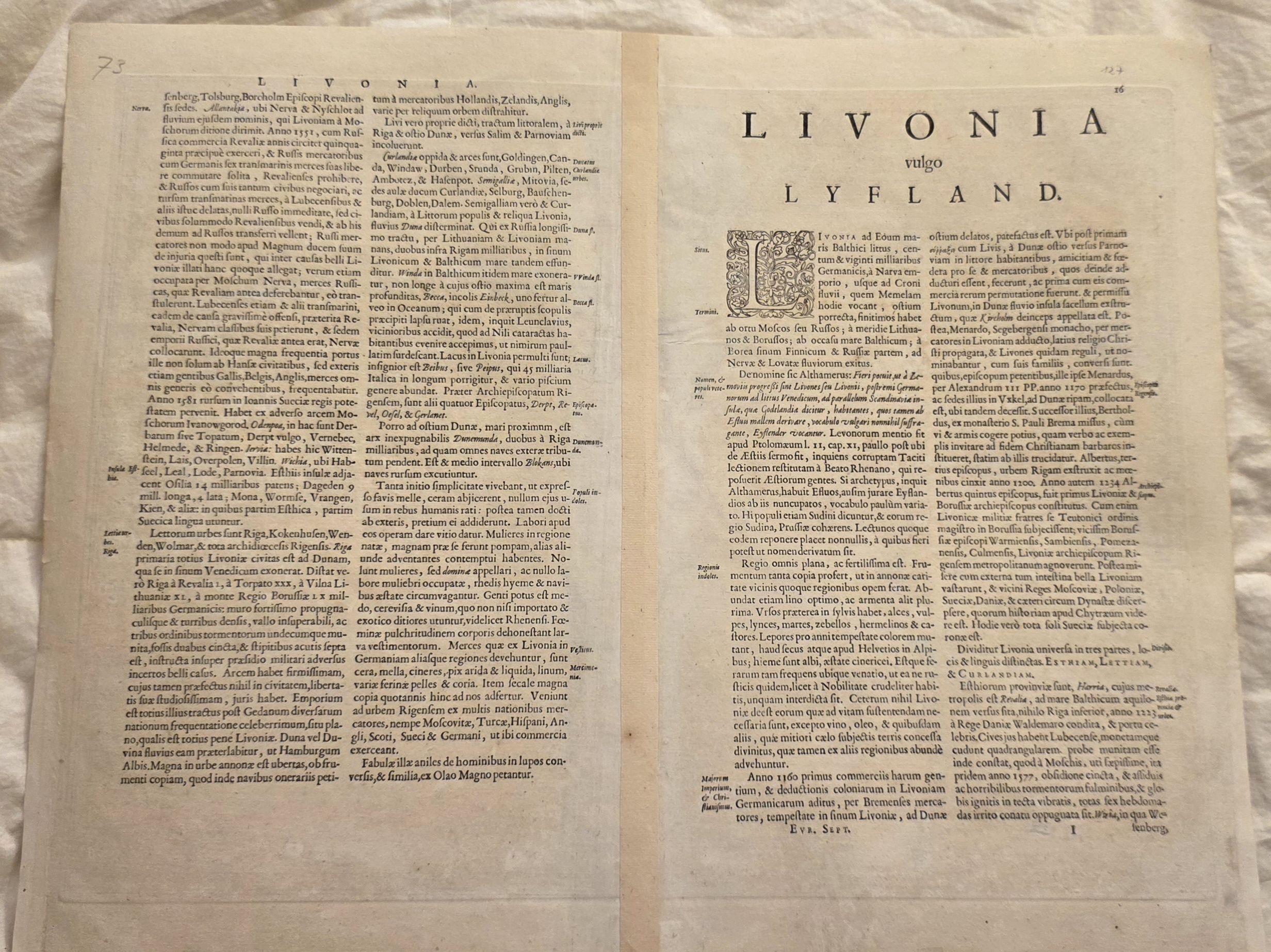
Let's ask Gemini 3.8 Flash to transcribe and translate it all into English:
Transcribe and translate this text verbatim.
Do not summarize.
Translate ALL OF IT.
The English translation:
LIVONIA
Commonly called
LYFLAND
(Marginal note: Situation. Boundaries.)
Livonia extends along the eastern shore of the Baltic Sea for one hundred and twenty German miles, reaching from Narva, an emporium, all the way to the mouth of the river Cronus, which is today called the Memel. It borders to the east upon the Muscovites or Russians; to the south upon the Lithuanians and the Prussians; to the west upon the Baltic Sea; and to the north upon the Gulf of Finland and part of Russia, where the mouths of the Narva and Lovata rivers lie.
(Marginal note: Name and character of the peoples.)
Concerning the name, Althamerus writes thus: It could have happened that the Livonians or Livones advanced into the territory of the Lithuanians; and finally that Germans, having advanced to the Venedic coast, to the parallel of the island of Scandinavia which is called Gothland, called the inhabitants whom they found there Estians, an ancient name, though with a slight shift in common speech they are called Eyslanders. Mention is made of the Levoni in Ptolemy, Book 2, Chapter 11, shortly after he speaks of the Estians, remarking that the corrupt reading of Tacitus was restored by Beatus Rhenanus, who identified the tribes of the Estians. If the archetype is sound, inquires Althamerus, I would dare affirm that the Eyslandians were named by them, the word having changed slightly. These people are also called Sudini, and their region Sudina, adjoining Prussia. Some prefer to emend the reading in that same passage, from which it can be inferred whence the name was derived.
(Marginal note: Character of the region.)
The entire region is flat and extremely fertile. It yields so great an abundance of grain that in times of scarcity it brings aid even to neighboring regions. It also abounds in the finest flax, as well as in plentiful livestock. In addition, it harbors bears in the forests, as well as elks, wolves, lynxes, martens, sables, ermines, and beavers. The hares change their color according to the season of the year, not unlike those among the Swiss in the Alps: in winter they are white, in summer ash-gray. Hunting is so widespread everywhere that not even peasants are ever forbidden it, although they are treated cruelly by the nobility. Furthermore, Livonia lacks nothing necessary to sustain life, except wine, oil, and certain other goods which divine providence has granted to milder lands under the sky; these, however, are abundantly imported from other regions.
(Marginal note: First beginning of commerce and the introduction of Christianity.)
In the year 1160, the first access to trade with these nations and to the founding of colonies in Livonia by the Germans took place, when merchants from Bremen, driven by a storm into the Gulf of Livonia, toward the mouth of the Daugava [Duna], reached safe harbor. There, after an initial skirmish with the Livonians dwelling along the shore from the mouth of the Daugava toward Pärnu, they concluded a peace and alliance on behalf of themselves and the merchants whom they subsequently brought thither; and at first their trade with them was an exchange of goods. And with the permission of the Livonians, they built a chapel on an island in the river Daugava, which was thereafter called Ykeskol [Ikšķile]. Afterward, when Meinard, a monk of Segeberg, was brought to Livonia by the merchants, the Christian religion was spread more widely, and certain chieftains of the Livonians, as they were called, were converted together with their families.
(Marginal note: First bishop.)
Upon their petitioning for a bishop, that same Meinard was appointed by Pope Alexander III in the year 1170, and his seat was placed at Yxkel on the bank of the Daugava, where he eventually died. His successor, Berthold, sent from the monastery of St. Paul in Bremen, when he began to compel the barbarians to the Christian faith by force and arms rather than inviting them by word and example, was immediately slain by them. Albert, the third bishop, founded the city of Riga and encircled it with walls in the year 1200.
(Marginal note: First archbishop.)
Moreover, in the year 1234 Albert, the fifth bishop, was made the first archbishop of Livonia and Prussia. For when the warrior Brothers of the Livonian Militia [the Livonian Sword-Brothers] had subjected themselves to the Grand Master of the Teutonic Order in Prussia, in turn the bishops of Prussia—those of Warmia, Sambia, Pomesania, and Chełmno—acknowledged the archbishop of Livonia at Riga as their metropolitan. Afterwards, almost all foreign and internal wars devastated Livonia; and the neighboring kings of Muscovy, Poland, and Sweden, of Denmark, and other surrounding Princes tore it apart, whose history may be seen in Chytraeus. Today, however, the whole land is subject to the crown of Sweden alone.
(Marginal note: Division of the region.)
The whole of Livonia is divided into three parts, distinguished by locations and languages: Esthia [Estonia], Lettia [Latvia], and Curlandia [Courland].
(Marginal note: Revalia. Principal city.)
The provinces of the Estonians are: Harria, whose metropolis is Revalia [Tallinn], lying near the Baltic Sea toward the north, in no way inferior to Riga; founded in the year 1223 by Valdemar, King of Denmark, and renowned for its harbor. The citizens possess the Law of Lübeck and strike a four-sided coin. That it is exceedingly well fortified is clear from the fact that, having been besieged by the Muscovites very frequently, and notably in the year 1577, with continuous and terrible artillery thunder, and with burning fireballs hurled onto its roofs, it was attacked for six whole weeks to no avail. Wicia, in which are Wesenberg, Tolsburg, Borcholm—
(Marginal note: Diocese.)
—the seat of the Bishop of Reval. Allentakia, where the Narva and the Nyſchlot river of the same name divide Livonia from the dominion of the Muscovites. In the year 1551, when Russian commerce was conducted primarily at Reval for about fifty years, and the Russian merchants were accustomed freely to barter their goods with transmarine Germans, the Revalians prohibited it, wanting the Russians to trade only with their own citizens, and that transmarine goods brought thither by the Lübeckers and others should not be sold directly to any Russian, but only to citizens of Reval, and from them at last transferred to the Russians. The Russian merchants not only complained of the injustice before their Grand Duke (which he also alleges among the causes of the war brought upon Livonia), but when Muscovite Narva was seized, they diverted thither the Russian goods that they previously brought to Reval. The Lübeckers, too, and other transmarine traders, highly offended for the same reason, bypassed Reval, sailed with their fleets to Narva, and established there the seat of Russian commerce that had once belonged to Reval. Hence that port came to be frequented with great abundance not only by the Hanseatic cities, but also by foreign nations—Gauls, English, and Scots—who gathered thither with all kinds of merchandise. In the year 1581 it returned once more under the power of King John of Sweden. Across from the fortress of the Muscovites, Ivangorod, it has Odenpoa; in this area are Derbatum, formerly Topatum, Derpt in the vernacular, Vernebec, Helmede, and Ringen. Jervia: in this area are Wittenstein, Lais, Overpolen, Villin. Wichia, where are Habsel, Leal, Lode, Parnovia.
(Marginal note: Islands of Esthia.)
Adjacent to Esthia are the islands of Ösel, 14 miles in circuit; Dagö, 9 miles long, 4 wide; Mona, Worms, Vrangen, Kien, and others; in which partly the Estonian and partly the Swedish tongue is used.
(Marginal note: Settlements of the Letts. Riga.)
The cities of the Letts are Riga, Kokenhusen, Wenden, Wolmar, and the entire archdiocese of Riga. Riga, the principal city of all Livonia, is situated on the Daugava, where it empties into the Gulf of Riga [Venedic Gulf]. Riga is distant from Reval 50 [German miles], from Tartu 30, from Vilnius in Lithuania 51, from Königsberg in Prussia 60 German miles: it is defended by a very strong wall, with bastions and dense towers, virtually impregnable, encircled by three lines of artillery on all sides, enclosed by two moats and fences of sharp stakes, and additionally equipped with a military garrison against the uncertain fortunes of war. It has a very strong citadel, whose governor, however, possesses no authority over the city, which is extremely zealous for its liberty. Its trading emporium is the most renowned in all this region after Gdańsk, because of its location in a flat country, such as nearly all of Livonia is. The river Daugava flows past it, just as the Elbe flows past Hamburg. There is great abundance of food in the city, thanks to the plenty of grain, so that ships gather from everywhere to be laden with it by merchants of Holland, Zeeland, and England, and it is dispersed variously through the rest of the world.
(Marginal note: The Livonians properly so called.)
The Livonians properly so called inhabited the coastal tract from Riga and the mouth of the Daugava toward Salis and Pärnu.
(Marginal note: Towns of Courland.)
The towns and fortresses of Courland are Kuldīga, Kandava, Ventspils, Durben, Srunda, Grobiņa, Piltene, Embūte, and Aizpute. Semigallia, Jelgava, the seat of the court of the Dukes of Courland, Selburg, Bauska, Dobele, Dahlen. The river Daugava separates Semigallia and Courland from the coastal peoples and the rest of Livonia.
(Marginal note: River Daugava.)
Flowing from Russia over a very long course through Lithuania and Livonia, two miles below Riga it finally empties into the Gulf of Livonia and the Baltic Sea.
(Marginal note: River Venta.)
The Venta likewise empties into the Baltic Sea; not far from its mouth is the greatest depth of the sea.
(Marginal note: River Becca.)
The Becca, called Eisbeck by the inhabitants, is carried into the ocean in a single channel; falling headlong over sheer cliffs, the same thing happens, says Leunclavius, as we have heard occurs to those living near the cataracts of the Nile: namely, they gradually grow deaf.
(Marginal note: Lakes.)
There are numerous lakes in Livonia; the most notable is Lake Peipus, sive Peipus, which stretches 45 Italian miles in length and abounds in various kinds of fish. Besides the Archbishopric of Riga, there are four other Bishoprics: Tartu, Reval, Ösel, and Courland.
(Marginal note: Dünamünde fortress.)
Furthermore, at the mouth of the Daugava, closest to the sea, is the impregnable fortress of Dünamünde, two miles from Riga, upon which all foreign ships depend. And at the midway point is Blokens, where ships are searched on their way back.
(Marginal note: Character of the people.)
Formerly they lived in such simplicity that they threw away honeycombs after the honey was pressed out, and put them to no human use; later, however, having been taught by foreigners, they set a value upon them. Hard labor is considered a disgrace among them. The women in this region walk about with great ostentation, holding all arrivals from elsewhere in contempt. They do not want to be called women, but ladies; engaged in no womanly labor, they travel about in carriages in winter and in boats in summer. The drink of the common people is mead, ale, and beer; they do not use wine unless it is imported, and the wealthier sort use exotic wines, namely Rhenish. Women disfigure the beauty of their bodies with broad garments.
(Marginal note: Commodities.)
The commodities that are exported from Livonia to Germany and other regions are wax, honey, ashes, dry and liquid pitch, flax, and various wild animal skins and hides. Likewise, a great abundance of rye is brought from here to us every year. Merchants from many nations come to the city of Riga: namely, Muscovites, Turks, Spaniards, English, Scots, Swedes, and Germans, in order to conduct their commerce there.
Those old wives' tales concerning men turned into wolves, and similar stories, may be sought from Olaus Magnus.
The original Latin:
[Page 127 / 16]
L I V O N I A
vulgo
L Y F L A N D.
(Marginal note: Situs.)
LIVONIA ad Eöum maris Balthici littus, centum & viginti milliaribus Germanicis, à Narva emporio, uſque ad Croni fluvii, quem Memelam hodie vocant, oſtium porrecta, finitimos habet ab ortu Moſcos ſeu Ruſſos; à meridie Lithuanos & Boruſſos; ab occaſu mare Balthicum; à Borea ſinum Finnicum & Ruſſiæ partem, ad Nervæ & Lovatæ fluviorum exitus.
(Marginal note: Termini.)
(Marginal note: Nomen, & populi mores.)
De nomine ſic Althamerus: Fieri potuit ut à Lemonum progreſſi ſint Livones ſeu Livoni, poſtremo Germanorum ad littus Venedicum, ad parallelum Scandinaviæ inſulæ, quæ Godtlandia dicitur, habitantes, quos tamen ab Eſtua mallem derivare, vocabulo vulgari nonnihil ſuffragante, Eyſlender vocantur. Levonorum mentio fit apud Ptolomæum l. 11, cap. 11, paullo poſt ubi de Æſtiis ſermo fit, inquiens corruptam Taciti lectionem reſtitutam à Beato Rhenano, qui repoſuerit Eſtiorum gentes. Si archetypus, inquit Althamerus, habuit Eſtuos, auſim jurare Eyſlandios ab iis nuncupatos, vocabulo paulùm variato. Hi populi etiam Sudini dicuntur, & eorum regio Sudina, Pruſſiæ cohærens. Lectiones quoque eodem reponere placet nonnullis, à quibus fieri poteſt ut nomen derivatum ſit.
(Marginal note: Regionis indoles.)
Regio omnis plana, ac fertiliſſima eſt. Frumentum tanta copia profert, ut in annonæ caritate vicinis quoque regionibus opem ferat. Abundat etiam lino optimo, ac armenta alit plurima. Urſos præterea in ſylvis habet, alces, vulpes, lynces, martesz, zebellos, hermelinos & caſtores. Lepores pro anni tempeſtate colorem mutant, haud ſecus atque apud Helvetios in Alpibus; hieme ſunt albi, æſtate cinericei. Eſtque ferarum tam frequens ubique venatio, ut ea ne ruſticis quidem, licet à Nobilitate crudeliter habitis, unquam interdicta ſit. Cæterum nihil Livoniæ deeſt eorum quæ ad vitam ſuſtentandam neceſſaria ſunt, excepto vino, oleo, & quibuſdam aliis, quæ mitiori cælo ſubjectis terris conceſſa divinitus, quæ tamen ex aliis regionibus abundè advehuntur.
(Marginal note: Maiorum Imperium, & Chriſtianiſmi.)
Anno 1160 primus commerciis harum gentium, & deductionis coloniarum in Livoniam Germanicarum aditus, per Bremenſes mercatores, tempeſtate in ſinum Livoniæ, ad Dunæ oſtium delatos, patefactus eſt. Ubi poſt primam rixam cum Livis, à Dunæ oſtio verſus Parnoviam in littore habitantibus, amicitiam & fœdera pro ſe & mercatoribus, quos deinde adduxiſſent, fecerunt, ac prima cum eis commercia rerum permutatione fuerunt. & permiſſu Livonum, in Dunæ fluvio inſula ſacellum exſtructum, quæ Ykeskol deinceps appellata eſt. Poſtea, Menardo, Segebergenſi monacho, per mercatores in Livoniam adducto, latius religio Chriſti propagata, & Livones quidam reguli, ut nominabantur, cum ſuis familiis, converſi ſunt.
(Marginal note: Epiſcopus primus.)
quibus, epiſcopum petentibus, ille ipſe Menardus, per Alexandrum III PP. anno 1170 præfectus, ac ſedes illius in Yxkel, ad Dunæ ripam, collocata eſt, ubi tandem deceſſit. Succeſſor illius, Bertholdus, ex monaſterio S. Pauli Bremæ miſſus, cùm vi & armis cogere potius, quam verbo ac exemplis invitare ad fidem Chriſtianam barbaros inſtitueret, ſtatim ab illis trucidatur. Albertus, tertius epiſcopus, urbem Rigam exſtruxit ac mœnibus cinxit anno 1200.
(Marginal note: Archiepiſcopus.)
Anno autem 1234 Albertus quintus epiſcopus, fuit primus Livoniæ & Boruſſiæ archiepiſcopus conſtitutus. Cum enim Livonicæ militiæ fratres ſe Teutonici ordinis magiſtro in Boruſſia ſubjeciffent; viciſſim Boruſſiæ epiſcopi Warmienſis, Sambienſis, Pomezanenſis, Culmenſis, Livoniæ archiepiſcopum Rigenſem metropolitanum agnoverunt. Poſtea miſere cum externa tum inteſtina bella Livoniam vaſtarunt, & vicini Reges Moſcoviæ, Poloniæ, Sueciæ, Daniæ, & cæteri circum Dgnaſtæ diſcerpſere, quorum hiſtoriam apud Chytraum videre eſt. Hodie verò tota ſoli Sueciæ ſubjecta coronæ eſt.
(Marginal note: Diviſio.)
Dividitur Livonia univerſa in tres partes, locis & linguis diſtinctas. ESTHIAM, LETTIAM, & CURLANDIAM.
(Marginal note: Revalia. Eſthiæ præcipua urbs.)
Eſthiorum provinciæ ſunt, Harria, cujus metropolis eſt Revalia, ad mare Balthicum aquilonem verſus ſita, nihilo Riga inferior, anno 1223 à Rege Daniæ Waldemaro condita, & portu celebris. Cives jus habent Lubecenſe, monetamque cudunt quadrangularem. probe munitam eſſe inde conſtat, quod à Moſchis, uti ſæpiſſime, ita pridem anno 1577, obſidione cincta, & aſſiduis ac horribilibus tormentorum fulminibus, & globis ignitis in tecta vibratis, totas ſex hebdomadas irrito conatu oppugnata ſit. Wicia, in qua Weſenberg, Tolsburg, Borcholm
[Page 73]
Epiſcopi Revalienſis ſedes.
(Marginal note: Diœceſis.)
Allentakia, ubi Nerva & Nyſchlot ad fluvium ejuſdem nominis, qui Livoniam à Moſchorum ditione dirimit. Anno 1551, cum Ruſſica commercia Revaliæ annis circiter quinquaginta præcipuè exerceri, & Ruſſis mercatoribus cum Germanis ſex tranſmarinis merces ſuas libere commutare ſolita, Revalienſes prohibere, & Ruſſos cum ſuis tantum civibus negociari, ac rurſum tranſmarinas merces, à Lubecenſibus & aliis iſtuc delatas, nulli Ruſſo immediate, ſed civibus ſolummodo Revalienſibus vendi, & ab his demum ad Ruſſos transferri vellent; Ruſſi mercatores non modo apud Magnum ducem ſuum de injuria quæſti ſunt, qui inter cauſas belli Livoniæ illati hanc quoque allegat; verum etiam occupata per Moſchum Nerva, merces Ruſſicas, quæ Revaliam antea deferebantur, eò tranſtulerunt. Lubecenſes etiam & alii tranſmarini, eadem de cauſa graviſſimè offenſi, præterita Revalia, Nervam claſſibus ſuis petierunt, & ſedem emporii Ruſſici, quæ Revaliæ antea erat, Nervæ collocarunt. Ideoque magna frequentia portus ille non ſolum ab Hanſæ civitatibus, ſed exteris etiam gentibus Gallis, Belgis, Anglis, merces omnis generis eò convehentibus, frequentabatur. Anno 1581 rurſum in Ioannis Sueciæ regis poteſtatem pervenit. Habet ex adverſo arcem Moſchorum Ivanowgorod, Odenpoa, in hac ſunt Derbatum ſive Topatum, Derpt vulgo, Vernebec, Helmede, & Ringen. Iervia: habes hic Wittenſtein, Lais, Overpolen, Villin. Wichia, ubi Habſeel, Leal, Lode, Parnovia.
(Marginal note: Inſulæ Eſthiæ.)
Eſthiis inſulæ adjacent Oſilia 14 milliaribus patens; Dageden 9 mill. longa, 4 lata; Mona, Wormſe, Vrangen, Kien, & aliæ: in quibus partim Eſthica, partim Suecica lingua utuntur.
(Marginal note: Lettorum urbes. Riga.)
Lettorum urbes ſunt Riga, Kokenhuſen, Wenden, Wolmar, & tota archidiœceſis Rigenſis. Riga primaria totius Livoniæ civitas eſt ad Dunam, qua ſe in ſinum Venedicum exonerat. Diſtat verò Riga à Revalia l, à Torpato xxx, à Vilna Lithuaniæ li, à monte Regio Boruſſiæ lx milliaribus Germanicis: muro fortiſſimo propugnaculiſque & turribus denſis, vallo inſuperabili, ac tribus ordinibus tormentorum undecumque munita, foſſis duabus cincta, & ſtipitibus acutis ſepta eſt, inſtructa inſuper præſidio militari adverſus incertos belli caſus. Arcem habet firmiſſimam, cujus tamen præfectus nihil in civitatem, libertatis ſuæ ſtudioſiſſimam, juris habet. Emporium eſt totius illius tractus poſt Gedanum diverſarum nationum frequentatione celeberrimum, ſitu plano, qualis eſt totius pene Livoniæ. Duna vel Duvina fluvius eam præterlabitur, ut Hamburgum Albis. Magna in urbe annonæ eſt ubertas, ob frumenti copiam, quod inde navibus onerariis petitum à mercatoribus Hollandis, Zelandis, Anglis, varie per reliquum orbem diſtrahitur.
(Marginal note: Livi propriè dicti.)
Livi vero proprie dicti, tractum littoralem, à Riga & oſtio Dunæ, verſus Salim & Parnoviam incoluerunt.
(Marginal note: Curlandiæ urbes.)
Curlandiæ oppida & arces ſunt, Goldingen, Canda, Windaw, Durben, Srunda, Grubin, Pilten, Ambotez, & Haſenpot. Semigallia, Mitovia, ſedes aulæ ducum Curlandiæ, Selburg, Baufchenburg, Doblen, Dalem. Semigalliam verò & Curlandiam, à Littorum populis & reliqua Livonia, fluvius Duna diſterminat.
(Marginal note: Duna f.)
Qui ex Ruſſia longiſſimo tractu, per Lithuaniam & Livoniam manans, duobus infra Rigam milliaribus, in ſinum Livonicum & Balthicum mare tandem effunditur.
(Marginal note: Winda f.)
Winda in Balthicum itidem mare exoneratur, non longe à cujus oſtio maxima eſt maris profunditas.
(Marginal note: Becca fl.)
Becca, incolis Eisbeck, uno fertur alveo in Oceanum; qui cum de præruptis ſcopulis præcipiti lapſu ruat, idem, inquit Leunclavius, vicinioribus accidit, quod ad Nili cataractas habitantibus evenire accepimus, ut nimirum paullatim ſurdeſcant.
(Marginal note: Lacus.)
Lacus in Livonia permulti ſunt; inſignior eſt Beibus, ſive Peipus, qui 45 milliaria Italica in longum porrigitur, & vario piſcium genere abundat.
(Marginal note: Epiſcopatus.)
Præter Archiepiſcopatum Rigenſem, ſunt alii quatuor Epiſcopatus, Derpt, Reval, Oeſel, & Gerlanet.
(Marginal note: Dunemunde arx.)
Porro ad oſtium Dunæ, mari proximum, eſt arx inexpugnabilis Dunemunde, duobus à Riga milliaribus, ad quam omnes naves exteræ tributum pendent. Eſt & medio intervallo Blokens, ubi naves rurſum excutiuntur.
(Marginal note: Populi indoles.)
Tanta initio ſimplicitate vivebant, ut expreſſo favis melle, ceram abjicerent, nullum ejus uſum in rebus humanis rati: poſtea tamen docti ab exteris, pretium ei addiderunt. Labori apud eos operam dare vitio datur. Mulieres in regione natæ, magnam præ ſe ferunt pompam, alias aliunde advectantes contemptui habentes. Nolunt mulieres, ſed dominæ appellari, ac nullo labore muliebri occupatæ, rhedis hyeme & navibus æſtate circumvagantur. Genti potus eſt medo, cereviſia & vinum, quo non niſi importato & exotico ditiores utuntur, videlicet Rhenenſi. Fœminæ pulchritudinem corporis dehoneſtant larva veſtimentorum.
(Marginal note: Veſtitus.)
(Marginal note: Merces.)
Merces quæ ex Livonia in Germaniam aliaſque regiones devehuntur, ſunt cera, mella, cineres, pix arida & liquida, linum, variæ ferinæ pelles & coria. Item ſecale magna copia quotannis hinc ad nos adfertur. Veniunt ad urbem Rigenſem ex multis nationibus mercatores, nempe Moſcovitæ, Turcæ, Hiſpani, Angli, Scoti, Sueci & Germani, ut ibi commercia exerceant.
Fabulæ illæ aniles de hominibus in lupos converſis, & ſimilia, ex Olao Magno petantur.