
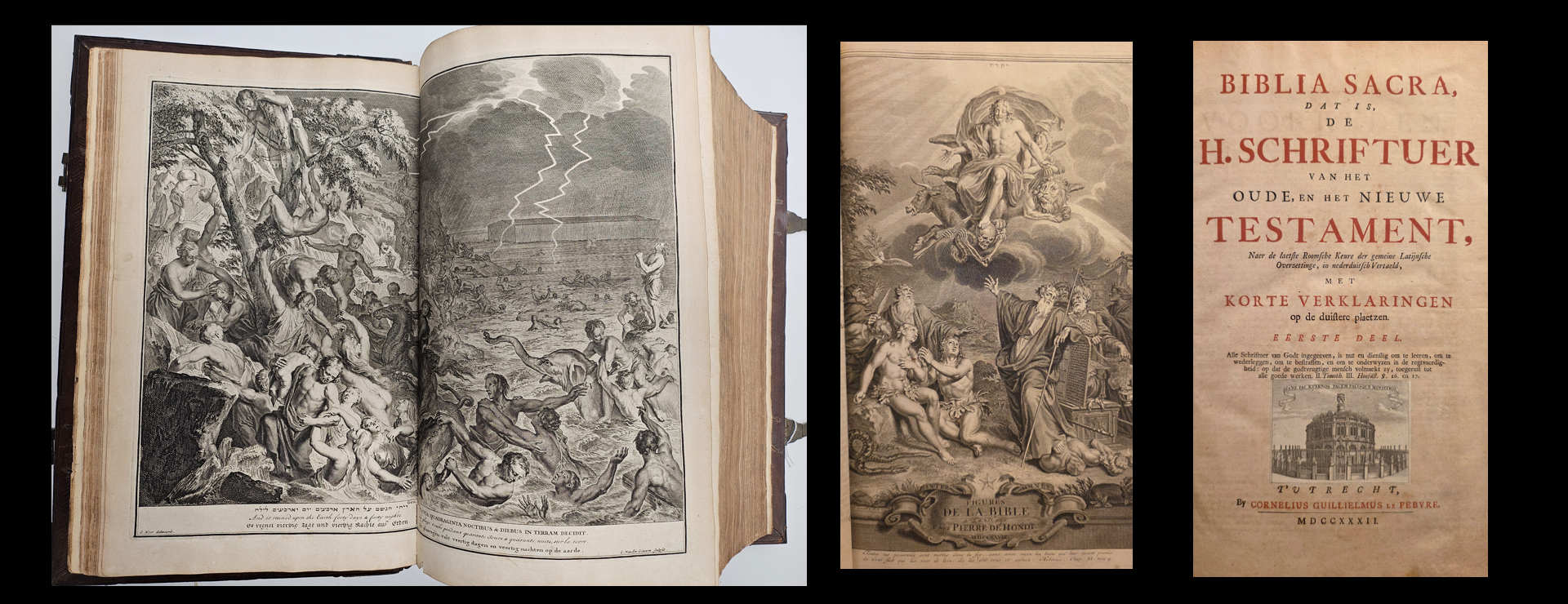
Amongst The Collection's seminal collection of the landmark picture Bibles is a complete 1729 copy of famed Pieter de Hondt’s illustrated Bible bound inside a 1732 first edition of the Bible of the Dutch Old Catholics. Yesterday we explored what Gemini could tell us about the handwritten notes in this copy and, most fascinatingly, an intriguing puzzle: an engraving from another book that was glued onto the title page over the original printer's device. For yesterday's experiments we used Gemini 3.1 Pro, which, while extremely powerful, has a tendency to hallucinate details when confronted with complex reasoning questions like this for which there are no easy answers. Here we explore what the vastly more powerful Gemini Deep Research can tell us about the engraving and its proposed explanations of its meaning. In the end, Gemini Deep Research devises a fascinating potential explanation that dives deeply into the ecclesiastical history of the Netherlands in the early 1700s and is actually quite plausible – once again demonstrating the tremendous power of Deep Research to bring to bear immense amounts of historical information and reasoning power to tackle complex bibliography challenges.
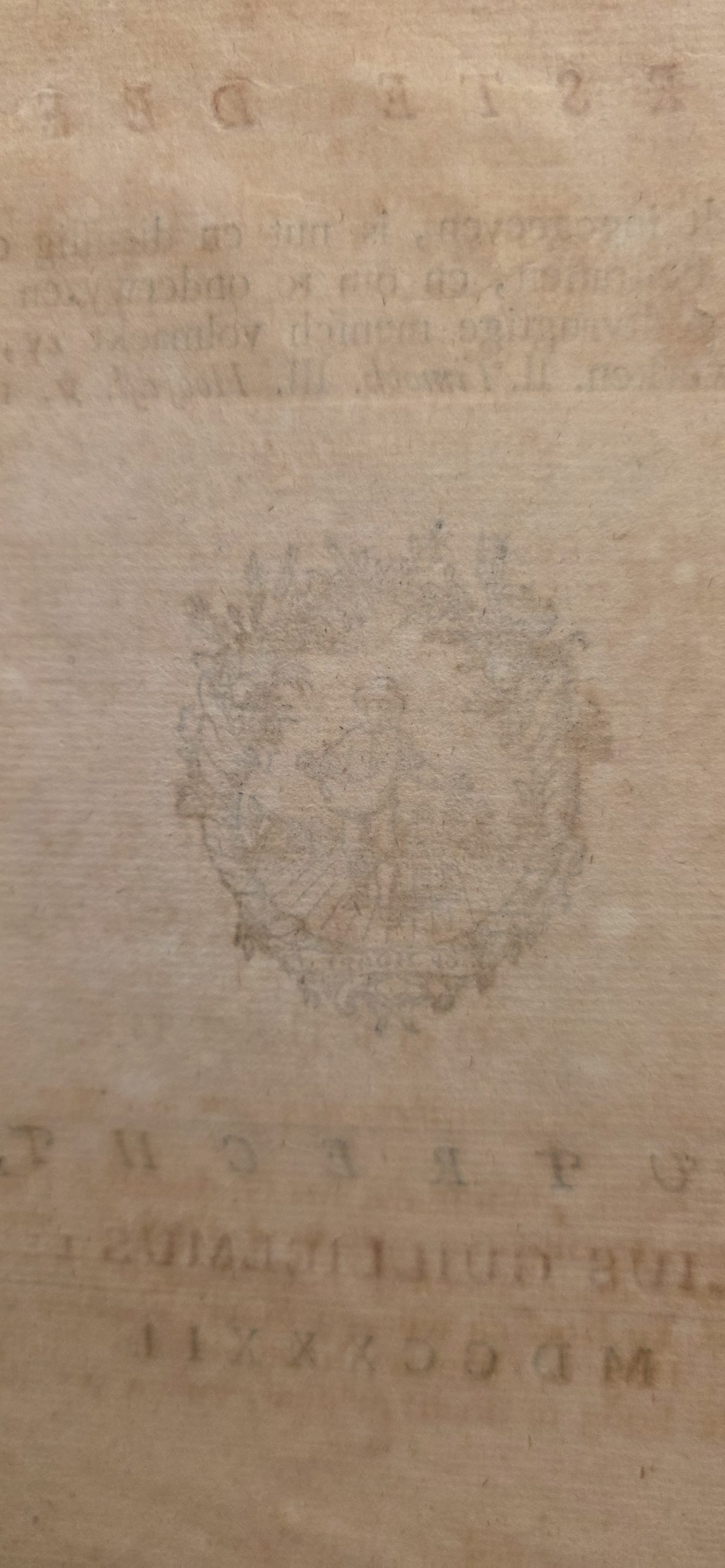
Below you can see the modified title page of this Bible, with the pasted-in engraving clearly visible. A careful analysis of the engraving demonstrates it is on contemporary paper and that there are no markings or writing being obscured by it other than the original printer's device. The fact that it isn't covering up anything indicates it was not pasted in merely to obscure some previous writing (in which case it might have been just randomly selected from whatever the owner had at hand at the moment) and was thus purposely chosen for its symbolic meaning. The printer's mark visible through the back of the page exactly matches what is expected and this particular printer and emblem were not controversial (and thus there would have been no reason for the owner to obscure the printer's device). It is also notable that the image was pasted onto the Bible's title page specifically. So, why did a previous owner paste this particular image onto this particular Bible's title page?
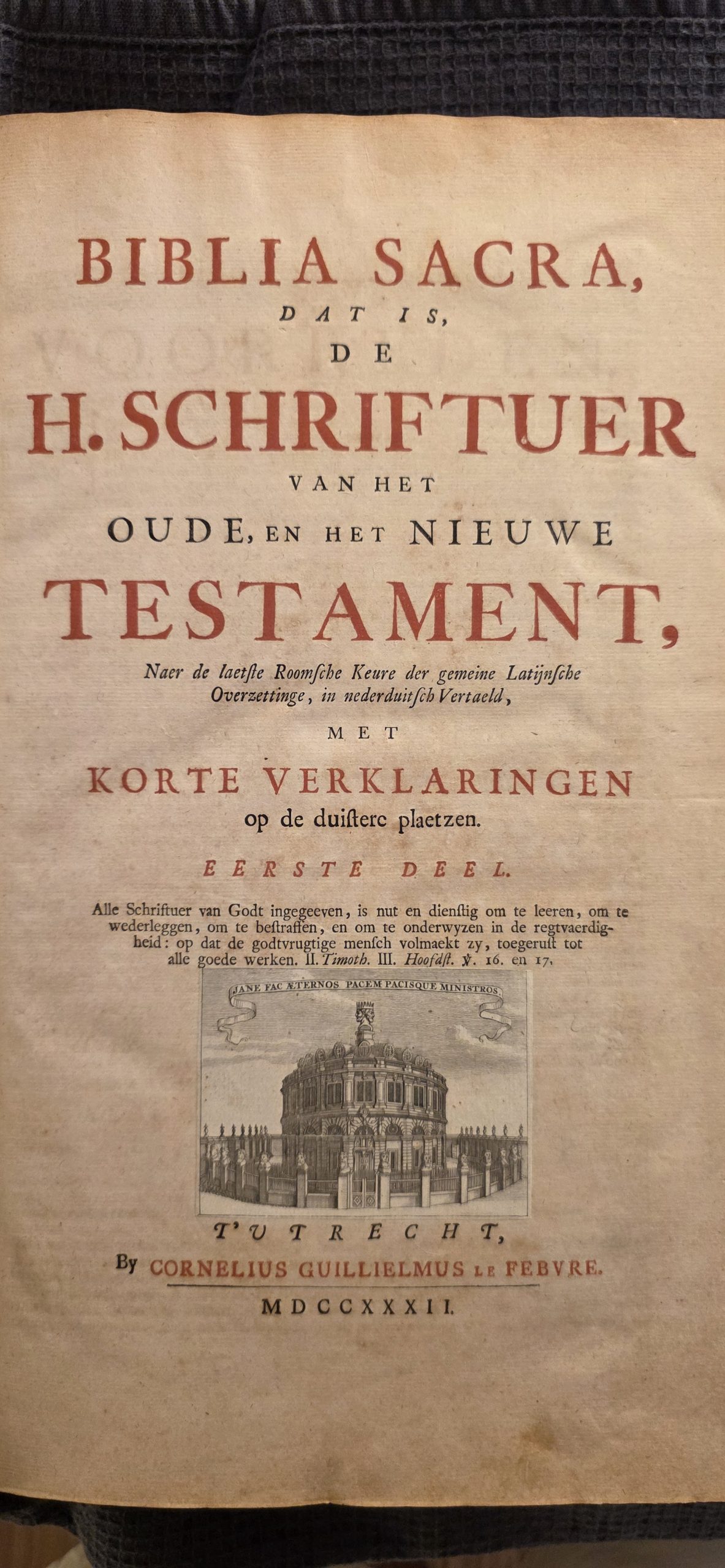
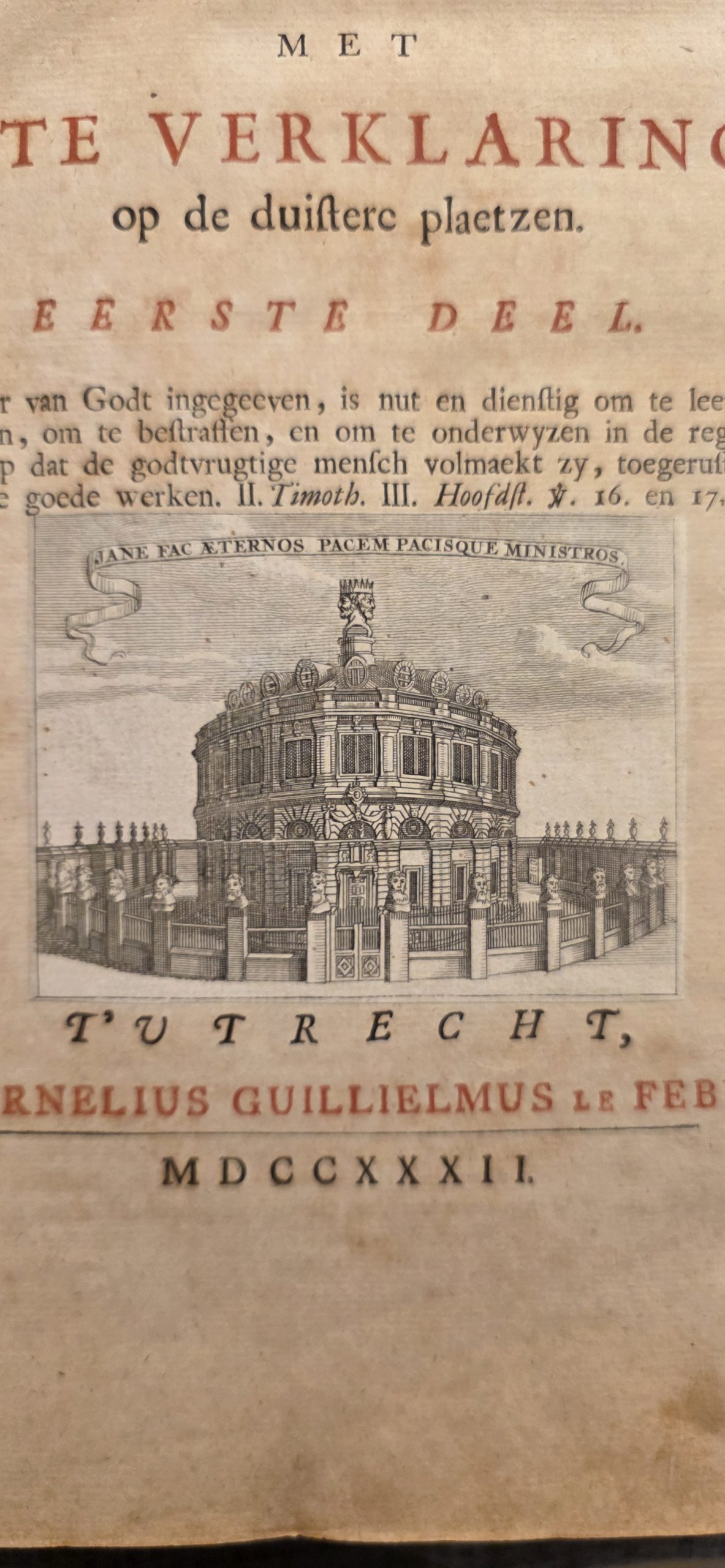
Let's first try to identify the pasted-in engraving. Historically this would have been done through a reverse Google Images search. Unfortunately, given that this is the printer's device of Oxford University Press (OUP) and depicts the Sheldonian Theatre in Oxford, England where OUP was based at the time, Google Images returns a nearly infinite array of results of both the OUP device and any and every other form of depiction of the theater:
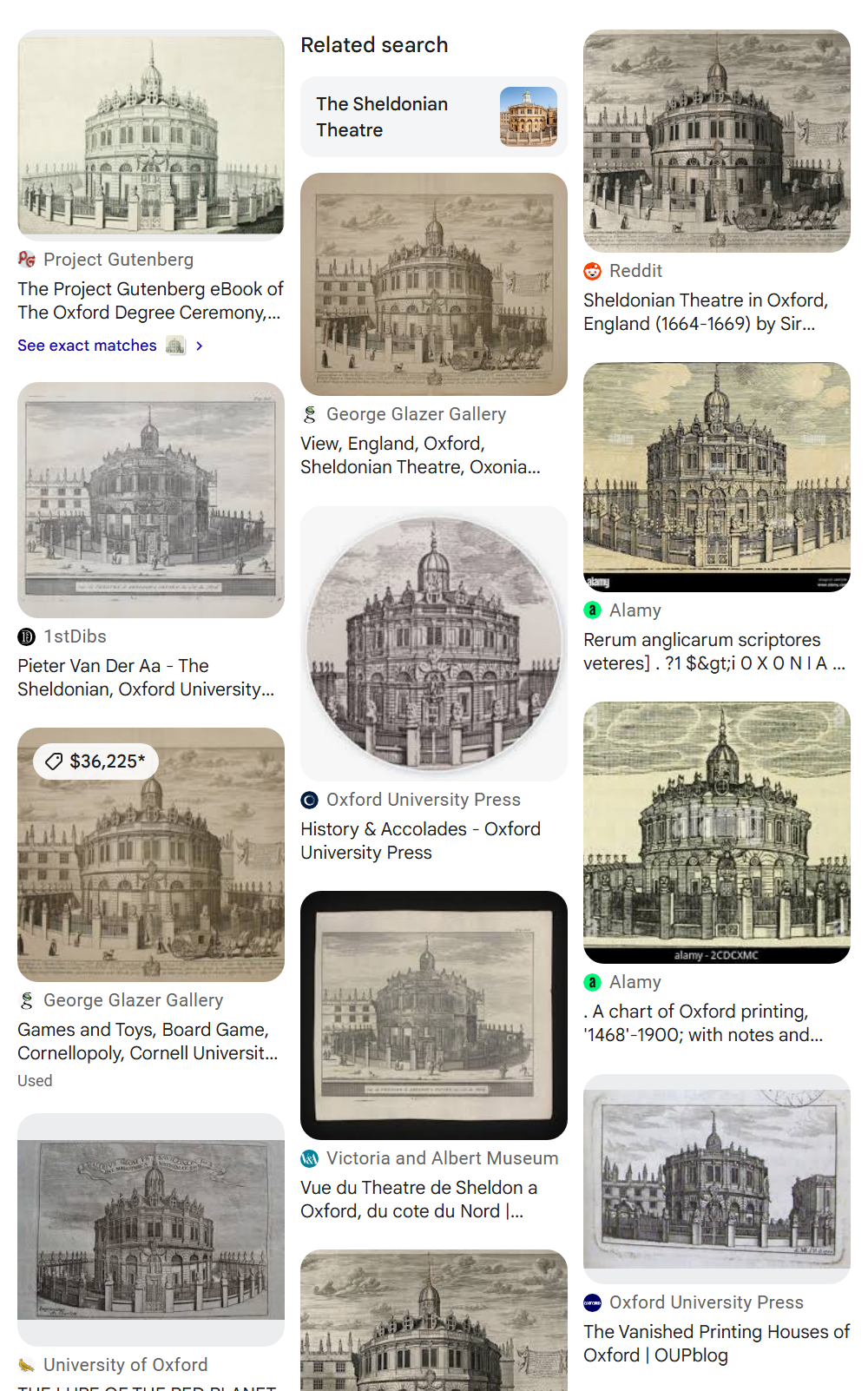
Historically, one would address this by requesting that Google Images return only "exact matches" rather than "visual matches". Theoretically this means that Google Images would return only that precise exact image, rather than images that look extremely similar. Unfortunately, as we can see below, no matter what we try to do to guide it, Google Images fixates too much on the depiction of the theater and loses focus on the text ribbon and Janus head at top and thus returns an infinite array of "nearly similar" matches, but none of them are the actual image we are looking for.
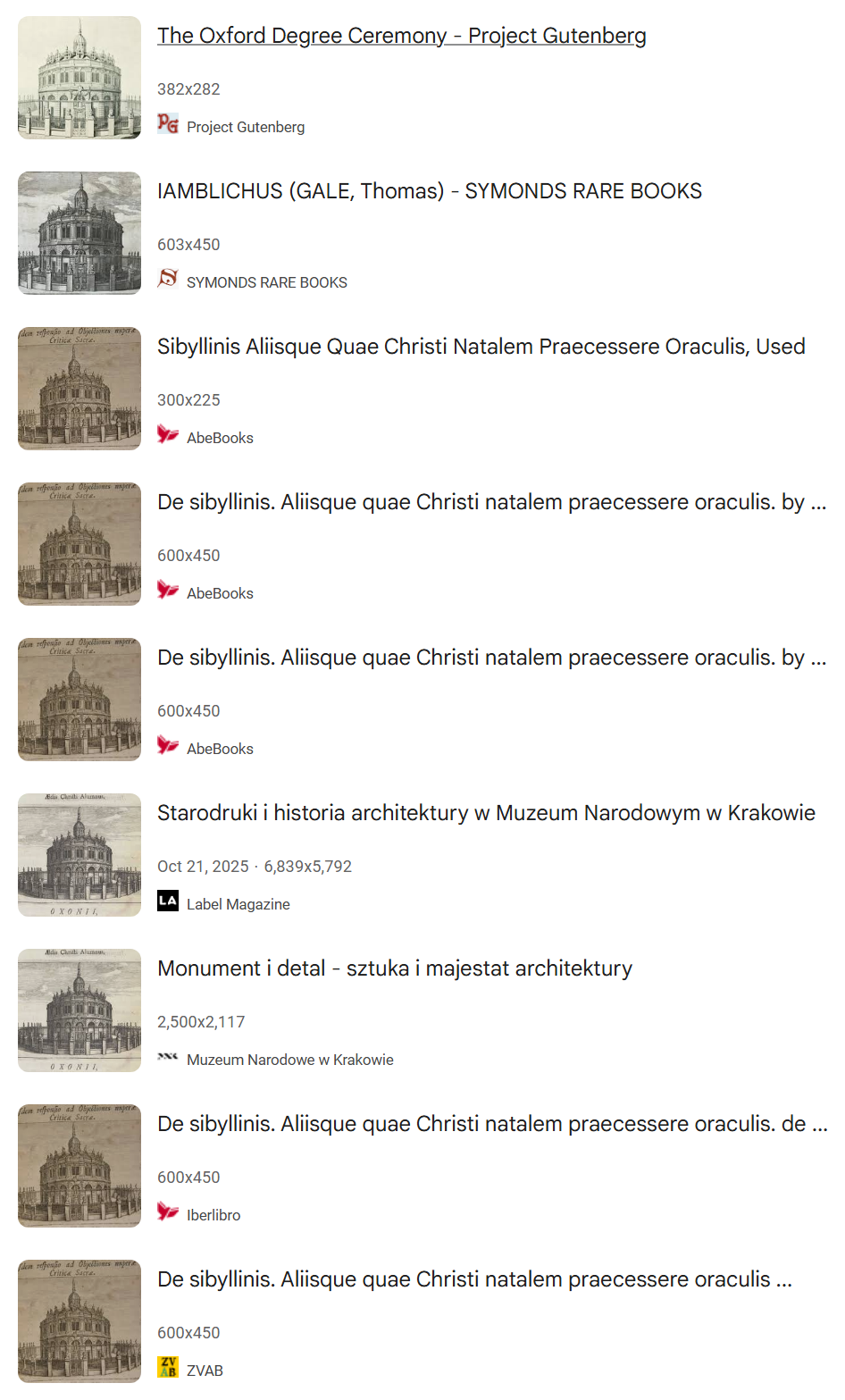
Image search is actually an area where frontier AI models are proving especially adept, though with caveats. Yesterday when we asked Gemini repeatedly to identify the engraving, it was unable to identify the actual work and instead asserted that it was a special commemorative device designed by OUP to recognize the 1713 Peace of Utrecht, which we were unable to confirm through any sources (and which appears to be false). Extensive Google Images searching yielded no matches for this engraving. Gemini 3.1 Pro did manage to identify it as the OUP printer's device and transcribe and translate the Latin text at top as "JANE FAC AETERNOS PACEM PACISQUE MINISTROS" ("O Janus, make peace and the ministers of peace everlasting"), but that was the limits of its ability to identify the image.
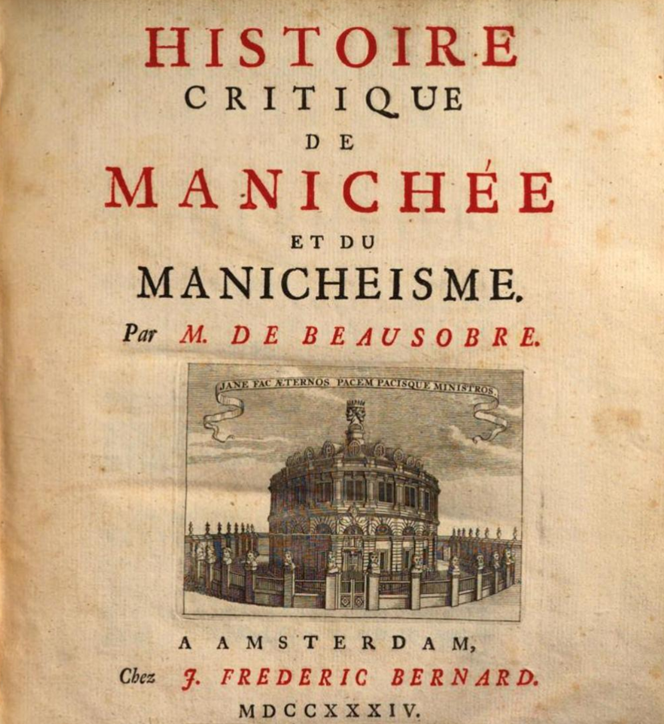
As an experiment, today we tried Gemini Deep Think, a vastly more powerful model that allows Gemini far more thinking time and incorporates additional reasoning structuring designed to guide the model to higher quality results. This took just over 48 and a half minutes, but in the end it found a single match: Beausobre’s 1732 Histoire critique de Manichée et du manichéisme. You can see that the title page contains exactly the engraving that was pasted into our Bible:
The question, of course, is why. Why did a previous owner of this Bible select this particular image from what appears to be an entirely unrelated book, cut it out and glue it onto the title page of this Bible?
Let's see what Gemini Deep Research is able to come up with:
This title page has been modified by a previous owner gluing this engraving on top.
Identify this exact engraving, with that specific latin text at top (not other versions of the engraving) and track down its meaning.
Why was this engraving glued to this title page?
As Gemini notes, the engraving on Beausobre's title page, while an exact replica of Oxford's Sheldonian Theatre, appears in this case, with its coupling with the Janus invocation, to be a crude stand-in for the Temple of Janus. Importantly, as Gemini puts it, "the owner did not glue a random floral ornament or a generic biblical scene over the title page; they chose the Temple of Janus with its invocation for peace". That the owner did not paste a Biblical scene on the title page is particularly noteworthy, especially given that they had paid so much for an extra-illustrated Bible containing the complete Hondt Biblical series, indicating an especial interest in Biblical imagery.
Here Gemini comes up with an interesting hypothesis that the choice of Beausobre’s Janus Temple coupled with that specific motto was a deliberate invocation of its call for peace amidst the 1723 Utrecht Schism:
The merging of Beausobre's Temple of Janus with Van der Schuur's Biblia Sacra reveals a fascinating intersection of religious trauma and cross-confessional solidarity in the 18th-century Dutch Republic. On the surface, French Calvinists (Huguenots) and Dutch Catholics (Jansenists) were irreconcilable theological adversaries, separated by the fundamental divide of the Reformation.
However, in the crucible of early 18th-century Europe, they shared powerful structural similarities. Both were fiercely persecuted minority communities living in exile or existing outside the bounds of official state religion. Both were victims of the absolute authority of the French Crown and the Papacy. Both viewed the powerful Jesuit order as their primary ideological enemy. And crucially, both communities adhered to strict, austere Augustinian theologies regarding divine grace, which isolated them from the mainstream theological shifts of their respective broader traditions.
In this context, the Ovidian motto transcends its classical pagan origins and its specific Huguenot application, becoming a universally applicable cry for the persecuted.
For the Old Catholic owner of the 1732 Bible, the phrase Jane, fac aeternos pacem pacisque ministros resonated with immediate, desperate political relevance. The Schism of Utrecht had plunged their church into a state of spiritual warfare with Rome. They were excommunicated, their sacraments were frequently declared illicit, and their hierarchy was unrecognized by the broader Catholic world.
By pasting the Temple of Janus onto the title page of their sacred text, the owner was utilizing a potent metaphor to describe the state of their church. It was a visual prayer for an end to the schism, a closing of the gates of theological warfare, and a return to unity.
Furthermore, the crux of the Old Catholic conflict with Rome rested on the validity of their clergy. Rome argued that the Archbishop of Utrecht and his priests were rebels lacking canonical standing. The Old Catholics fiercely defended the apostolic succession and the spiritual validity of their priests, viewing them as true, legitimate shepherds of the flock. By superimposing the words Make the ministers of peace eternal onto their Bible, the owner was making a subversive declaration of legitimacy. In this localized context, the "ministers of peace" were not Augustan diplomats or Protestant exiles; they were the embattled, unrecognized clergy of the Utrecht church. The owner was claiming that despite Roman excommunication, the Utrecht priests remained the true ministers of the Gospel of Peace, and their ministry was valid, enduring, and eternal.
This actually seems like an entirely reasonable hypothesis. What other hypotheses might Gemini come up with? This time lets give Deep Research all of the details we have learned thus far and ask it to focus all of its attention on trying to understand the selection of this particular image.
A previous owner of this 1732 Dutch Old Catholics Bible cut this engraving from the title page of Beausobre’s 1732 Histoire critique de Manichée et du manichéisme and glued it onto the title page of their Bible.
It doesn't cover anything up, it was just glued to the title page.
Think deeply and carefully about the symbolism of this engraving.
Why did they pick this particular engraving? Is there a connection with the source book?
What is the likely deeper meaning here?
Some of Gemini's very first thoughts in its reasoning chain already offer some interesting insights:
Uncovering Motto Origin
I identified the Latin inscription featured on the emblem—'Jane, fac aeternos pacem pacisque ministros'—as a direct quotation from Ovid's *Fasti* (Book I, line 287). Translated as 'Janus, make peace and the ministers of peace eternal,' the motto serves as a classical invocation for lasting harmony and the protection of religious ministers.
Examining Publication Context
I analyzed the history behind the 1732 Dutch Bible printed in Utrecht by Cornelius Guillielmus le Febvre. This edition represents the Old Catholic translation of the Vulgate, published shortly after the 1723 Utrecht schism with Rome. During this turbulent decade, the Utrecht clergy faced excommunication and severe theological disputes while maintaining their legitimacy as true ministers.
Synthesizing Emblem Symbolism
By synthesizing the historical context of both works, I resolved the intent behind pasting the cut-out emblem onto the Bible's title page. The primary drive appears to be the motto's plea for 'peace and the ministers of peace,' which resonated deeply with an 18th-century Old Catholic reader seeking reconciliation amid conflict. Additionally, the image of the two-faced Janus at a temple rotunda symbolizes the bridge between the Old and New Covenants, while filling a blank spatial void on the original print layout.
As Gemini puts it best:
The physical act of cutting an emblem from an expensive, multi-volume academic history of a third-century Persian dualist sect, and gluing it onto a heavy, folio-sized Dutch Catholic Bible, required both considerable financial capital (to own or access both costly volumes) and significant intellectual audacity. It points to an owner situated firmly within the Republic of Letters—an individual who consumed both avant-garde Protestant scholarship and vernacular Catholic theology, and who perceived a vital, necessary dialogue between the two.
Gemini once again connects the two volumes through the image's call to peace, this time adding some additional rich texture to its argument. It is ultimately likely that some version of this argument is the actual reason for the previous owner's choice to glue this image to the title page:
Janus is the Roman deity of beginnings, transitions, time, doorways, passages, and endings. He looks simultaneously backward to the past and forward to the future. In the context of early modern intellectualism and the Republic of Letters, Janus was frequently deployed as a symbol of objective scholarship, critical history, and wisdom—the ability to see both sides of a theological or philosophical argument, and the necessity of understanding the ancient past in order to navigate the modern future.
…
The most critical element of the engraving—and the absolute key to unlocking the owner's specific intent in pasting it into a Bible—is the Latin motto inscribed on the ribbon fluttering above the rotunda: "JANE FAC AETERNOS PACEM PACISQUE MINISTROS."
This line is lifted directly from Book 1, line 287 of Ovid's Fasti, a poetic calendar detailing the festivals, legends, and astronomical phenomena of the Roman year. The full context of Ovid's verse is a prayer addressed to Janus, celebrating the Augustan peace that followed decades of devastating Roman civil war. The literal translation is: "O Janus, make eternal peace and the ministers of peace."
In its original Augustan context, the "ministers of peace" were Emperor Augustus and his imperial administration, who had brought an end to the civil wars and subsequently closed the gates of Janus. However, when this classical line is excised from an academic text and transposed onto the title page of a schismatic Catholic Bible during a period of intense ecclesiastical warfare, its valency fundamentally and radically shifts. The ministros cease to be Roman emperors and become Christian clergy. It transforms from a civic Roman panegyric into a desperate, immediate Christian prayer for the survival of the priesthood.
…
The 1732 Biblia Sacra printed in Utrecht was the product of a community in existential crisis. … The Church of Utrecht—now formally in schism and entirely independent of Rome—would eventually become known as the Old Catholic Church. … It is in the immediate, traumatized aftermath of this schism that the 1732 Utrecht Bible is published by Cornelius Guillielmus le Febvre. Translating the Vulgate into Dutch was an inherently defiant act, aligning the community directly with the condemned principles of Quesnel and the Jansenist insistence on vernacular reading.
…
The most direct and heartbreaking reason for selecting this specific engraving lies in the Ovidian text. In 1732, the clergy of the Church of Utrecht—the Archbishop, the priests, the deacons—were living under a severe sentence of excommunication. To Rome, they were invalid, illicit, and heretical. They were ministers stripped of their ministry, forbidden from administering the sacraments.
By pasting the banner "JANE FAC AETERNOS PACEM PACISQUE MINISTROS" (O Janus, make eternal peace and the ministers of peace) directly onto the title page of their vernacular Bible, the owner transforms classical Roman poetry into a defiant, liturgical petition. It is a direct prayer to the divine to preserve the Old Catholic apostolic succession. The owner is asserting that the excommunicated priests of Utrecht are not heretics, but rather the true "ministers of peace," and begging God to make their precarious, illegal ministry eternal in the face of relentless papal attempts to annihilate them. The grammatical plurality of ministros encompasses the entire embattled hierarchy of the Utrecht church.
…
The visual of the closed doors of the Temple of Janus communicates a desperate exhaustion with theological warfare. The Jansenist controversy had torn families, parishes, and the European intellect apart for nearly a century. The Dutch Catholics had endured the deposition of their archbishop, the infiltration of Jesuit polemicists, the loss of properties, and the agonizing spiritual decision to break formal ties with the Pope. Gluing the closed gates of Janus to the Bible is a visual plea for the end of the schism—a deep, visceral desire for a time when the theological wars will finally cease and they can practice their faith in peace, without fear of damnation from Rome or persecution from the Protestant Dutch state.