
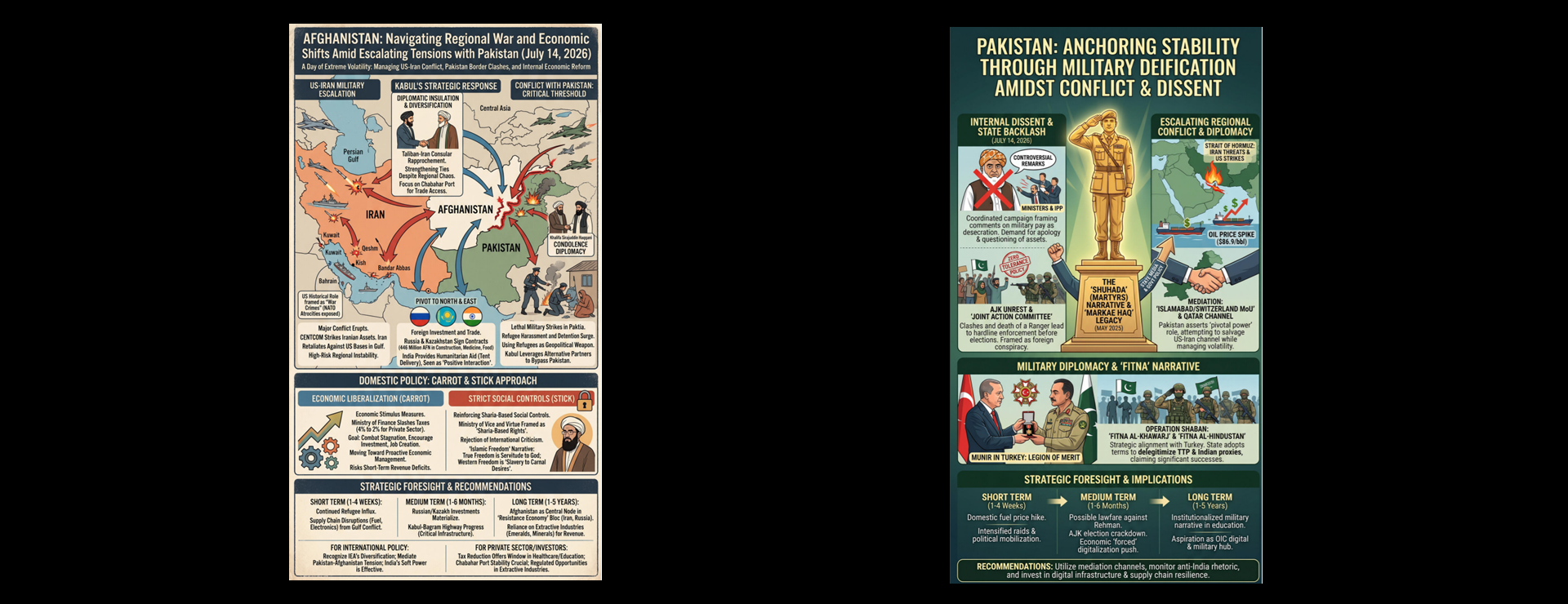
One of the most powerful aspects of our daily Media Trends reports is Gemini's ability to look across an entire day's worth of coverage and tease out the overarching thematic pillars that define the day's coverage. In other words, when looking across all of the stories, narratives, framings and coverage choices of the day, what are the themes that seem to draw them all together? A human analyst watching a day's worth of coverage can gather an idea of the major stories a given channel considers the most important of the day, but only a machine thinking deeply over all of it at once can begin to see the patterns and themes that weave through it all. This is the power and potential of AI-powered deep thematic analysis: not summarizing news articles, but looking across an entire day's worth of stories to understand the narratives and themes they convey.
As but one example, below are a list of the three major overarching thematic pillars identified by Gemini that weave together yesterday's RTA coverage from Afghanistan:
The Uzbekistan Pivot and the "Heart of Asia" Reality
Afghanistan is moving beyond mere rhetoric of being a regional "bridge" and is actively constructing the infrastructure (rail and road) and regulatory framework (customs labs, banking MoUs) to facilitate Central-South Asian transit. The Uzbekistan visit is the most concrete evidence of this, shifting the focus from the unreliable Torkham/Pakistan route toward the Hairatan-Uzbekistan corridor. This trend suggests a strategic decoupling from Pakistan's economic influence in favor of a more stable, investment-ready partner in Tashkent. The $5 billion trade target, if even partially met, would fundamentally alter Afghanistan's balance of payments and reduce its vulnerability to Pakistani border closures.
Institutionalizing Narrative Control
The "Government in the Mirror of Media" initiative represents a transition from reactionary propaganda to a proactive, institutionalized state communications strategy. By requiring every ministry to present weekly reports, the IEA is attempting to monopolize the "truth" and overwhelm any remaining independent reporting with a flood of "official achievements." This serves the dual purpose of projecting governance competence to foreign investors and maintaining domestic morale by focusing exclusively on tangible infrastructure wins rather than social or political grievances.
Sovereignty via Technical Self-Sufficiency
A recurring theme is the pride in domestic technical capabilities—whether it is complex heart surgery performed by Afghan doctors at a military hospital or the installation of 500kV substations. These reports are carefully curated to show that the IEA can manage modern systems without direct Western oversight. This "technical sovereignty" is being used to argue that international recognition is a formality that should follow the reality of the ground-level state capacity the IEA has demonstrated.